Best Prompt Engineering Frameworks: Explained
Artificial intelligence tools have evolved from experimental technology into everyday productivity systems. Today, people use AI for writing articles, generating code, creating marketing campaigns, summarizing research, automating workflows, and even running business operations. Modern Large Language Models (LLMs) such as OpenAI ChatGPT, Google Gemini, and Anthropic Claude have made advanced AI accessible to millions of users worldwide.
But as powerful as these tools are, their output quality depends heavily on one thing: the prompt.
A poorly written prompt often creates vague, repetitive, or inaccurate responses. A structured prompt, on the other hand, gives AI clearer direction, stronger context, and better instructions. This is why prompt engineering has become one of the most important skills in modern AI workflows.
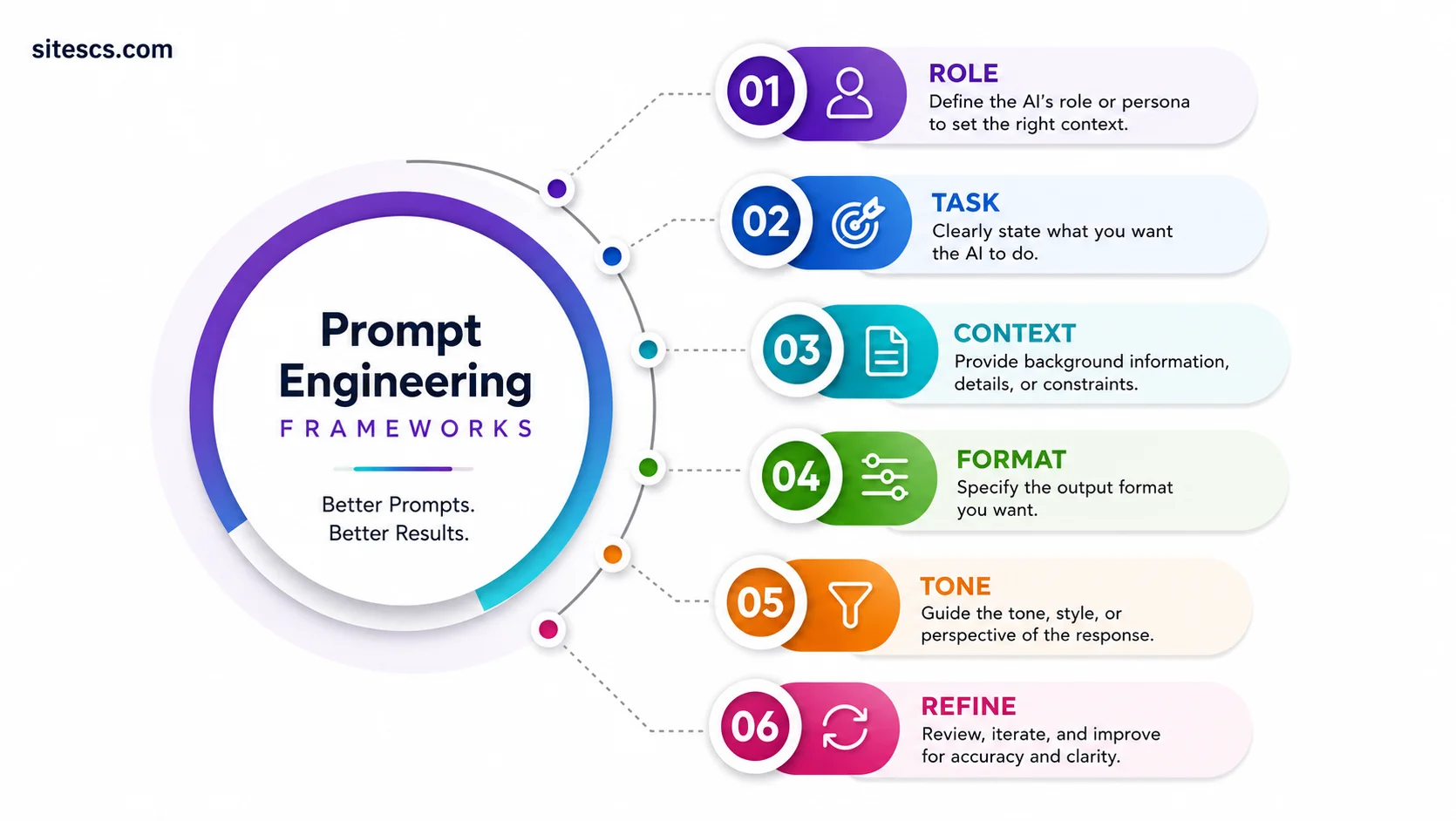
Instead of typing random instructions and hoping for good results, many professionals now use prompt engineering frameworks. These frameworks provide structured prompting methods that organize prompts into clear sections such as context, objective, audience, tone, format, and expected response style. The result is more consistent outputs, better accuracy, improved creativity control, and faster AI workflows.
As AI adoption continues growing across industries, structured prompts are becoming essential for content creation, automation, coding, research, and business communication. Frameworks like CO-STAR, CREATE, RTF, and Chain-of-Thought prompting are helping users generate better AI responses with far less trial and error.
Table of Contents
- What Are Prompt Engineering Frameworks?
- Why Prompt Frameworks Are Important for AI Outputs
- The CO-STAR Framework for Prompt Engineering
- The CREATE Framework for Prompt Engineering
- The RTF Framework Explained
- The Chain-of-Thought Prompting Framework
- Best Prompt Engineering Frameworks Compared
- How to Choose the Right Prompt Framework
- Common Mistakes When Using Prompt Engineering Frameworks
- Future of Prompt Engineering Frameworks
In this guide, we’ll explore the most popular prompt engineering frameworks, how they work, why they matter, and how to choose the right AI prompting method for different use cases.
What Are Prompt Engineering Frameworks?
Prompt engineering frameworks are structured methods used to design effective AI prompts. Instead of writing random instructions every time, these frameworks organize prompts into a logical format that helps AI models understand tasks more clearly. In simple terms, a prompt framework acts like a communication system between humans and AI.
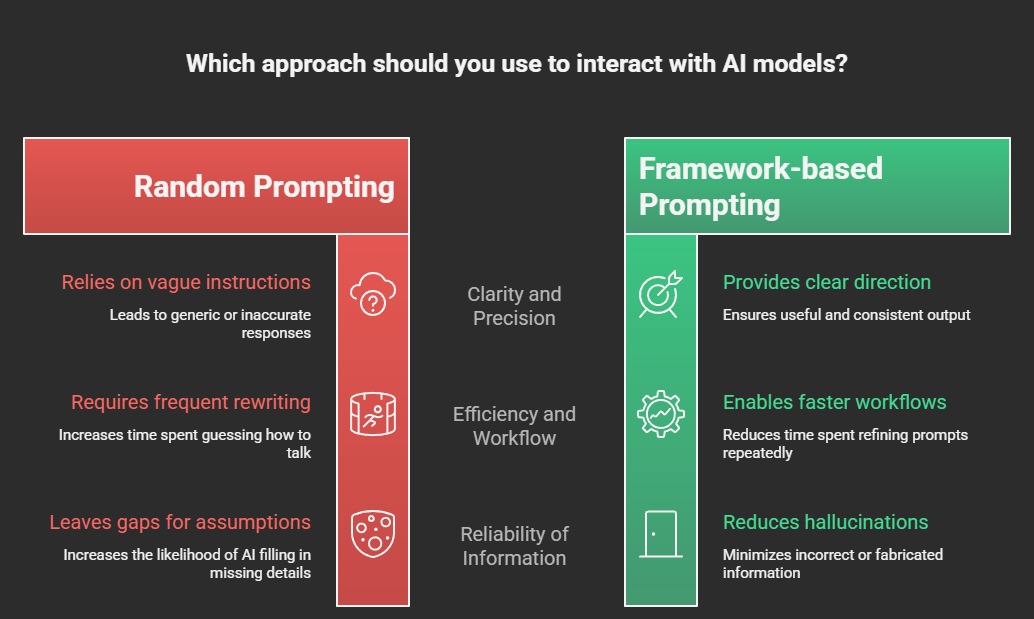
Modern AI models are extremely powerful, but they rely heavily on context and instruction clarity. If a prompt is vague, the AI fills gaps using assumptions, which often leads to generic or inaccurate responses. This is why structure matters in AI prompting.
For example, a random prompt might look like this:
“Write something about AI.”
A systematic prompt using a prompt design framework would look very different:
“Write a beginner-friendly 1,000-word article explaining how AI automation helps small businesses. Use simple language, practical examples, and a conversational tone.”
The second prompt gives the AI clear direction about the topic, audience, style, and expected outcome. As a result, the output becomes more useful and consistent.
This is the core purpose of structured AI prompts. They reduce ambiguity and improve communication with AI systems.
Framework-based prompting also offers several important benefits:
| Benefit | Why It Matters |
|---|---|
| Better Outputs | AI generates more relevant and higher-quality responses |
| Reduced Hallucinations | Clear instructions reduce incorrect or fabricated information |
| Faster Workflows | Less time spent rewriting prompts repeatedly |
| Improved Consistency | Outputs maintain similar tone and structure |
| Better Prompt Optimization | Easier to refine and scale prompts for different tasks |
For beginners, prompt engineering frameworks simplify the entire process. Instead of guessing how to talk to AI, users can follow a repeatable structure that improves results across writing, coding, research, marketing, and automation tasks. As AI instruction systems continue evolving, structured prompting is becoming an essential skill rather than an optional technique.
Why Prompt Frameworks Are Important for AI Outputs
AI models do not truly “understand” information the way humans do. They generate responses by predicting patterns based on the instructions and context they receive. Because of this, prompt clarity plays a major role in determining AI output quality. Even highly advanced models can produce weak results if the prompt lacks structure or direction.
This is where prompt engineering frameworks become extremely valuable.
A structured framework helps AI interpret requests more accurately by organizing instructions in a clear and logical way. Instead of relying on vague commands, users provide detailed context, objectives, tone, formatting requirements, and response expectations. The result is better AI responses with fewer misunderstandings.
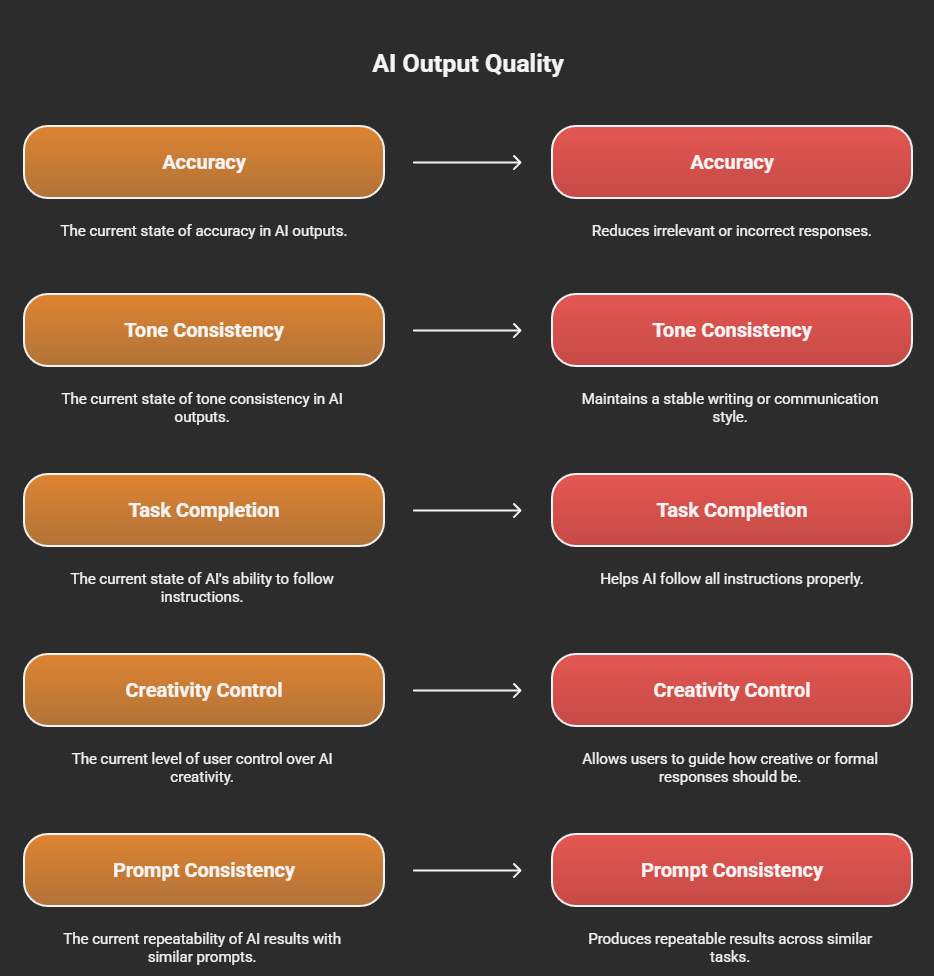
Prompt frameworks improve several important areas of AI performance:
| Improvement Area | Impact on AI Outputs |
|---|---|
| Accuracy | Reduces irrelevant or incorrect responses |
| Tone Consistency | Maintains a stable writing or communication style |
| Task Completion | Helps AI follow all instructions properly |
| Creativity Control | Allows users to guide how creative or formal responses should be |
| Prompt Consistency | Produces repeatable results across similar tasks |
These benefits become even more important in real-world workflows where businesses and professionals depend on reliable AI performance.
In blogging and content creation, structured prompts help generate SEO-friendly articles with consistent formatting and tone. Developers use prompt frameworks for coding assistance, debugging, and documentation. Marketing teams rely on them for ad copy, email campaigns, and social media content. Researchers use structured prompts to summarize information, compare data, and analyze large amounts of text. In automation systems, prompt frameworks improve reliability by making AI behavior more predictable.
Another major advantage is scalability. Once a business creates an effective prompt structure, it can reuse that framework across teams, projects, and workflows. This makes AI workflow optimization much easier because successful prompts can be repeated and refined instead of recreated from scratch every time.
As AI becomes more integrated into daily work, structured prompting is rapidly evolving from a useful technique into a core productivity skill.
The CO-STAR Framework for Prompt Engineering
The CO-STAR framework is one of the most popular structured prompting methods used in modern AI workflows. It is designed to help users create detailed and organized prompts that produce higher-quality AI responses. Many content creators, marketers, and business professionals use CO-STAR prompting because it balances simplicity with strong output control.
CO-STAR stands for:
| Element | Purpose |
|---|---|
| Context | Provides background information about the task |
| Objective | Explains what the AI needs to accomplish |
| Style | Defines the writing or presentation style |
| Tone | Controls the emotional or communication tone |
| Audience | Identifies who the content is for |
| Response | Specifies the desired output format |
This AI writing framework works well because it removes ambiguity. Instead of giving scattered instructions, users guide the AI step by step.
For example, imagine someone wants AI to write a blog post about remote work productivity. A weak prompt might simply say:
“Write a blog about remote work.”
A structured CO-STAR prompt would look much better:
Context: You are writing for a productivity blog focused on professionals working from home.
Objective: Explain how remote workers can improve focus and time management.
Style: Educational long-form article with practical tips.
Tone: Conversational and encouraging.
Audience: Remote employees and freelancers.
Response: Create a 1,200-word blog post with headings, examples, and a short FAQ section.
Notice how much clearer the second prompt is. The AI now understands the purpose, audience, formatting, and communication style before generating the response.
This is why the CO-STAR framework for prompt engineering is highly effective for content generation tasks. It improves prompt clarity while maintaining flexibility for different industries and workflows.
CO-STAR works especially well for:
- Blog writing
- Social media content
- Marketing copy
- Emails and newsletters
- SEO-focused articles
- Brand communication
Another major advantage is consistency. Businesses using structured content prompts can maintain a stable tone and messaging style across multiple AI-generated outputs. This becomes extremely valuable when scaling AI content production or managing larger marketing workflows.
For beginners, CO-STAR is often the easiest starting point because it introduces structure without becoming overly technical or complicated.
The CREATE Framework for Prompt Engineering
The CREATE framework is a more detailed and advanced approach to prompt engineering. While simpler frameworks focus mainly on clarity and structure, CREATE is designed for situations where AI needs deeper instructions, multiple constraints, and more controlled outputs. This makes it especially useful for advanced AI prompting, automation workflows, and professional content generation.
CREATE commonly stands for:
| Element | Purpose |
|---|---|
| Context | Provides background information about the task |
| Request | Explains what the AI should do |
| Examples | Shows sample outputs or references |
| Adjustments | Adds refinements, rules, or limitations |
| Type of Output | Defines the format and structure |
| Extras | Includes additional instructions or enhancements |
What makes the CREATE prompting framework powerful is its layered instruction system. Instead of giving AI one broad command, users gradually build a complete instruction environment. This improves prompt clarity and reduces confusion, especially in complex workflows.
For example, imagine a company using AI to create customer onboarding guides.
A basic prompt might say:
“Write a customer onboarding document.”
A CREATE-based prompt would be far more detailed:
Context: You are creating onboarding content for a SaaS project management platform.
Request: Write a beginner-friendly onboarding guide for new users.
Examples: Use formatting similar to modern help-center articles.
Adjustments: Avoid technical jargon and keep explanations simple.
Type of Output: Create step-by-step sections with bullet points.
Extras: Add troubleshooting tips and a short FAQ section at the end.
This prompt building structure gives the AI much more direction, which often results in more polished and usable outputs.
Compared to frameworks like CO-STAR or RTF, CREATE is more detailed and workflow-oriented. Simpler frameworks are usually better for quick tasks such as short blog posts, social media captions, or email drafts. CREATE becomes more valuable when tasks involve:
- Multiple instructions
- Long-form outputs
- Process automation
- Technical documentation
- Multi-step workflows
- AI instruction templates for teams
Because of its depth, CREATE is widely used in enterprise AI systems and advanced content operations where consistency and precision matter more than speed.
For beginners, CREATE may initially feel more complex than other frameworks. However, once understood, it becomes a highly effective method for generating detailed, structured, and scalable AI outputs.
The RTF Framework Explained
The RTF framework is one of the simplest and most beginner-friendly methods in prompt engineering. RTF stands for:
| Element | Purpose |
|---|---|
| Role | Defines who the AI should act as |
| Task | Explains what the AI needs to do |
| Format | Specifies how the response should be presented |
This framework is popular because it is easy to learn, quick to use, and highly effective for everyday AI tasks. Unlike advanced prompting systems that require detailed instructions, the RTF prompt framework focuses only on the three most essential elements of communication.
For example, instead of writing a vague instruction like:
“Help me write an email.”
An RTF-based prompt would look like this:
Role: Act as a professional marketing manager.
Task: Write a follow-up email for potential customers after a product demo.
Format: Keep the email short, persuasive, and professional.
Even with minimal structure, the AI now has much clearer guidance.
Here’s another quick example:
Role: Experienced Python developer
Task: Explain loops in Python for beginners
Format: Use simple language with short code examples
This role task format prompting method works especially well for:
- Emails
- Blog outlines
- Coding help
- Summaries
- Social media captions
- Quick research tasks
One reason beginners prefer RTF is its speed. Users can create effective AI prompt templates within seconds without needing complicated frameworks or long instructions. It also reduces the learning curve for people who are new to beginner prompt engineering.
While RTF may not provide the same level of depth as frameworks like CREATE or CO-STAR, its simplicity makes it extremely practical for fast and efficient AI interactions.
The Chain-of-Thought Prompting Framework
The Chain-of-Thought prompting framework is a reasoning-based prompting method that encourages AI models to solve problems step by step instead of jumping directly to a final answer. Rather than asking AI to simply generate an output, users guide the model to explain its thinking process along the way.
This approach improves reasoning quality because the AI breaks complex problems into smaller logical steps before reaching a conclusion.
For example, a normal prompt might say:
“Solve this math problem.”
A Chain-of-Thought prompt would say:
“Solve this math problem step by step and explain your reasoning clearly before giving the final answer.”
That small change can significantly improve the quality and accuracy of responses.
Chain-of-Thought prompting works especially well for tasks that require logic, analysis, or structured thinking. Instead of producing rushed answers, the AI follows a more organized reasoning path. This reduces mistakes and improves clarity.
Here’s a simple example:
“A store gives a 20% discount on a ₹2,000 product. After the discount, an 18% tax is added. Calculate the final price step by step.”
In this case, the AI first calculates the discount, then applies tax, and finally provides the answer. The reasoning process becomes visible and easier to verify.
This framework is highly effective for:
| Use Case | Why It Helps |
|---|---|
| Math Problems | Improves calculation accuracy |
| Coding Tasks | Helps debug and explain logic |
| Research & Analysis | Breaks complex topics into understandable parts |
| Logical Reasoning | Reduces inconsistent conclusions |
| Decision-Making Tasks | Encourages structured analysis |
One major advantage of chain of thought prompting is transparency. Users can see how the AI arrived at an answer rather than only seeing the final output. This makes reasoning prompts especially valuable in education, programming, problem-solving, and analytical workflows.
As AI systems become more advanced, step by step AI prompts are increasingly important for improving reliability in complex tasks that require deeper reasoning and logical accuracy.
Best Prompt Engineering Frameworks Compared
Not all prompt engineering frameworks serve the same purpose. Some are designed for simplicity and speed, while others focus on detailed instructions, reasoning, or advanced workflow control. Choosing the right framework depends on your goals, experience level, and the type of AI task you want to perform.
A beginner creating social media content may not need the same prompting structure as a developer building AI automation systems. Similarly, researchers often require reasoning-focused prompts, while marketers prioritize tone and audience control.
The table below provides a structured prompting comparison of the most popular frameworks:
| Framework | Complexity Level | Best Use Cases | Ease of Use | Output Quality |
|---|---|---|---|---|
| RTF | Low | Quick tasks, emails, simple content | Very Easy | Good |
| CO-STAR | Medium | Blog writing, marketing, branded content | Easy | Very Good |
| CREATE | High | Complex workflows, automation, documentation | Moderate | Excellent |
| Chain-of-Thought | Medium | Logic, coding, math, research | Moderate | Excellent for reasoning |
Each framework has its own strengths.
The RTF framework is ideal for beginners because it is fast and simple. Users only need to define the role, task, and format. This makes it perfect for quick AI interactions and basic prompt engineering methods.
The CO-STAR framework works especially well for marketers, writers, and content creators. Its structured approach improves tone consistency, audience targeting, and content quality, making it one of the best prompt frameworks for AI-generated content.
The CREATE framework is better suited for advanced users, businesses, and automation systems. It offers deeper instruction control and performs well in large-scale AI workflows where consistency and precision matter.
Meanwhile, Chain-of-Thought prompting is highly valuable for developers, analysts, and researchers because it improves reasoning quality through step-by-step problem-solving.
In practice, many professionals combine multiple frameworks depending on the task. As AI tools continue evolving, flexibility in prompting strategies is becoming just as important as mastering a single framework.
How to Choose the Right Prompt Framework
Choosing the right prompt framework depends mainly on your goals, workflow complexity, and the type of results you expect from AI. There is no single framework that works perfectly for every situation. Some frameworks are better for speed and simplicity, while others are designed for precision, reasoning, or advanced automation.
For content writing tasks such as blog posts, newsletters, SEO articles, and social media content, frameworks like CO-STAR are often the best choice. They provide strong control over tone, audience, style, and formatting, which helps maintain consistent content quality.
For coding and technical workflows, developers often prefer Chain-of-Thought prompting because it improves logical reasoning and step-by-step problem solving. This is especially useful for debugging, algorithm explanations, and code analysis.
In research-focused tasks, detailed prompting frameworks help AI process information more systematically. Structured prompts improve summarization, comparison, analysis, and data interpretation by reducing ambiguity in instructions.
Businesses using AI for automation or enterprise workflows may benefit more from the CREATE framework. Its layered instruction system works well for repetitive processes, documentation, onboarding systems, and AI-driven operations where consistency is critical.
One important factor to consider is the balance between simplicity and detail.
A simple framework like RTF is faster and easier for quick tasks. However, more detailed frameworks often produce higher-quality outputs for complex projects. Overcomplicating prompts can sometimes reduce efficiency, while overly simple prompts may lack enough direction.
The best AI prompting method usually comes through experimentation. Testing multiple AI prompt strategies helps users understand how different frameworks affect output quality, reasoning, and creativity.
As part of any strong prompt engineering guide, it’s important to remember that frameworks are tools, not rigid rules. The most effective AI users often adapt and combine frameworks depending on the task, audience, and desired outcome.
Common Mistakes When Using Prompt Engineering Frameworks
Even the best prompt frameworks can produce weak results if they are used incorrectly. Many beginners assume that adding more instructions automatically improves AI performance, but poorly structured prompts often create confusion instead of clarity.
One of the most common prompt engineering mistakes is overcomplicating prompts. Adding excessive details, unnecessary rules, or conflicting instructions can overwhelm the AI model. Instead of improving output quality, it may generate inconsistent or unfocused responses.
Another major issue is lack of context. AI systems rely heavily on background information to understand tasks properly. A prompt without context forces the model to make assumptions, which often leads to generic or inaccurate answers.
Users also frequently make the mistake of giving too many instructions at once. When prompts contain multiple unrelated objectives, AI may struggle to prioritize tasks correctly. Clear and focused prompts usually perform much better than overloaded ones.
Ignoring audience and tone is another common problem. A response intended for technical professionals should sound very different from content written for beginners. Without specifying tone, style, or audience, outputs may feel inconsistent or poorly targeted.
Other common AI prompting errors include:
- Using vague objectives
- Not defining output format
- Failing to refine prompts
- Expecting perfect first responses
- Skipping prompt testing and iteration
Prompt optimization is often an ongoing process rather than a one-time action. Skilled users regularly test, adjust, and improve prompts based on output quality.
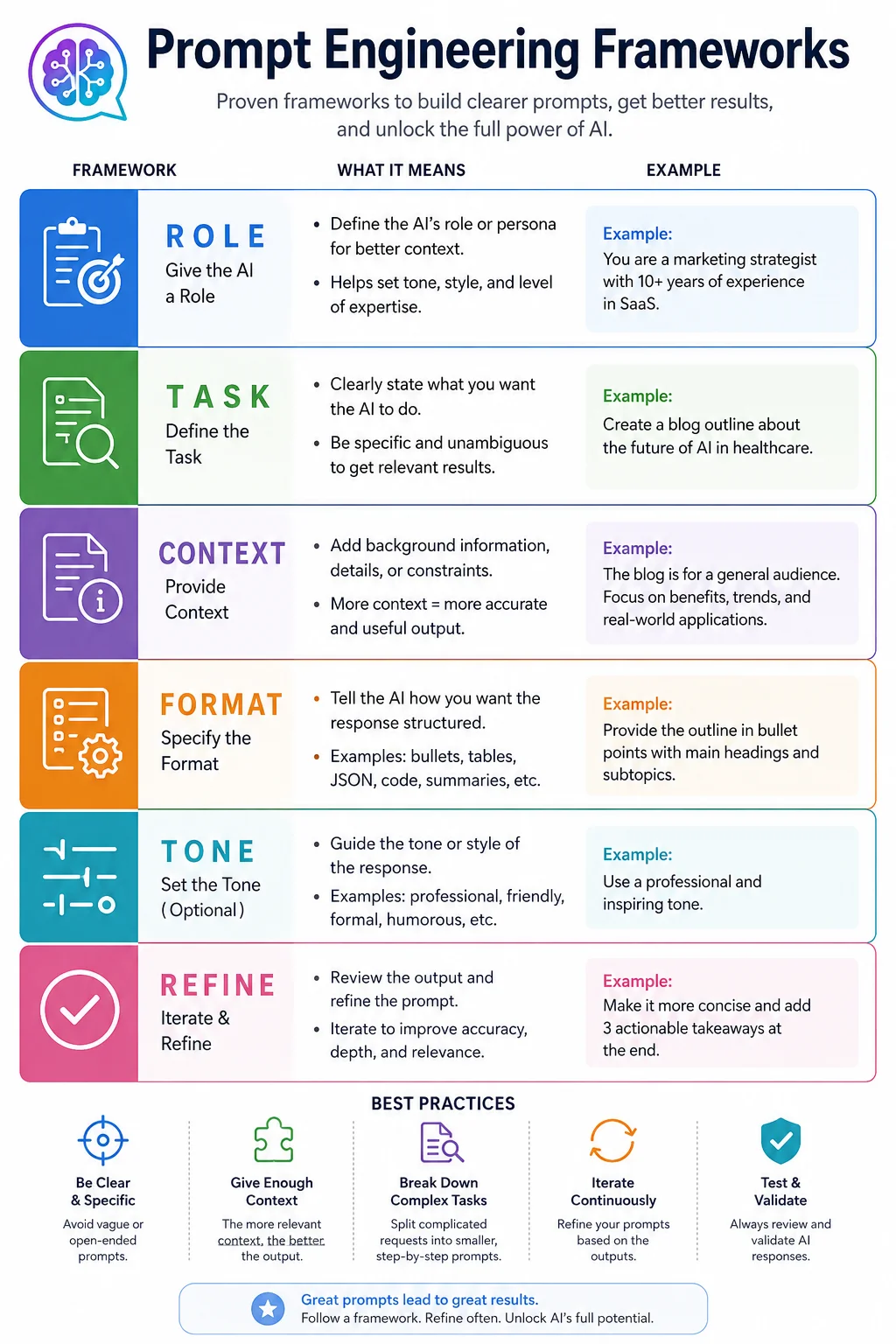
The key to avoiding bad AI prompts is clarity. Well-structured instructions with focused objectives almost always outperform complicated prompts filled with unnecessary information.
Future of Prompt Engineering Frameworks
Prompt engineering is evolving rapidly as AI systems become more advanced and integrated into everyday workflows. What started as a technique for improving chatbot responses is now developing into a larger discipline focused on AI workflow standardization, automation, and intelligent system design.
One major trend shaping the future of prompt engineering is the rise of AI agents. Instead of responding to single prompts, AI agents can perform multi-step tasks, make decisions, use external tools, and complete autonomous workflows. In these systems, structured prompting becomes even more important because prompts act like operational instructions for AI-driven processes.
Another major shift is the growth of multimodal AI prompts. Future AI systems will increasingly process text, images, audio, video, and documents together within a single workflow. Prompt frameworks will likely evolve to handle multiple input types rather than focusing only on text-based communication.
Businesses are also building centralized prompt libraries and reusable AI instruction systems. Instead of creating prompts manually every time, organizations are developing standardized templates for marketing, customer support, coding, analytics, and automation tasks. This improves consistency and scalability across teams.
As enterprise AI adoption expands, prompt engineering frameworks may become deeply integrated into workplace software, CRM platforms, automation tools, and productivity systems. AI prompting could eventually function like a standardized layer between humans and intelligent systems.
The future of prompt engineering is moving toward smarter automation, reusable workflows, and more reliable AI collaboration. As next generation prompting systems continue improving, the ability to design clear and effective prompts will likely become a core digital skill across many industries.