What is chain-of-thought prompting
Last Updated: June 2026
Reviewed by: Krishna, AI researcher and founder of sitescs.com
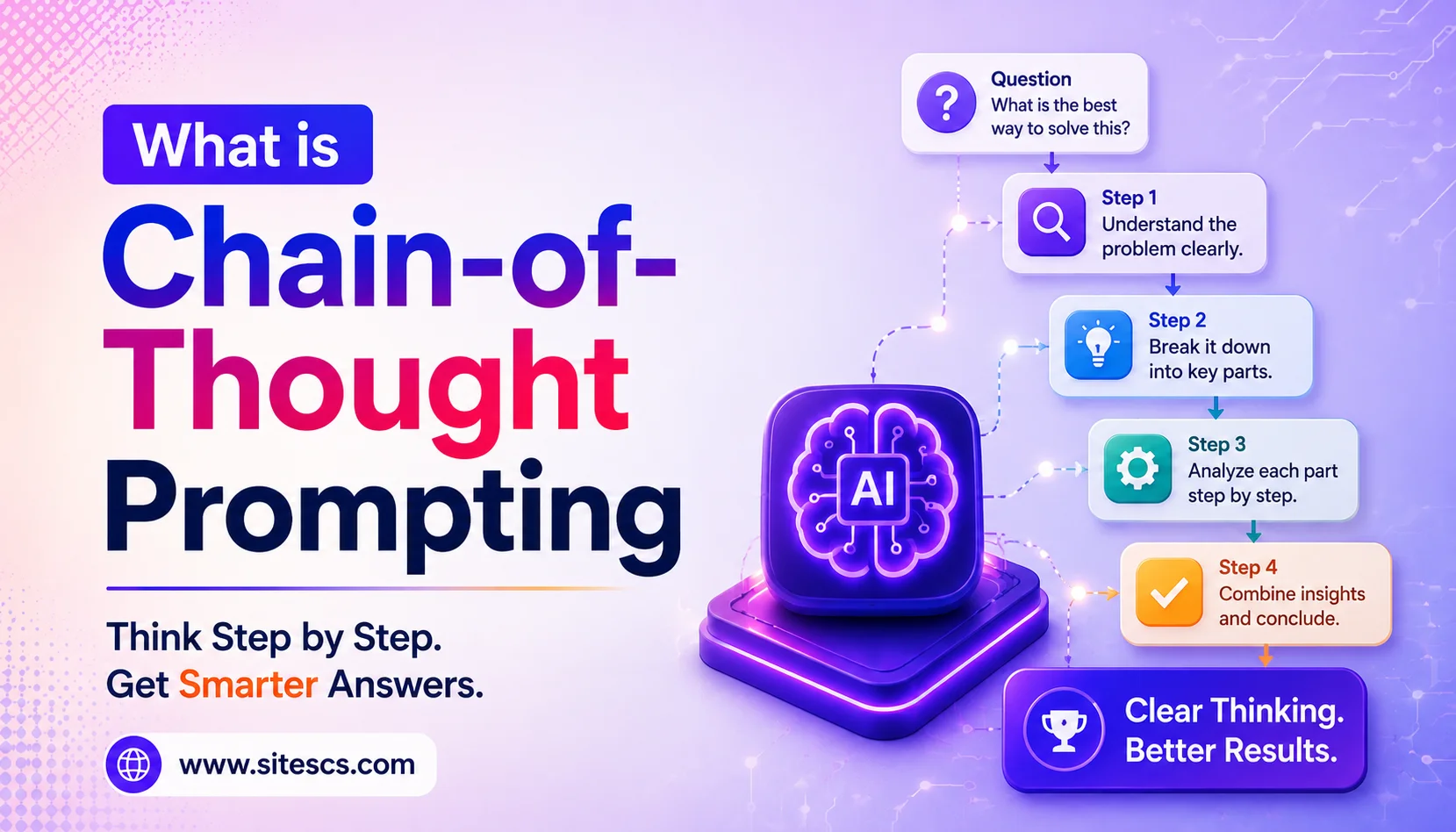
Chain-of-thought prompting is a technique that encourages an AI model to reason through a problem step by step before giving a final answer. It works by guiding the model to break complex tasks into smaller logical steps. This helps users get more accurate, detailed, and reliable responses, especially for reasoning and problem-solving tasks.
Introduction
If you use AI tools like ChatGPT, Claude, or Gemini, you may have noticed that some prompts produce much better answers than others.
One reason is chain-of-thought prompting.
This prompting technique helps AI think through a problem in a structured way instead of jumping directly to an answer.
In simple terms, it tells the AI:
“Let’s solve this step by step.”
The result is often a more accurate and useful response.
What Is Chain-of-Thought Prompting?
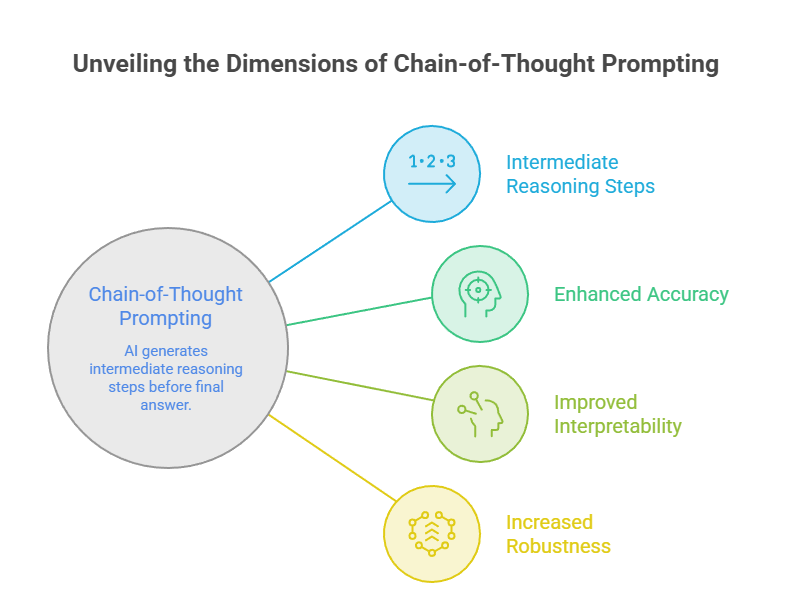
Chain-of-thought prompting (CoT) is a prompting method where the AI is encouraged to generate intermediate reasoning steps before reaching a final answer.
Technical term: Reasoning process
Plain English: The AI shows its thinking path instead of only showing the final result.
Researchers found that large language models often perform better when they break a problem into smaller logical steps.
This is especially useful for:
✓ Math problems
✓ Logical reasoning
✓ Coding tasks
✓ Business analysis
✓ Decision-making
✓ Multi-step instructions
A Simple Analogy
Imagine you are solving a difficult math question at school.
Your teacher does not want only the final answer.
They want to see:
- How you started
- What formula you used
- Your calculations
- Your final result
Chain-of-thought prompting works the same way.
Instead of saying:
“The answer is 42.”
The AI explains:
“First I looked at this information. Then I calculated this value. After that I compared the results. Therefore the answer is 42.”
Just like showing your work in an exam.
How Chain-of-Thought Prompting Works
Let’s look at a simple example.
Problem
A shop sells pens for $2 each.
John buys 5 pens.
How much does he pay?
Without Chain-of-Thought Prompting
Prompt:
How much does John pay?
AI Response:
$10
The answer is correct, but no explanation is provided.
With Chain-of-Thought Prompting
Prompt:
Solve this step by step. A shop sells pens for $2 each. John buys 5 pens.
AI Response:
Step 1: Cost of one pen = $2
Step 2: Number of pens = 5
Step 3: Multiply 2 × 5
Step 4: Total cost = $10
Final Answer: $10
The result is easier to verify and understand.
Another Real Example
Without Chain-of-Thought Prompting
Prompt:
Which marketing strategy is better for a new local business?
Response:
Social media marketing.
Not very helpful.
With Chain-of-Thought Prompting
Prompt:
Analyze this step by step. Which marketing strategy is better for a new local business?
Response:
- Identify business goals
- Determine target audience
- Compare available marketing channels
- Estimate costs
- Evaluate expected return
Conclusion:
Social media marketing is often the best starting option because it is affordable and highly targeted.
The answer becomes much more useful.
Why It Matters
Chain-of-thought prompting offers several practical benefits.
✓ Better Accuracy
Breaking problems into smaller steps reduces mistakes.
✓ Easier Learning
Beginners can understand how the AI reached its answer.
✓ Improved Problem Solving
Complex tasks become easier to manage.
✓ Valuable for Professionals
Business owners, developers, marketers, and analysts can receive more structured insights and recommendations.
Krishna’s Personal Experience
While building AI workflows and prompt systems for websites and automation projects, Krishna found that chain-of-thought prompting often improves answer quality when tasks involve multiple decisions or reasoning steps.
Common Misconceptions
Misconception 1: Chain-of-thought prompting is only for developers.
Reality: Anyone can use it.
Students, writers, marketers, and business owners benefit from it.
Misconception 2: It makes AI smarter.
Reality: It does not change the model itself.
It simply helps the model organize its reasoning better.
Misconception 3: It is required for every prompt.
Reality: Simple questions usually do not need it.
It works best for complex or multi-step tasks.
Real-World Examples
1. A Student Preparing for the SAT
A student preparing for the SAT can use chain-of-thought prompting to understand math and logic questions step by step instead of only seeing the answer.
2. A Software Developer Debugging Code
A developer can ask AI to analyze code systematically and identify possible causes of an error before suggesting a fix.
3. A Marketing Professional Creating Campaigns
A marketer can use chain-of-thought prompting to evaluate audience segments, channels, budgets, and expected outcomes before selecting a strategy.
When Should You Use Chain-of-Thought Prompting?
Use it when:
✓ The task has multiple steps
✓ You need logical reasoning
✓ You want detailed explanations
✓ You are comparing options
✓ You are solving a problem
✓ You want to learn the process, not just the answer
Avoid it when:
✗ Asking simple factual questions
✗ Looking for very short responses
✗ Speed is more important than explanation
Example Prompts You Can Use
Basic Prompt
Think step by step and explain your reasoning.
Problem-Solving Prompt
Break this problem into smaller steps before answering.
Decision-Making Prompt
Analyze each option step by step and recommend the best choice.
Learning Prompt
Explain this concept as if teaching a beginner and show your reasoning process.
Official Resource
For deeper research, review official documentation and research from:
→ Google Research on Chain-of-Thought Prompting
This landmark research paper introduced the concept and demonstrated significant improvements in reasoning tasks.
FAQ
1. Is chain-of-thought prompting difficult to learn?
No. Most people can learn the basics in less than an hour. The core idea is simply asking the AI to solve a problem step by step. Once you understand this principle, you can apply it to studying, writing, coding, and business tasks.
2. Do I need a technical background for chain-of-thought prompting?
No. You do not need programming knowledge or AI expertise. Anyone who can write clear instructions can use chain-of-thought prompting. Students, teachers, marketers, freelancers, and business owners use it successfully every day.
3. How long does it take to learn chain-of-thought prompting?
Most beginners understand the concept within a few minutes. Becoming skilled at writing effective prompts may take a few days of practice. Regular experimentation helps you learn which prompts produce the best results.
4. What is the difference between chain-of-thought prompting and prompt engineering?
Chain-of-thought prompting is one technique within prompt engineering. Prompt engineering is the broader practice of designing prompts for better AI outputs. Chain-of-thought specifically focuses on encouraging structured reasoning before generating an answer.
5. Is chain-of-thought prompting still relevant in 2026?
Yes. Even though modern AI models have stronger built-in reasoning abilities, chain-of-thought prompting remains useful for improving clarity, transparency, and problem-solving quality. It continues to be widely used in education, business, and AI workflows.
→ Pillar Article: Chain-of-Thought Prompting Complete Guide
Final Thoughts
Chain-of-thought prompting is one of the most valuable AI prompting techniques available today.
It helps AI break problems into smaller pieces, reason more clearly, and generate better answers.
If you are learning AI, prompt engineering, or using tools like ChatGPT, Claude, or Gemini, mastering chain-of-thought prompting can significantly improve the quality of your results.
Start with a simple instruction:
“Think step by step.”
Sometimes those four words make all the difference.


