Prompt Engineering Guide: Learn AI Prompting Step-by-Step (2026)
Artificial Intelligence (AI) has become a part of everyday life. Millions of people use AI tools for writing content, generating images, learning new skills, coding software, creating marketing campaigns, and solving business problems. Tools like ChatGPT, Claude, Gemini, and many other generative AI platforms are changing how people work and communicate.
However, many users do not get the best results from AI. The reason is simple: they do not know how to communicate effectively with AI systems. This is where prompt engineering becomes important.
Prompt engineering is the skill of writing clear instructions that help AI understand exactly what you want. A well-written prompt can produce detailed, accurate, and useful responses. On the other hand, a vague prompt often leads to poor results.
As AI becomes more powerful, the ability to create effective prompts is becoming a valuable skill for students, content creators, marketers, developers, business owners, and professionals across different industries.
The good news is that prompt engineering is not difficult to learn. Anyone can improve their AI prompting skills by understanding a few simple principles and practicing regularly.
In this complete guide, you will learn what prompt engineering is, why it matters, how AI models understand prompts, the key components of effective prompts, popular prompting techniques, common mistakes to avoid, and best practices for achieving better AI results.
Whether you are a beginner or someone already using AI tools, this guide will help you unlock the full potential of generative AI.
What Is Prompt Engineering?
Prompt engineering is the process of designing and writing instructions that guide an AI model to produce the desired output.
In simple terms, prompt engineering is the art of communicating with AI effectively. Just as humans need clear instructions to perform tasks correctly, AI models also require well-structured prompts to generate accurate responses.
A prompt can be a question, command, description, or set of instructions provided to an AI system. The quality of the prompt directly influences the quality of the AI’s response.
For example:
Basic Prompt:
“Write about digital marketing.”
Improved Prompt:
“Write a 500-word beginner-friendly article explaining digital marketing, including SEO, social media marketing, and email marketing. Use simple language and provide practical examples.”
The second prompt gives the AI more context and direction, leading to a much better output.
Prompt engineering has become a critical skill because modern AI systems are capable of performing a wide variety of tasks. They can write articles, summarize documents, generate code, analyze data, create business plans, and much more.
The better your prompt design, the better the AI understands your intent.
Real-world applications of prompt engineering include:
- Content writing
- SEO optimization
- Software development
- Customer support
- Marketing campaigns
- Educational tutoring
- Research assistance
- Business automation
Prompt engineering acts as the bridge between human intent and AI capabilities.
Why Prompt Engineering Matters in AI
Prompt engineering plays a major role in improving AI performance.
Many people believe AI automatically knows what they want. In reality, AI generates responses based on the instructions it receives. Poor instructions often lead to poor outputs.
Here are some key reasons why prompt engineering matters:
Better Output Quality
Clear prompts produce detailed and relevant responses.
Improved Accuracy
Specific instructions reduce misunderstandings and improve answer quality.
Reduced AI Hallucinations
Providing context and constraints can help minimize incorrect or fabricated information.
Time Savings
Well-crafted prompts reduce the need for multiple revisions and corrections.
Higher Productivity
Professionals can complete tasks faster by generating useful outputs on the first attempt.
Business Benefits
Companies use prompt engineering to improve workflows, customer service, content creation, and decision-making processes.
As AI adoption continues to grow, effective prompting is becoming an essential workplace skill.
How AI Models Understand Prompts
To become a better prompt engineer, it helps to understand how AI models process information.
AI language models are trained on massive amounts of text data. They learn patterns, relationships, and language structures from that data.
When you enter a prompt, the AI analyzes the text and predicts the most likely response based on its training.
Tokens and Context
AI models do not read text exactly as humans do. Instead, they process information using tokens.
A token may represent:
- A word
- Part of a word
- A punctuation mark
- A number
The AI examines relationships between tokens to understand meaning.
Natural Language Processing
Natural Language Processing (NLP) allows AI systems to understand human language.
NLP helps AI identify:
- Intent
- Context
- Sentiment
- Structure
- Meaning
Context Windows
Every AI model has a context window, which determines how much information it can process at one time.
Larger context windows allow AI to remember more details during a conversation.
Importance of Instructions
AI heavily relies on instructions provided within prompts.
For example:
“Write an article.”
This instruction is broad.
Now compare it with:
“You are an SEO expert. Write a 1,000-word article about email marketing for beginners using simple language and practical examples.”
The second instruction gives significantly more context.
Clarity Improves Results
The clearer your instructions, the easier it becomes for AI to generate useful outputs.
Think of AI as a highly intelligent assistant that performs best when given clear directions.
Components of an Effective Prompt
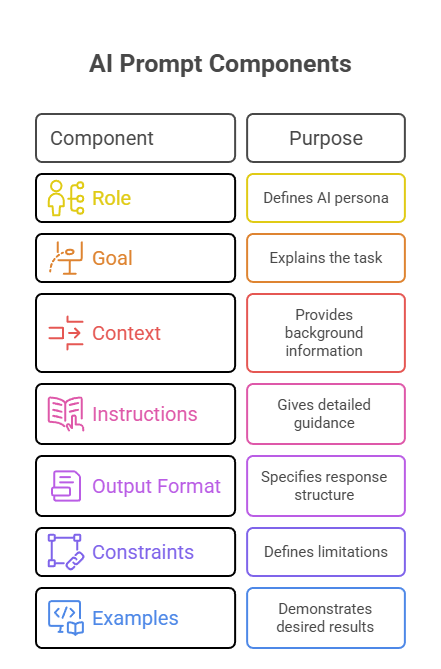
Effective prompts usually contain several important elements.
The following framework can dramatically improve AI outputs.
| Component | Purpose |
|---|---|
| Role | Defines who the AI should act as |
| Goal | Explains the task |
| Context | Provides background information |
| Instructions | Gives detailed guidance |
| Output Format | Specifies response structure |
| Constraints | Defines limitations |
| Examples | Demonstrates desired results |
Role
Assigning a role helps guide AI behavior.
Example:
“Act as an SEO expert.”
Goal
Clearly state what you want.
Example:
“Write a blog post about email marketing.”
Context
Provide background information.
Example:
“The audience is small business owners with no marketing experience.”
Instructions
Specify detailed requirements.
Example:
“Use simple language, practical examples, and actionable tips.”
Output Format
Define the response structure.
Example:
“Provide the answer in a table.”
Constraints
Set limitations.
Example:
“Keep the article under 1,000 words.”
Examples
Showing examples often improves consistency.
Example:
“Use a format similar to this sample.”
The more relevant information you provide, the better the AI can perform.
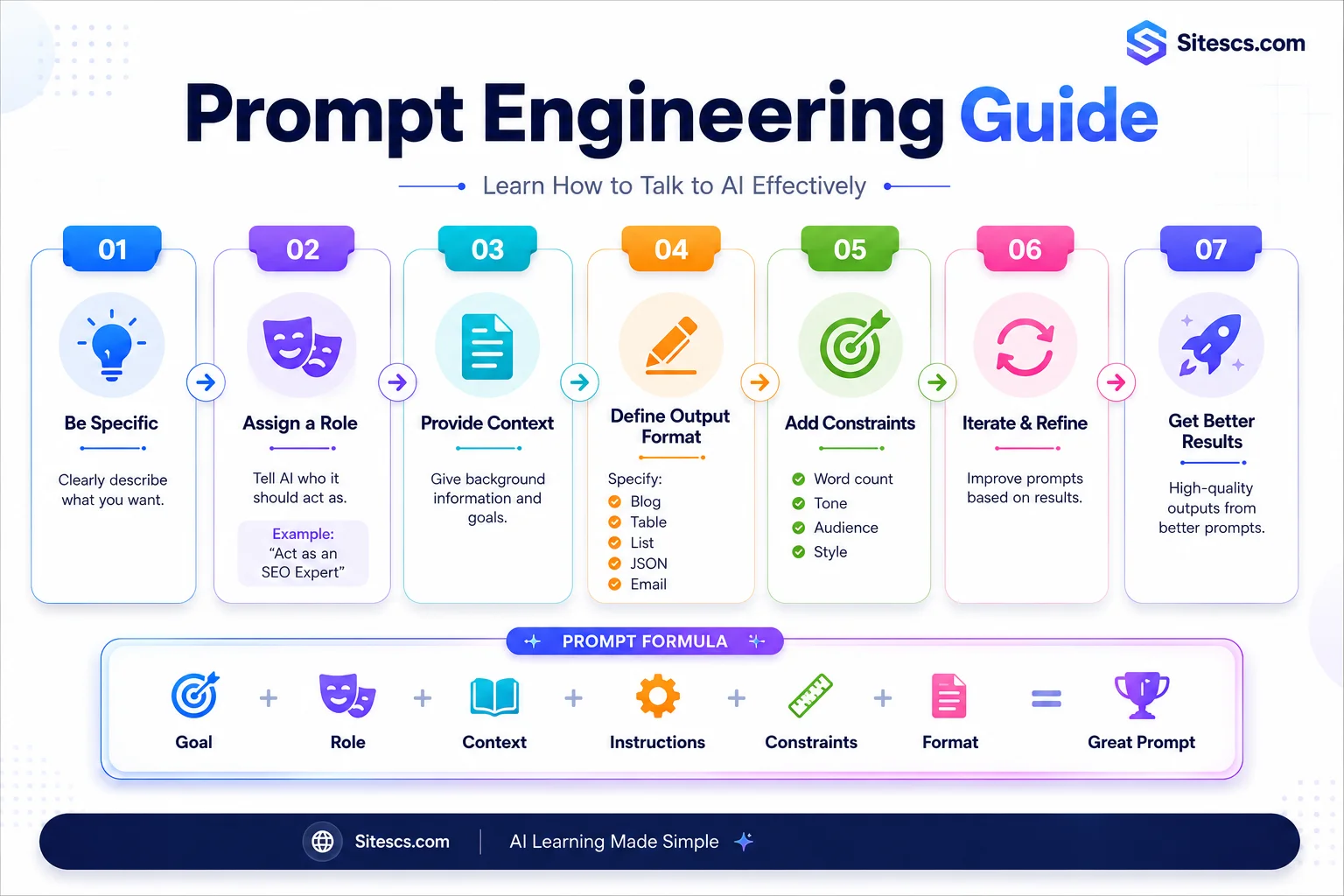
Step-by-Step Prompt Engineering Framework
A structured process makes prompt writing easier.
Follow these steps:
Define the Objective
Start by identifying your desired outcome.
Ask yourself:
“What exactly do I want AI to do?”
Provide Context
Explain the situation, audience, purpose, and background.
Good context improves relevance.
Assign a Role
Tell AI who it should act as.
Examples:
- Teacher
- Marketer
- Software Engineer
- SEO Specialist
- Business Consultant
Add Instructions
Provide detailed guidance.
Examples:
- Use simple language
- Include examples
- Create a table
- Write step-by-step instructions
Specify Output Format
Clearly define how the response should look.
Examples:
- Blog post
- Table
- Checklist
- Bullet points
- JSON
Refine and Test
Prompt engineering is an iterative process.
If results are not ideal:
- Add more context
- Clarify instructions
- Adjust constraints
- Test different wording
Continuous refinement often produces dramatically better outputs.
Types of Prompt Engineering Techniques
Several prompting techniques are commonly used with AI systems.
Zero-Shot Prompting
The AI receives a task without examples.
Example:
“Write a product description for a smartphone.”
The AI performs the task using its existing knowledge.
One-Shot Prompting
One example is provided before the task.
Example:
Input one sample product description and ask AI to create another.
Few-Shot Prompting
Multiple examples are provided.
This helps improve consistency and accuracy.
Example:
Provide three customer support responses and ask AI to create a fourth.
Role-Based Prompting
The AI is assigned a specific role.
Example:
“Act as a professional financial advisor.”
Role prompting often improves quality and expertise.
Chain-of-Thought Prompting
The AI is encouraged to reason through a problem step by step.
Example:
“Solve this problem and explain each step.”
This technique often improves complex reasoning tasks.
Step-by-Step Prompting
Breaking tasks into smaller steps helps improve accuracy.
Example:
- Analyze the problem.
- Identify solutions.
- Compare options.
- Provide recommendations.
This approach is highly effective for business and technical tasks.
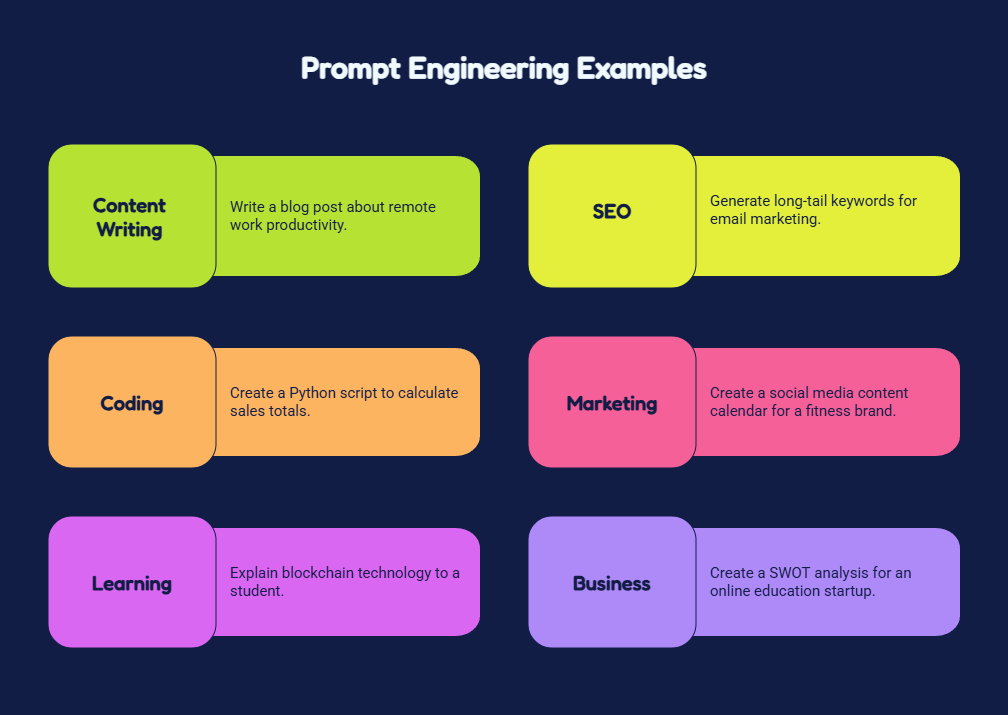
Prompt Engineering Examples for Different Use Cases
Prompt engineering can be applied across many industries.
Content Writing Prompt
“Act as a content writer. Write a 1,500-word blog post about remote work productivity tips. Use simple language and include practical examples.”
SEO Prompt
“Act as an SEO expert. Generate 20 long-tail keywords related to email marketing with low competition and high search intent.”
Coding Prompt
“Act as a Python developer. Create a script that reads a CSV file and calculates monthly sales totals.”
Marketing Prompt
“Act as a digital marketing consultant. Create a 30-day social media content calendar for a fitness brand.”
Learning Prompt
“Act as a teacher. Explain blockchain technology to a 15-year-old student using simple examples.”
Business Prompt
“Act as a business strategist. Create a SWOT analysis for a new online education startup.”
These examples show how structured instructions improve AI performance.
Common Prompt Engineering Mistakes to Avoid
Many beginners make similar prompting mistakes.
Using Vague Prompts
Example:
“Write something about marketing.”
This lacks direction.
Missing Context
Without context, AI may generate generic responses.
Too Many Instructions
Overloading prompts with excessive requirements can create confusion.
No Output Format
Failing to specify format often leads to inconsistent responses.
Unrealistic Expectations
AI is powerful but not perfect.
Expecting flawless results without revisions is unrealistic.
Ignoring Iteration
Prompt engineering requires testing and refinement.
The first prompt is rarely the best prompt.
Avoiding these mistakes can significantly improve AI results.
Best Practices for Writing Better AI Prompts
Follow these proven practices to improve prompt quality.
Be Specific
Specific prompts generate more accurate outputs.
Use Clear Language
Avoid ambiguity and confusing wording.
Provide Examples
Examples help AI understand expectations.
Set Constraints
Define word count, format, tone, audience, and limitations.
Define Output Format
Clearly explain how the response should be structured.
Iterate and Improve
Treat prompt engineering as an ongoing process.
Small adjustments often create major improvements.
Use a Prompt Formula
A simple formula:
Role + Goal + Context + Instructions + Format + Constraints
This framework works well across most AI tools.
Prompt Engineering for ChatGPT, Claude, Gemini, and Other AI Tools
Most modern AI tools follow similar prompting principles.
However, there are some differences.
Similarities
All major AI models benefit from:
- Clear instructions
- Context
- Defined roles
- Examples
- Output formats
ChatGPT
Works well with structured prompts and detailed instructions.
Claude
Often performs strongly on long documents and nuanced reasoning tasks.
Gemini
Integrates effectively with Google’s ecosystem and handles multimodal tasks.
Other AI Models
Many AI platforms support similar prompting strategies.
Prompt Portability Tips
To make prompts work across different tools:
- Use clear language
- Avoid platform-specific commands
- Include detailed instructions
- Define outputs clearly
Well-designed prompts often transfer successfully between platforms.
Future of Prompt Engineering
Prompt engineering continues to evolve rapidly.
Several trends are shaping its future.
AI Agents
AI agents can perform multi-step tasks autonomously.
Prompt design will remain important for guiding agent behavior.
Multimodal Prompting
Future prompts will combine:
- Text
- Images
- Audio
- Video
Voice Prompts
Voice-based AI interactions are becoming increasingly common.
Automated Prompt Optimization
AI systems may automatically improve prompts in real time.
Advanced Personalization
Future AI models will adapt prompts based on user preferences and goals.
Despite these advancements, the ability to communicate clearly with AI will remain valuable.
Frequently Asked Questions
What is prompt engineering in simple terms?
Prompt engineering is the process of writing clear instructions that help AI generate better responses.
Is prompt engineering difficult to learn?
No. Most people can learn the basics quickly through practice and experimentation.
Can prompt engineering improve ChatGPT results?
Yes. Better prompts often lead to more accurate, detailed, and useful responses.
What are the most important prompt engineering techniques?
The most popular techniques include:
Zero-shot prompting
One-shot prompting
Few-shot prompting
Role-based prompting
Chain-of-thought prompting
Step-by-step prompting
Is prompt engineering a good career in 2026?
Yes. As AI adoption grows, organizations increasingly value professionals who can effectively work with AI systems.
Do I need coding skills for prompt engineering?
No. Many prompt engineering tasks require only strong communication and problem-solving skills. Coding knowledge can be helpful but is not mandatory.
Summary
Prompt engineering is one of the most valuable AI skills in today’s digital world. It helps users communicate effectively with AI systems and generate higher-quality results.
Throughout this guide, we explored what prompt engineering is, why it matters, how AI models understand prompts, and the key components of effective prompt design. We also covered practical frameworks, popular prompting techniques, real-world examples, common mistakes, and best practices.
The most important lesson is simple: better prompts lead to better outputs.
A structured prompt that includes a role, goal, context, instructions, format, and constraints will usually outperform a vague request.
Prompt engineering is not about finding a perfect prompt. It is about continuously testing, refining, and improving your instructions until you achieve the desired result.
The best way to learn prompt engineering is through hands-on practice. Experiment with different prompt structures, analyze the outputs, and identify what works best for specific tasks.
As AI technology continues to evolve, prompt engineering will remain an essential skill for students, professionals, creators, marketers, developers, and business leaders.
Start practicing today, and you will quickly discover how powerful effective prompting can be.


