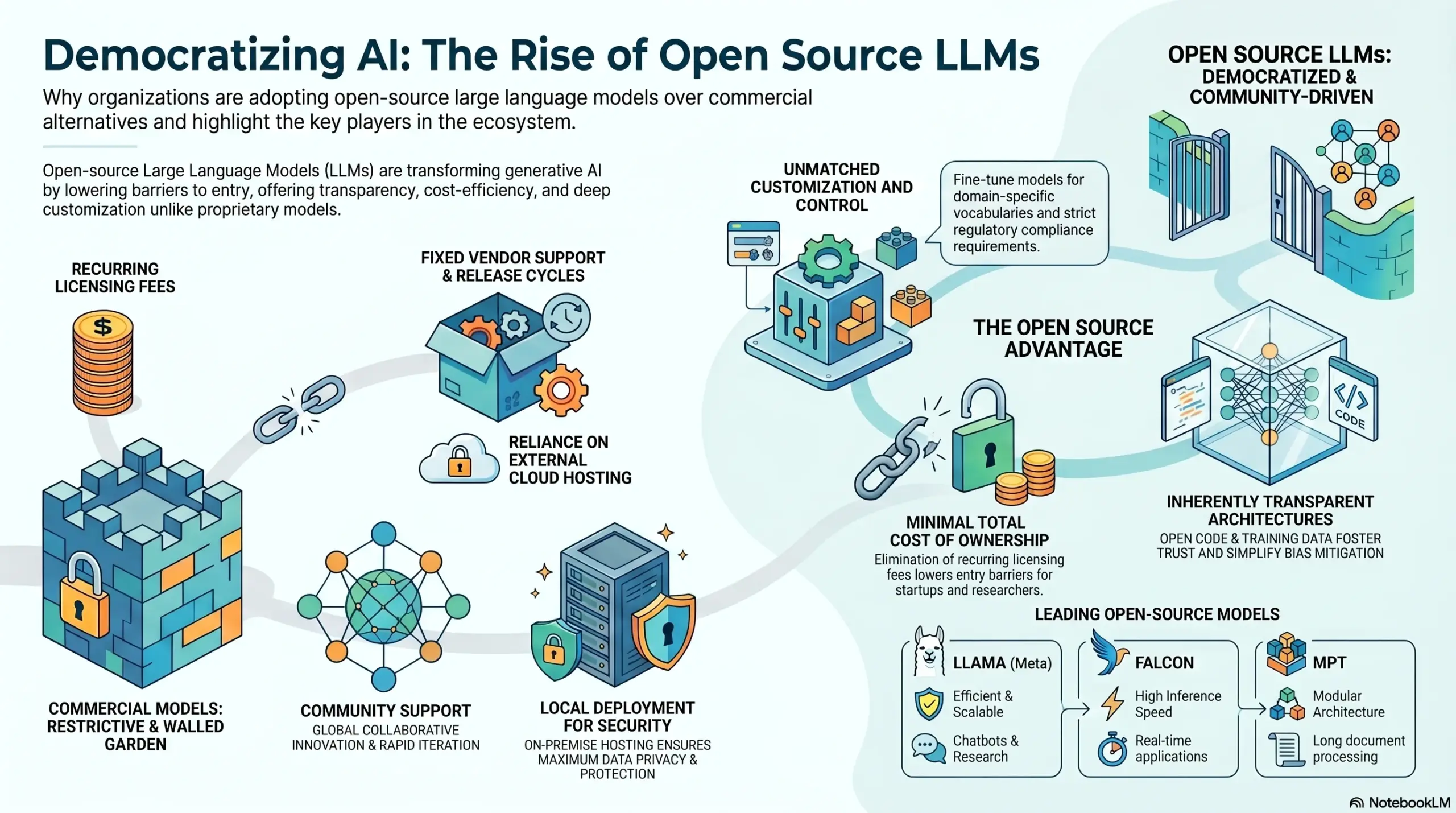
Open source large language models (LLMs) have gained significant popularity because they democratize access to advanced artificial intelligence, lowering the barriers to entry for a wide spectrum of organizations. While commercial models often dominate headlines, open source alternatives allow global communities to collaboratively harness, adapt, and refine generative AI for diverse use cases.
The popularity of these models is driven by several key factors:
1. Flexibility and Customization
One of the primary reasons for their adoption is the flexibility to fine-tune models according to specific organizational requirements. While commercial LLMs often provide standardized performance with limited modification options, open source models can be extensively tailored to handle domain-specific vocabularies or unique compliance needs. For example, industries like healthcare, finance, and education use these models for specialized tasks such as medical documentation, fraud detection, and personalized tutoring.
2. Cost Efficiency
Open source LLMs are highly attractive due to the absence of licensing fees, which lowers financial hurdles for startups, researchers, and academic institutions. In contrast, commercial offerings typically involve recurring subscription costs or pay-per-use API charges that can become expensive as an organization scales.
3. Transparency and Trust
Transparency is inherent to open source projects, allowing users to scrutinize model architectures and training data. This openness facilitates the identification and mitigation of biases, which helps practitioners build more explainable and trustworthy AI systems. Commercial models, by comparison, often treat their internal workings and training datasets as proprietary, making it difficult for users to assess potential risks or biases.
4. Community-Driven Innovation
The vibrant global community supporting open source LLMs accelerates the pace of innovation through rapid knowledge sharing and collective troubleshooting. This collaborative environment ensures that the technology evolves quickly and responsibly, often outpacing the release cycles and commercial priorities of private vendors.
5. Security and Data Control
Open source models offer organizations greater control over data handling. They can be deployed locally or within a Virtual Private Cloud (VPC), which is crucial for meeting strict regulatory requirements and ensuring data protection in sensitive environments. This level of control is often unavailable with commercial models that require data to be sent to a vendor’s API.
Leading Open Source Models
The growth of this ecosystem is exemplified by several prominent models, each offering unique advantages:
MPT: Offers a modular architecture and flexible context windows, which is useful for processing long documents in sectors like legal and compliance.
Llama (Meta): Known for efficient and scalable language modeling with high performance on limited resources.
Falcon: Optimized for inference speed and resource efficiency, making it ideal for cost-sensitive environments.
GPT-Neo/GPT-J (EleutherAI): Provides robust alternatives to early transformer models with permissive licensing.
BLOOM: Distinguished by its extensive multilingual support and collaborative development.
