Why Your AI Prompts Are Failing (The 7 Mistakes Everyone Makes)
Artificial Intelligence (AI) tools have become a part of everyday work. Whether you use ChatGPT, Claude, Gemini, Midjourney, or other AI platforms, the quality of your results depends heavily on one thing: your prompt.
Many people believe AI tools are not smart enough because they often receive inaccurate, incomplete, or generic responses. However, in most cases, the problem is not the AI itself. The real issue is the way the prompt is written.
A prompt is simply the instruction you give to an AI tool. Think of it like giving directions to a new employee. If your instructions are unclear, the results will also be unclear. On the other hand, when you provide detailed and structured instructions, AI can produce surprisingly accurate and useful outputs.
The difference between a beginner and an expert AI user is not the tool they use. It is the quality of their prompts.
In this guide, you will discover the seven most common prompt engineering mistakes that cause poor AI responses. More importantly, you will learn how to fix these mistakes so you can get better, faster, and more reliable results from any AI tool.
Let’s explore the reasons why your AI prompts are failing and how you can improve them today!
Mistake #1: Being Too Vague
One of the biggest reasons AI prompts fail is a lack of clarity.
Many users write short prompts such as:
“Write an article about AI.”
This instruction is too broad. The AI has no idea what type of article you want, who the audience is, how long it should be, or what tone to use.
Instead, provide specific details.
Poor Prompt:
Write an article about AI.
Better Prompt:
Write a 1,000-word beginner-friendly article about artificial intelligence. Use simple language, explain key concepts, and include practical examples.
The more specific your prompt is, the better the AI can understand your expectations.
Mistake #2: Not Defining the Audience
AI performs much better when it knows who the content is for.
A response written for a beginner should be very different from content created for software engineers or business executives.
Without audience information, AI often creates generic content that may not connect with readers.
Poor Prompt:
Explain machine learning.
Better Prompt:
Explain machine learning to a 15-year-old student using simple examples and easy language.
Always tell AI who the target reader is. This helps create content that matches the reader’s knowledge level and interests.
Mistake #3: Ignoring Context
AI does not automatically know your goals, business, industry, or project details.
When you provide little or no context, the output may feel disconnected from what you actually need.
Context helps AI understand the situation and generate more relevant responses.
Poor Prompt:
Write a product description.
Better Prompt:
Write a product description for a wireless gaming mouse designed for professional gamers. Highlight speed, comfort, battery life, and RGB lighting.
Adding context dramatically improves the quality and relevance of AI-generated content.
Mistake #4: Asking Too Many Things at Once
Many users overload a single prompt with multiple requests.
For example:
Write a blog post, create social media captions, generate keywords, design a marketing plan, and create email campaigns.
This often confuses the AI and reduces output quality.
Instead, break large tasks into smaller steps.
Better Approach:
Step 1: Create the blog post.
Step 2: Generate SEO keywords.
Step 3: Create social media captions.
Step 4: Write promotional emails.
Using a step-by-step process helps AI focus on one task at a time and produce stronger results.
Mistake #5: Forgetting to Specify Format
AI can create content in many formats, but it needs instructions.
Without format guidance, the output may not match your expectations.
For example, you may want a checklist, table, article, script, or email, but AI cannot read your mind.
Poor Prompt:
Tell me about prompt engineering.
Better Prompt:
Create a detailed blog article about prompt engineering using H2 headings, bullet points, examples, and a conclusion.
When you clearly define the format, AI structures the content exactly the way you need it.
Mistake #6: Not Assigning a Role to AI
One powerful prompt engineering technique is role prompting.
When you tell AI who it should act as, responses become more specialized and accurate.
Poor Prompt:
Give me SEO advice.
Better Prompt:
Act as an experienced SEO consultant and provide practical recommendations for improving a blog’s search engine rankings.
Role-based prompts help AI focus on a specific perspective, expertise level, and communication style.
Some common roles include:
- SEO Specialist
- Content Writer
- Marketing Consultant
- Software Engineer
- Business Analyst
- Career Coach
- Financial Advisor
Choosing the right role often leads to significantly better results.
Mistake #7: Never Refining the Prompt
Many users make one attempt and accept whatever AI provides.
Experts do the opposite.
They refine, improve, and iterate.
Prompt engineering is an ongoing process. Small changes can produce dramatically different outcomes.
For example:
First Prompt:
Write a blog post about AI.
Improved Prompt:
Write a 1,200-word beginner-friendly blog post about AI. Use simple language, practical examples, SEO best practices, and actionable tips.
Further Improved Prompt:
Act as an expert AI educator and SEO content writer. Create a 1,200-word blog post about AI for beginners. Include H2 headings, real-world examples, FAQs, and a strong conclusion.
Each revision gives the AI more information and improves the final output.
How to Create Better AI Prompts
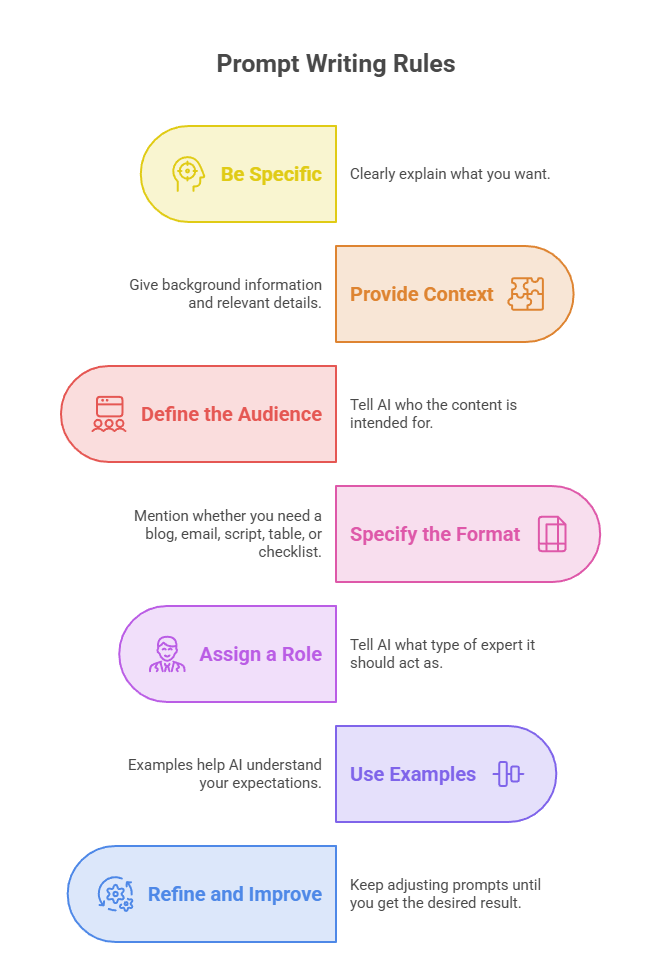
Follow these simple rules whenever you write prompts:
Be Specific
Clearly explain what you want.
Provide Context
Give background information and relevant details.
Define the Audience
Tell AI who the content is intended for.
Specify the Format
Mention whether you need a blog, email, script, table, or checklist.
Assign a Role
Tell AI what type of expert it should act as.
Use Examples
Examples help AI understand your expectations.
Refine and Improve
Keep adjusting prompts until you get the desired result.
These principles work across almost every AI platform available today.
Benefits of Writing Better Prompts
When you improve your prompting skills, you can:
- Get more accurate responses
- Save time on revisions
- Produce higher-quality content
- Improve productivity
- Generate better ideas
- Achieve more consistent results
- Use AI more effectively in professional work
Prompt engineering is quickly becoming one of the most valuable digital skills in today’s AI-driven world.
Conclusion
If you’ve ever wondered why your AI prompts are failing, the answer is often surprisingly simple. Most users make common mistakes such as being vague, providing little context, ignoring the target audience, or asking too many things at once.
The good news is that these problems are easy to fix.
By being specific, providing context, defining your audience, assigning roles, and refining your prompts, you can dramatically improve the quality of AI-generated responses.
Remember, AI is only as effective as the instructions it receives. Better prompts lead to better outputs!
Start applying these seven prompt engineering tips today, and you’ll immediately notice a significant improvement in your AI results.


