What Are AI Models? AI Models Explained
Artificial Intelligence is everywhere today! From smart chatbots like ChatGPT and Gemini to recommendation systems on YouTube and Netflix, AI is changing how people work, learn, search, and communicate. In 2026, AI is no longer just a futuristic idea. It has become a major part of daily life and modern technology.
But have you ever wondered what actually powers these smart AI tools behind the scenes? The answer is simple: AI models.
AI models are the brains behind modern artificial intelligence systems. They help machines understand language, recognize images, generate content, answer questions, and even make decisions. Whether you use voice assistants, AI image generators, or automated customer support, AI models are working silently in the background.
Understanding AI models is becoming very important today because AI is rapidly entering industries like healthcare, education, marketing, business automation, cybersecurity, and software development. Even beginners who are not technical can benefit from learning the basics of how AI works.
In this beginner-friendly guide, you will learn:
- What AI models are
- How AI models work
- Different types of AI models
- Popular AI model examples
- Real-world applications
- Advantages and limitations
- The future of AI technology
By the end of this article, you will have a clear and easy understanding of AI models without needing advanced technical knowledge.
What Are AI Models?
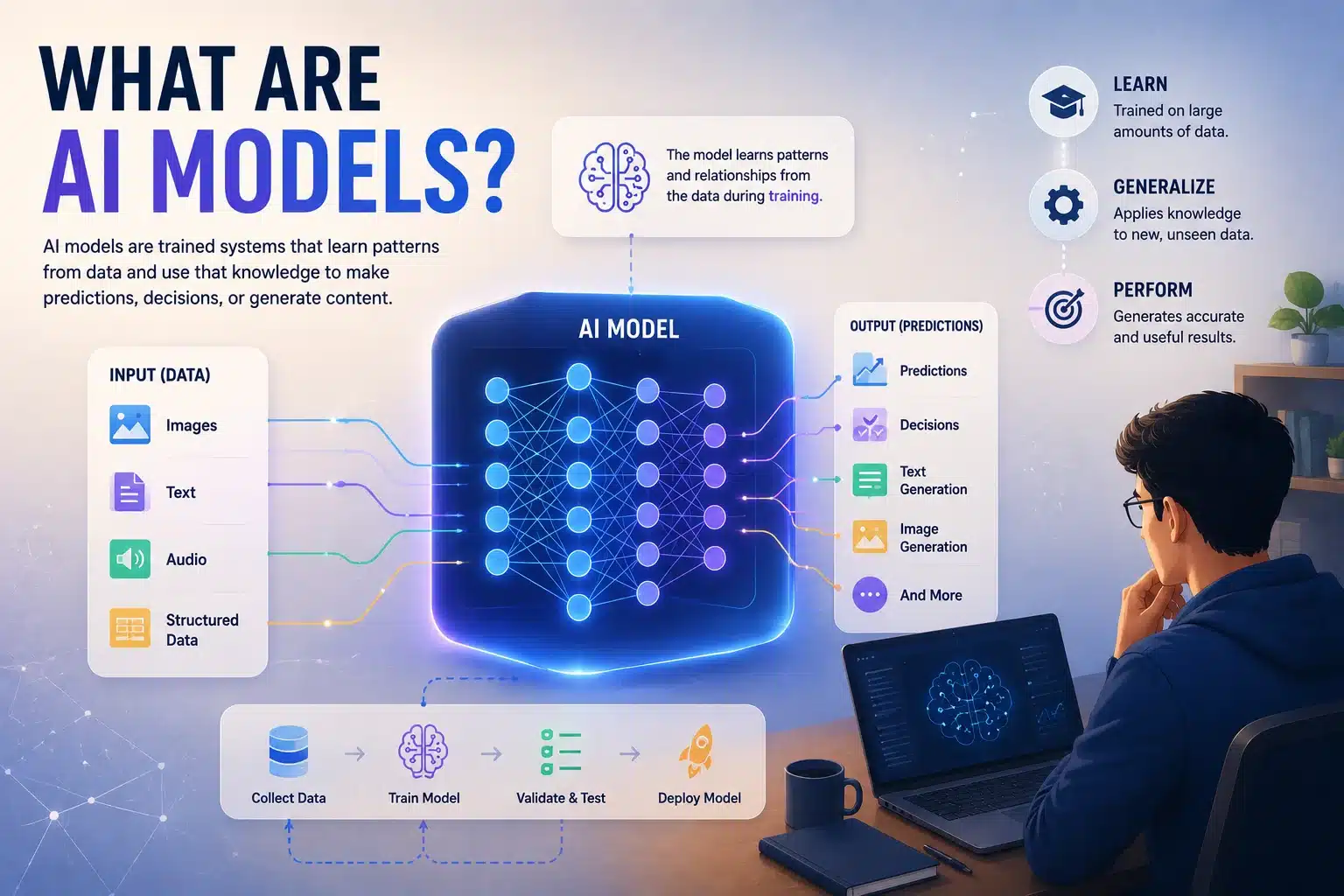
AI models are computer programs trained to recognize patterns, make decisions, and generate outputs using data. In very simple words, an AI model is like a digital brain that learns from examples instead of following only fixed instructions.
Unlike traditional software, which works using pre-written rules, AI models learn from large amounts of data. They study patterns, relationships, and behaviors to improve their performance over time.
For example:
- A spam filter learns which emails look suspicious
- A chatbot learns how humans communicate
- An image AI learns to recognize objects like cats, cars, or people
- A recommendation system learns what users like watching
This learning process is called “training.”
During training, developers feed massive datasets into the AI system. The AI model analyzes the data and gradually improves its ability to make predictions or generate useful responses.
Today, AI models power many modern technologies including:
- AI chatbots
- Search engines
- Self-driving systems
- Virtual assistants
- AI writing tools
- Image generators
- Translation apps
Without AI models, modern artificial intelligence would not exist.
A simple way to understand AI models is to compare them with human learning.
For example, a child learns to recognize dogs by seeing many dog pictures over time. Similarly, an AI model learns by analyzing thousands or even millions of examples.
The more quality data the AI receives, the better it becomes at understanding tasks.
In technical terms, AI models use algorithms and mathematical calculations to learn patterns from data and generate intelligent outputs.
1. Why AI Models Are Important
AI models are important because they allow machines to perform tasks that normally require human intelligence.
These tasks include:
- Understanding language
- Recognizing speech
- Detecting objects in images
- Generating text
- Making recommendations
- Predicting outcomes
Modern businesses use AI models to improve efficiency, reduce manual work, automate repetitive tasks, and provide better customer experiences.
Some major industries using AI models today include:
| Industry | AI Model Usage |
|---|---|
| Healthcare | Disease detection and diagnosis |
| Marketing | AI content and ad optimization |
| Education | AI tutors and learning systems |
| Finance | Fraud detection |
| E-commerce | Product recommendations |
| Customer Support | AI chatbots |
Because of their growing importance, AI models are now considered one of the core technologies shaping the future of the internet and digital innovation.
How Do AI Models Work?
AI models work by learning patterns from data and using that knowledge to make predictions or generate outputs. Although the technology behind AI can be complex, the basic process is actually easy to understand.
Most AI models follow a simple workflow:
Input Data → Training → Learning Patterns → Prediction/Output
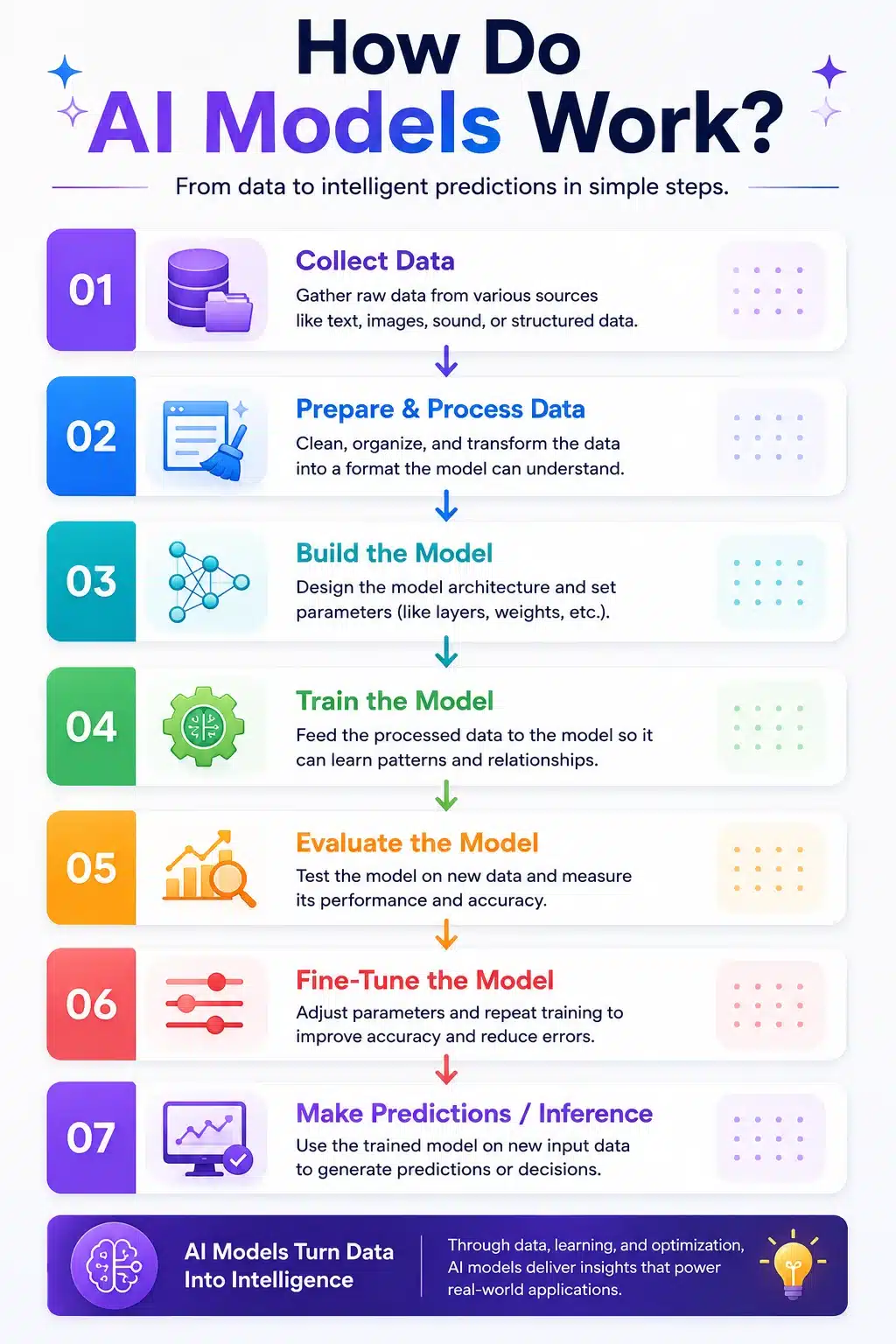
The AI system studies huge amounts of information during training. Over time, it becomes better at understanding relationships inside the data.
For example:
- A text AI learns language patterns
- An image AI learns visual features
- A music AI learns sound patterns
- A recommendation AI learns user behavior
After training, the AI enters the prediction phase, also called inference. This is when the AI uses its learned knowledge to answer questions or perform tasks.
1. Training Phase
The training phase is where the real learning happens.
Developers provide datasets containing examples for the AI model to study. These datasets may include:
- Text
- Images
- Videos
- Audio
- User behavior data
For example, if developers want an AI to recognize cats, they feed thousands of cat images into the system. The AI slowly learns common patterns like ears, eyes, fur shape, and body structure.
This learning process helps the model improve accuracy over time.
The training process may take days, weeks, or even months depending on the size of the AI model.
2. Prediction Phase
Once training is completed, the AI model can start making predictions or generating outputs.
This phase is called inference.
For example:
- ChatGPT predicts the next words in a sentence
- AI image tools generate visuals from prompts
- Recommendation systems suggest videos or products
- Voice assistants answer spoken questions
The AI does not “think” like humans. Instead, it predicts results based on patterns learned during training.
3. Why Data Matters
Data is one of the most important parts of AI development.
Good-quality data helps AI models become smarter and more accurate. Poor-quality data can create mistakes, bias, or incorrect outputs.
There is a common saying in AI:
“Better data creates better AI.”
For example:
- Clear medical datasets improve healthcare AI
- Large language datasets improve chatbots
- High-quality images improve image recognition systems
This is why major AI companies invest heavily in collecting and organizing quality training data.
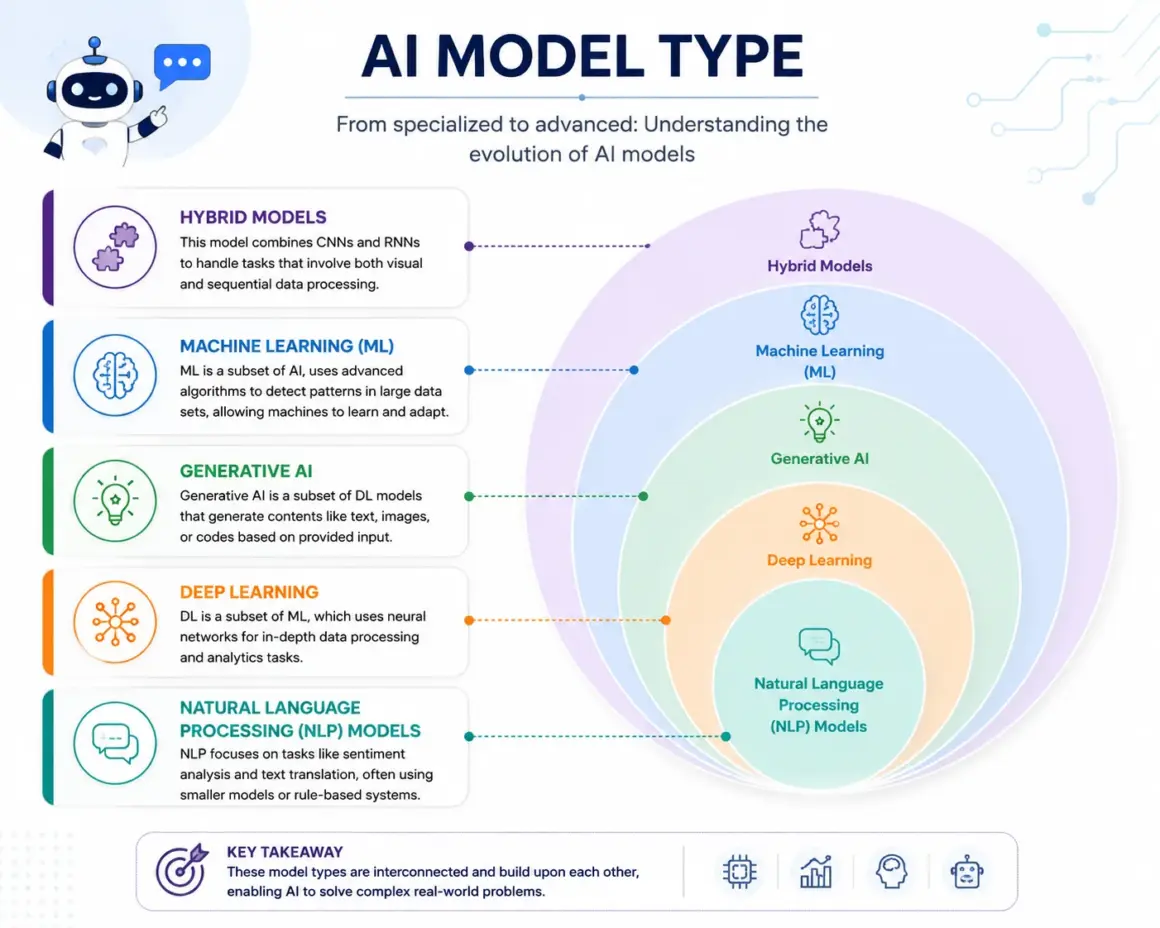
Types of AI Models
There are many different types of AI models, and each one is designed for specific tasks. Some AI models focus on recognizing patterns, while others generate content, understand language, or make predictions.
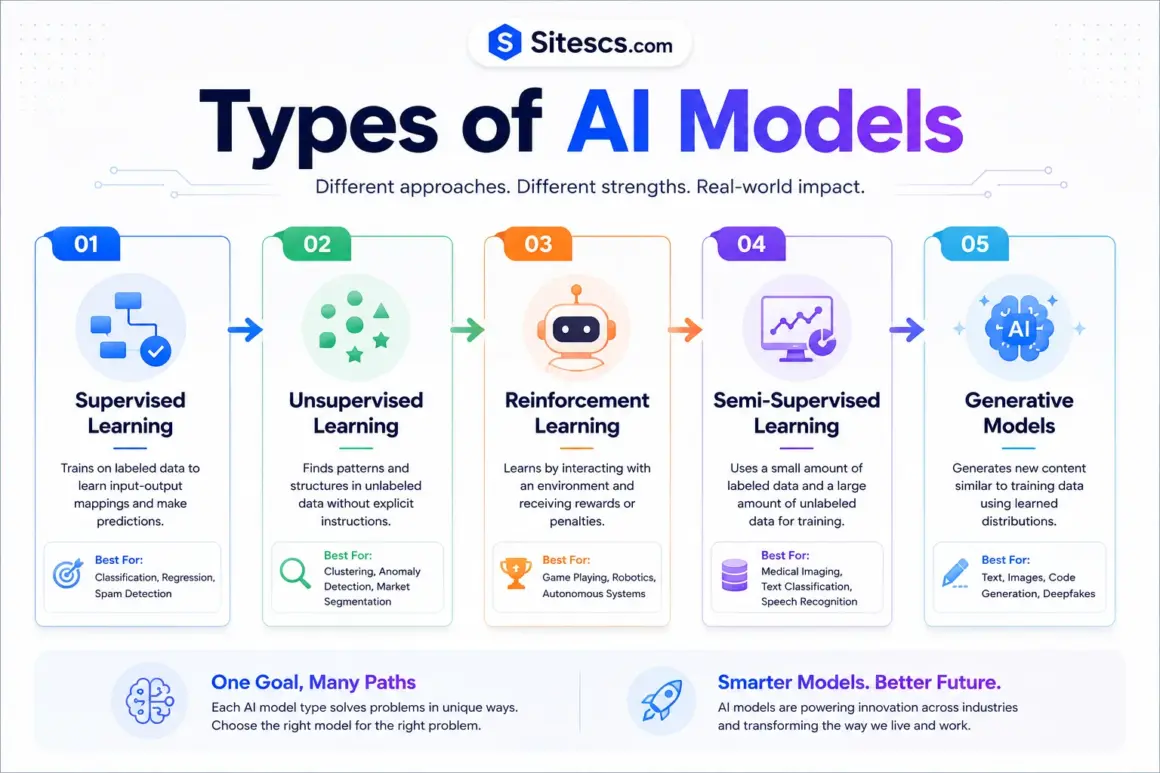
Understanding these categories helps beginners learn how modern AI systems work in real-world applications.
Below are the most important types of AI models used today.
1. Machine Learning Models
Machine Learning (ML) models are one of the most common types of AI models. These systems learn from data and improve automatically without needing manual programming for every task.
Instead of following fixed instructions, machine learning models identify patterns and make predictions based on previous examples.
Common examples include:
- Spam email filters
- Product recommendation systems
- Fraud detection systems
- Search engine ranking systems
For example, when Netflix recommends movies or YouTube suggests videos, machine learning models analyze your viewing history and behavior patterns.
These models become smarter as they process more data.
Common Uses of Machine Learning Models
| Application | Example |
|---|---|
| Email Filtering | Spam detection |
| E-commerce | Product recommendations |
| Banking | Fraud detection |
| Social Media | Feed personalization |
| Search Engines | Search result ranking |
Machine learning models are widely used because they are flexible, scalable, and efficient for data-driven tasks.
2. Deep Learning Models
Deep learning models are advanced AI systems inspired by the human brain. They use something called neural networks to process information.
These neural networks contain multiple layers that help AI understand complex patterns.
Deep learning is especially powerful for tasks involving:
- Images
- Speech
- Video
- Natural language
For example:
- Facial recognition systems use deep learning
- Voice assistants understand speech using deep learning
- Self-driving cars analyze road conditions using deep learning
Deep learning models usually require:
- Massive datasets
- High computing power
- Powerful GPUs
Because of their advanced capabilities, deep learning models are behind many modern AI breakthroughs.
Examples of Deep Learning Applications
| Technology | Usage |
|---|---|
| Face Unlock | Smartphone security |
| Speech Recognition | Virtual assistants |
| Medical Imaging | Disease detection |
| Self-driving Cars | Object detection |
| AI Translation | Language conversion |
Deep learning has become one of the most important technologies in modern artificial intelligence.
3. Large Language Models (LLMs)
Large Language Models, also called LLMs, are AI models trained to understand and generate human language.
These models are trained using massive text datasets collected from books, articles, websites, and conversations.
LLMs can:
- Answer questions
- Write articles
- Summarize content
- Generate code
- Translate languages
- Assist with research
Popular examples include:
- ChatGPT
- Claude
- Gemini
These AI systems use advanced deep learning techniques to predict the next words in a sentence.
For example, when you ask ChatGPT a question, the model analyzes patterns in language and generates a human-like response.
LLMs are now widely used in:
- AI chatbots
- Content writing
- Customer support
- Coding assistants
- Research tools
They are one of the biggest reasons why AI became extremely popular worldwide.
4. Generative AI Models
Generative AI models are designed to create new content instead of only analyzing existing data.
These models can generate:
- Text
- Images
- Videos
- Music
- Audio
- Code
Generative AI has transformed industries like content creation, design, marketing, and entertainment.
Popular examples include:
| AI Tool | Main Purpose |
|---|---|
| ChatGPT | Text generation |
| Midjourney | AI image creation |
| Stable Diffusion | AI artwork generation |
| Runway | AI video editing |
Generative AI models are becoming more powerful every year and are changing how digital content is created online.
Examples of Popular AI Models
Today, many powerful AI models are used by businesses, developers, students, and everyday internet users. Each AI model is designed for different purposes and tasks.
Some models focus on text generation, while others specialize in images, coding, voice recognition, or multimodal understanding.
Here are some of the most popular AI models in 2026.
1. GPT Models
GPT stands for “Generative Pre-trained Transformer.”
GPT models are developed by OpenAI and are among the most popular language AI systems in the world.
These models are designed to:
- Generate human-like text
- Answer questions
- Write content
- Assist with coding
- Summarize information
- Translate languages
The most well-known GPT-powered product is ChatGPT.
GPT models are trained using huge amounts of text data and advanced neural networks.
Main Features of GPT Models
| Feature | Purpose |
|---|---|
| Text Generation | Writing articles and responses |
| Coding Assistance | Helping programmers |
| Summarization | Shortening long content |
| AI Chatbots | Conversational support |
| Research Support | Information analysis |
GPT models are widely used in education, blogging, business automation, and software development.
2. Gemini
Gemini is an advanced AI model developed by Google.
Gemini is known for multimodal AI capabilities, meaning it can understand different types of content together such as:
- Text
- Images
- Audio
- Video
- Documents
This allows Gemini to perform more advanced reasoning tasks compared to traditional AI systems.
Gemini is commonly integrated into:
- Search systems
- Productivity tools
- AI assistants
- Workspace applications
Its ability to analyze multiple content formats makes it one of the leading AI models today.
3. Claude
Claude is a conversational AI model developed by Anthropic.
Claude focuses heavily on:
- Safe AI interactions
- Long conversations
- Document analysis
- Human-friendly responses
Many users prefer Claude for research, writing, and business communication because of its natural conversational style.
Claude is widely used in:
- Customer support
- AI writing assistance
- Research analysis
- Enterprise AI solutions
4. Image AI Models
AI is not limited to text only. Many AI models can now generate highly realistic images and artwork.
Popular image AI models include:
- Midjourney
- Stable Diffusion
- DALL·E
These tools create images using simple text prompts.
For example, users can type:
“Create a futuristic cyberpunk city at night”
The AI then generates a completely new image based on the description.
Image AI models are now used in:
- Graphic design
- Advertising
- Gaming
- Social media content
- Film production
They are transforming the creative industry very rapidly.
AI Models vs Traditional Programming
AI models and traditional software may look similar on the surface, but they work very differently.
Traditional programming depends on fixed rules written by developers. AI models, on the other hand, learn patterns from data and improve through experience.
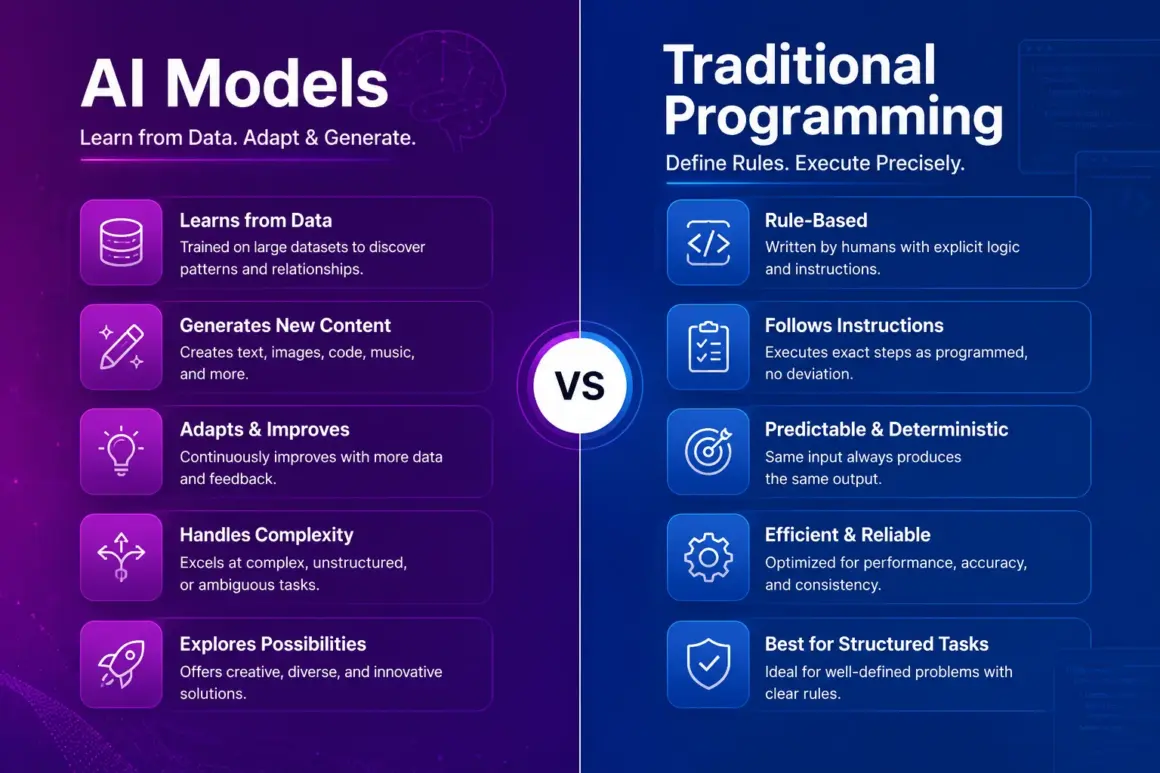
This difference is one of the biggest reasons AI has become so powerful in modern technology.
1. Rule-Based Software
Traditional software works using predefined instructions.
For example:
IF password is correct → login successful
ELSE → show error
The software only follows the exact rules programmed by developers.
This method works well for predictable tasks but struggles with:
- Complex decisions
- Human language
- Pattern recognition
- Dynamic environments
Traditional systems cannot “learn” automatically from new data.
2. Learning-Based AI Systems
AI systems work differently because they learn from examples instead of relying only on hardcoded rules.
For example:
- AI learns what spam emails look like
- AI learns customer preferences
- AI learns speech patterns
- AI learns writing styles
This makes AI systems far more adaptive and flexible.
Here is a simple comparison:
| Feature | Traditional Programming | AI Models |
|---|---|---|
| Works Using | Fixed rules | Data learning |
| Flexibility | Low | High |
| Learning Ability | No | Yes |
| Adaptability | Limited | Dynamic |
| Best For | Structured tasks | Complex pattern recognition |
Because of this learning capability, AI models can solve problems that traditional software cannot handle efficiently.
Real-World Uses of AI Models
AI models are no longer limited to research labs or large technology companies. Today, they are used in everyday life across many industries. From smartphones and healthcare systems to online shopping and education platforms, AI models are helping businesses work faster and smarter.
Most people interact with AI every single day without even realizing it.
For example:
- Voice assistants answer questions
- Streaming platforms recommend movies
- AI chatbots handle customer support
- Navigation apps suggest faster routes
- Social media platforms personalize feeds
As AI technology continues to grow, its real-world applications are expanding rapidly.
1. AI in Healthcare
Healthcare is one of the most important industries using AI models today.
AI helps doctors and medical professionals analyze huge amounts of patient data quickly and accurately.
Common healthcare AI applications include:
- Disease detection
- Medical image analysis
- Drug research
- Virtual health assistants
- Patient monitoring systems
For example, AI models can analyze X-rays or MRI scans to help detect diseases faster.
Hospitals also use AI-powered systems to:
- Predict patient risks
- Improve diagnosis accuracy
- Automate administrative tasks
Benefits of AI in Healthcare
| AI Application | Purpose |
|---|---|
| Medical Imaging | Disease detection |
| AI Chatbots | Patient support |
| Predictive Analytics | Risk analysis |
| Drug Discovery | Faster research |
| Virtual Assistants | Appointment management |
AI is helping healthcare become faster, smarter, and more efficient.
2. AI in Marketing
Marketing has changed dramatically because of AI models.
Businesses now use AI to:
- Generate content
- Improve SEO
- Analyze customer behavior
- Create personalized advertisements
- Automate email marketing
AI writing tools like ChatGPT help bloggers, marketers, and businesses create articles, social media posts, and ad copy much faster.
SEO professionals also use AI-powered tools for:
- Keyword research
- Content optimization
- Competitor analysis
- Search trend analysis
AI allows businesses to make data-driven marketing decisions and improve customer engagement.
Popular AI Marketing Uses
- AI content writing
- Chatbots
- Email automation
- SEO optimization
- Customer targeting
- Ad personalization
Because of automation, AI is becoming one of the most valuable tools in digital marketing.
3. AI in Education
AI models are transforming education and online learning.
Modern AI systems can personalize learning experiences for students based on their strengths and weaknesses.
Examples include:
- AI tutors
- Language learning apps
- Homework assistants
- Personalized learning systems
AI-powered tools help students:
- Understand difficult topics
- Generate study notes
- Practice problem-solving
- Improve writing skills
Teachers also use AI for:
- Automated grading
- Content generation
- Lesson planning
- Student performance analysis
Examples of AI in Education
| AI Tool Type | Usage |
|---|---|
| AI Tutors | Personalized learning |
| Writing Assistants | Grammar improvement |
| Language Apps | Translation and speaking practice |
| Learning Platforms | Adaptive education |
AI is making education more accessible and interactive for students worldwide.
4. AI in Business
Businesses across all industries are using AI models to improve productivity and reduce manual work.
AI helps companies automate repetitive tasks and improve decision-making.
Common business AI applications include:
- Customer support chatbots
- Data analysis
- Workflow automation
- Fraud detection
- Sales forecasting
For example, AI chatbots can answer customer questions 24/7 without human support agents.
Businesses also use AI to analyze large datasets and identify patterns that humans may miss.
Business Benefits of AI
| Business Area | AI Benefit |
|---|---|
| Customer Support | Faster responses |
| Data Analytics | Better insights |
| Automation | Reduced workload |
| Cybersecurity | Threat detection |
| Sales | Customer prediction |
AI is helping companies save time, reduce costs, and improve customer experiences.
Advantages and Limitations of AI Models
AI models offer many benefits, but they also have some limitations and risks. Understanding both sides is important for using AI responsibly.
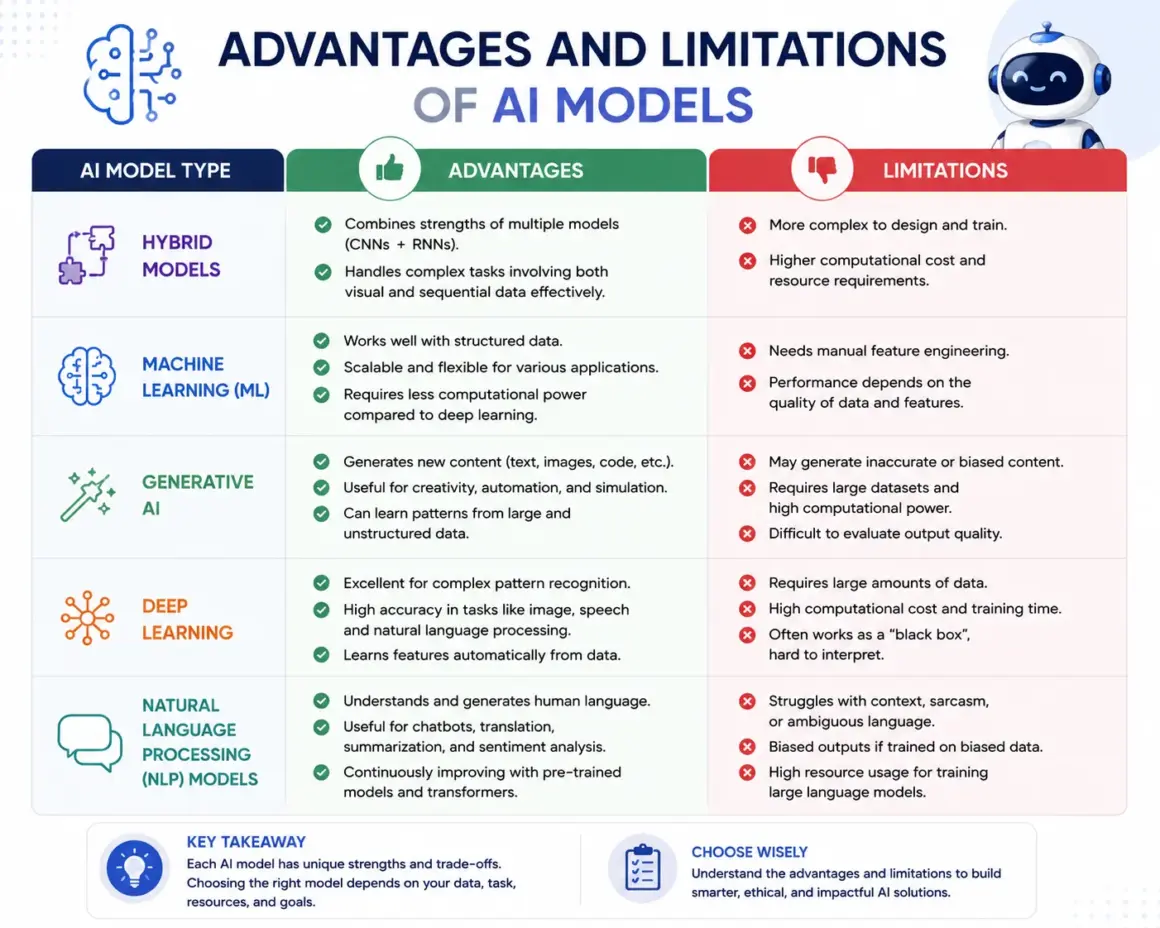
While AI can improve productivity and automation, it is not perfect and still depends heavily on data and human supervision.
1. Advantages of AI Models
AI models provide several major advantages across industries.
Speed and Efficiency
AI systems can process huge amounts of information much faster than humans.
For example:
- AI can analyze thousands of documents in seconds
- AI chatbots respond instantly
- AI tools automate repetitive work
This helps businesses save time and improve efficiency.
Automation
AI models automate tasks that normally require human effort.
Examples include:
- Customer support
- Data entry
- Content generation
- Image processing
Automation allows companies to reduce manual workload and focus on more important tasks.
Scalability
AI systems can handle millions of users at the same time.
For example:
- Search engines process billions of searches
- AI assistants support global users
- Recommendation systems analyze massive datasets
This scalability makes AI extremely powerful for modern internet platforms.
2. Limitations of AI Models
Despite their power, AI models still have several challenges.
Hallucinations
Sometimes AI generates incorrect or misleading information. This problem is called hallucination.
For example:
- AI may provide false facts
- AI can generate fake references
- AI may misunderstand questions
This is why human verification remains important.
Bias in AI
AI models learn from data. If the training data contains bias, the AI may also produce biased results.
Bias can affect:
- Hiring systems
- Facial recognition
- Search recommendations
- AI-generated responses
Developers work continuously to reduce AI bias and improve fairness.
Dependency on Data
AI models need massive amounts of high-quality data to perform well.
Poor-quality data can reduce:
- Accuracy
- Reliability
- Performance
Without proper training data, AI systems become less useful.
Quick Overview of AI Advantages vs Limitations
| Advantages | Limitations |
|---|---|
| Fast processing | Can generate mistakes |
| Automation | May contain bias |
| Scalability | Requires huge datasets |
| Improved productivity | High computing costs |
| 24/7 availability | Needs human supervision |
AI is powerful, but responsible usage and human oversight are still essential.
How AI Models Are Trained
Training an AI model is the process of teaching the AI system to recognize patterns and improve performance using data.
This process requires:
- Massive datasets
- Powerful computers
- Advanced algorithms
- Continuous optimization
Modern AI models are trained using millions or even billions of data examples.
1. Data Collection
Everything starts with data.
AI developers collect huge datasets containing:
- Text
- Images
- Videos
- Audio
- User interactions
For example:
- Language models train on books and websites
- Image AI trains on millions of pictures
- Voice AI trains on audio recordings
The quality of data directly affects AI performance.
Common AI Training Data Types
| Data Type | Example |
|---|---|
| Text | Articles and books |
| Images | Photos and graphics |
| Audio | Speech recordings |
| Video | Motion analysis |
| User Data | Behavioral patterns |
Good-quality datasets help AI models learn more accurately.
2. Model Training
During training, the AI analyzes the data repeatedly to identify patterns and relationships.
This process uses mathematical algorithms and neural networks.
The AI continuously adjusts itself to improve prediction accuracy.
For example:
- A language model learns grammar and sentence structure
- An image model learns object shapes and colors
- A recommendation AI learns user preferences
Training large AI models often requires:
- GPUs (Graphics Processing Units)
- Data centers
- Cloud computing infrastructure
Some advanced AI models may take weeks or months to fully train.
3. Fine-Tuning
After the main training phase, developers often improve the AI further using fine-tuning.
Fine-tuning helps AI specialize in specific tasks.
For example:
- Medical AI can be fine-tuned for healthcare
- Legal AI can specialize in legal documents
- Customer support AI can learn company policies
Fine-tuning improves:
- Accuracy
- Safety
- Response quality
- Domain expertise
This is why many companies customize AI models for their own industries and applications.
Future of AI Models
The future of AI models looks extremely exciting. AI technology is improving rapidly every year, and experts believe AI systems will become smarter, faster, and more helpful in daily life.
In the coming years, AI models are expected to handle more complex tasks with better accuracy and deeper understanding.
Future AI systems will likely become:
- More personalized
- More intelligent
- More multimodal
- More autonomous
- More energy efficient
Companies around the world are investing billions of dollars into AI research and development because AI is becoming one of the most important technologies of the modern era.
1. AI Agents
One of the biggest future trends is AI agents.
AI agents are advanced AI systems that can perform tasks automatically with minimal human involvement.
Unlike normal chatbots that only answer questions, AI agents can:
- Complete workflows
- Manage schedules
- Conduct research
- Analyze documents
- Automate business tasks
- Interact with software tools
For example, future AI agents may:
- Book appointments automatically
- Manage emails
- Create reports
- Run customer support systems
- Handle online shopping tasks
Many experts believe AI agents could become digital assistants for businesses and individuals.
This technology is already starting to appear in modern AI platforms.
2. Human + AI Collaboration
The future of AI is not about replacing humans completely. Instead, experts believe AI will mostly work alongside humans to improve productivity and creativity.
This concept is called Human + AI collaboration.
AI can help humans by:
- Automating repetitive tasks
- Assisting with research
- Improving decision-making
- Increasing work efficiency
- Supporting creativity
For example:
| Profession | AI Assistance |
|---|---|
| Writers | Content generation |
| Doctors | Diagnosis support |
| Designers | AI image creation |
| Developers | Code assistance |
| Teachers | Personalized learning |
Instead of replacing professionals, AI is expected to become a powerful support tool across industries.
3. Rise of Multimodal AI
Future AI models will increasingly become multimodal.
Multimodal AI can understand multiple forms of content together, such as:
- Text
- Images
- Video
- Audio
- Documents
For example, future AI assistants may:
- Watch videos and summarize them
- Understand voice commands and images together
- Analyze presentations and documents simultaneously
Models like Gemini are already moving toward this direction.
This will make AI systems more natural and useful for real-world applications.
4. AI Regulation and Ethics
As AI becomes more powerful, governments and organizations are also focusing on AI regulation and safety.
Important concerns include:
- Privacy protection
- AI-generated misinformation
- Bias reduction
- Copyright concerns
- Responsible AI development
Many countries are now creating AI policies to ensure ethical and safe AI usage.
In the future, AI companies will likely face stricter rules regarding transparency and responsible development.
FAQs About AI Models
What is an AI model in simple words?
An AI model is a computer system trained to learn patterns from data and make predictions or generate outputs automatically.
In simple language, AI models help machines perform tasks that normally require human intelligence.
What are examples of AI models?
Some popular examples of AI models include:
ChatGPT
Gemini
Claude
Midjourney
Stable Diffusion
These AI models are used for text generation, image creation, automation, and problem-solvi
Are ChatGPT and Gemini AI models?
Yes! Both ChatGPT and Gemini are AI models.
More specifically, they are Large Language Models (LLMs) trained on massive text datasets to understand and generate human-like language.
What is the difference between AI and machine learning?
Artificial Intelligence (AI) is the broader concept of machines performing intelligent tasks.
Machine Learning (ML) is a subset of AI that focuses on systems learning from data automatically.
In simple terms:
AI is the big field
Machine learning is one technology inside AI
How are AI models trained?
AI models are trained using large datasets and advanced algorithms.
The training process includes:
Collecting data
Feeding data into the AI system
Learning patterns
Improving accuracy through repeated training
Large AI models also use powerful GPUs and cloud computing systems during training.
Can AI models think like humans?
No, AI models do not truly think or understand like humans.
AI systems work by identifying patterns and predicting outputs based on training data.
Although AI can appear intelligent, it does not have human emotions, consciousness, or real understanding.
What is the most powerful AI model today?
There is no single “best” AI model because different models are designed for different tasks.
Some of the most advanced AI systems in 2026 include:
GPT
Gemini
Claude
Each model has strengths in areas like reasoning, multimodal understanding, coding, or long conversations.
Summary
AI models are the foundation of modern artificial intelligence systems. They allow machines to learn from data, recognize patterns, generate content, and make intelligent decisions.
Today, AI models power many technologies we use daily, including:
- AI chatbots
- Search engines
- Recommendation systems
- Voice assistants
- Image generators
- Business automation tools
In this guide, you learned:
- What AI models are
- How AI models work
- Different types of AI systems
- Real-world AI applications
- Advantages and limitations
- AI training methods
- Future AI trends
As AI continues to evolve, understanding AI models is becoming an essential digital skill for students, businesses, creators, and professionals.
The future of AI will likely bring smarter assistants, better automation, and deeper human-AI collaboration across industries.
Learning AI today can help you stay prepared for the future of technology and innovation.
Suggested Internal Links
You can internally link this article to:
- “What Is Prompt Engineering?”
- “How Does ChatGPT Work?”
- “Types of Artificial Intelligence”
- “Best AI Tools for Beginners”
Suggested External References
For more trusted AI learning resources, visit:


