13 Prompt Engineering Tips to Get Better AI Results
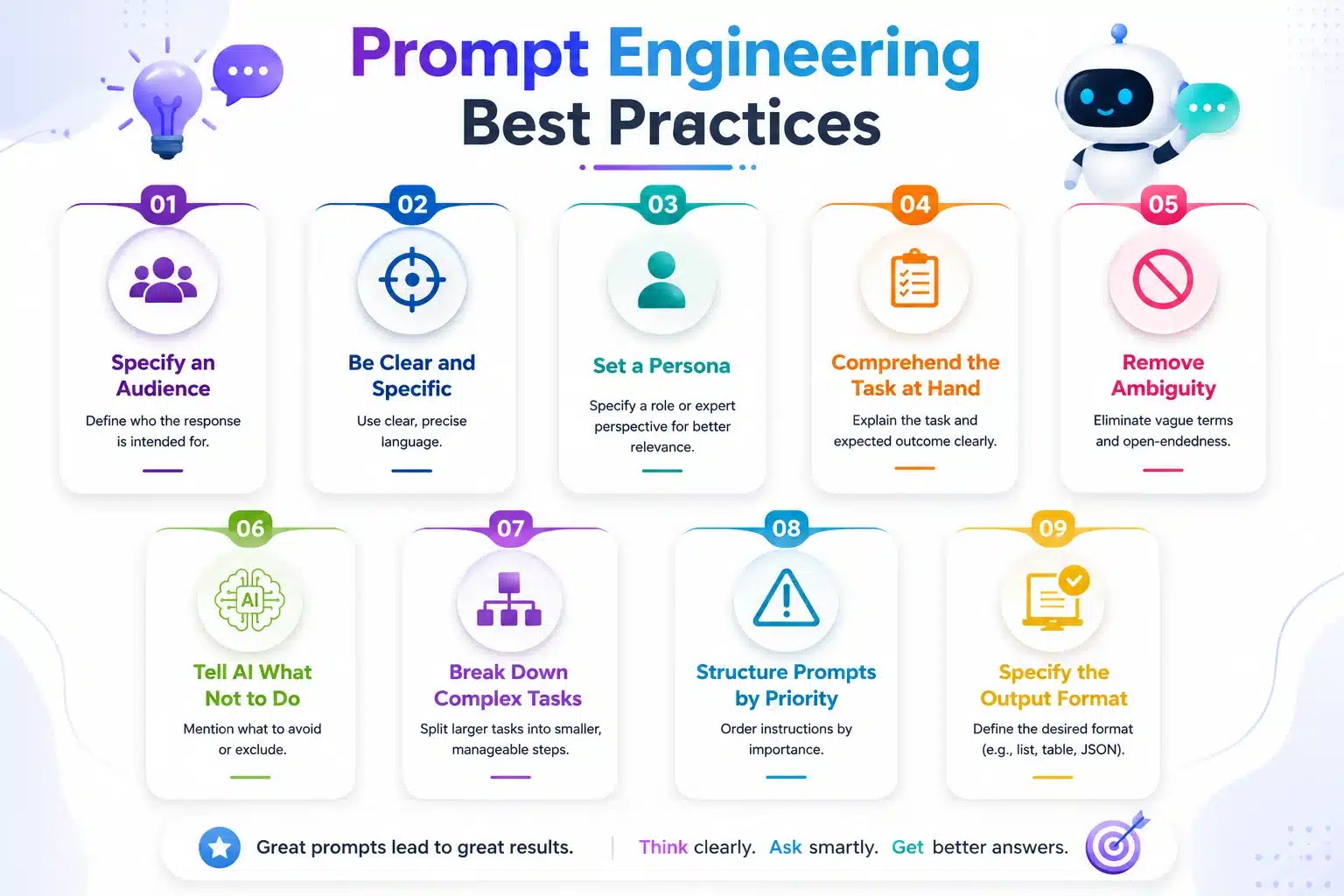
Are you tired of getting boring or wrong answers from AI? You are not alone! Many people struggle to get exactly what they need from tools like ChatGPT or Claude. The secret to success is called prompt engineering, and it is the most important skill you can learn today!
In this guide, we will show you 13 simple prompt engineering tips that will turn you into an AI expert. Let’s dive in!
What is Prompt Engineering?
Definition: Prompt engineering is the art of creating and improving inputs (called “prompts”) to get the best possible results from an AI model. Think of it like giving clear instructions to a very smart, but sometimes unfocused, digital assistant.
How Prompt Engineering Works
When you send a prompt, the AI goes through a few steps to help you:
- Tokenizing: It breaks your words into small pieces it can understand.
- Intent Understanding: It tries to figure out what you are actually asking for.
- Knowledge Retrieval: It look through the massive amount of data it was trained on.
- Response Generation: It writes a reply that fits your request.
Prompting vs. Fine-Tuning: What is the difference?
It is easy to get these mixed up! Here is a simple comparison:
| Feature | Prompt Engineering | Fine-Tuning |
|---|---|---|
| Effort | Easy and fast! | Hard and takes a long time. |
| Cost | Very low or free. | High (needs lots of computer power). |
| Technical Skill | None needed—just good English! | Needs coding and data science. |
| Method | Changing the wording of the ask. | Changing the AI’s internal settings. |
13 Prompt Engineering Tips to Get Better AI Results
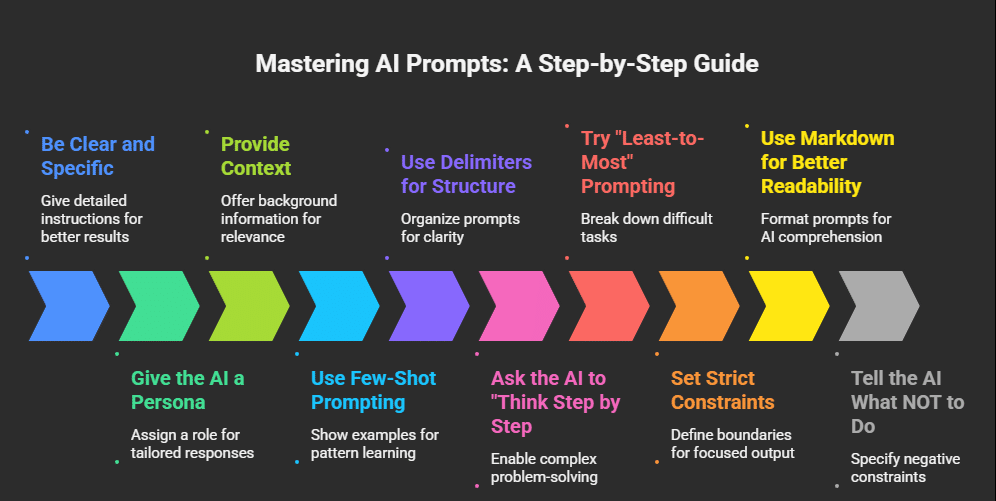
1. Be Clear and Specific
The biggest mistake is being too vague! If you say “Explain science,” the AI will get confused. Instead, say: “Explain how a star is born using simple words for a 10th grader”. The more details you give, the better the answer will be!
2. Give the AI a Persona (Role-Playing)
Tell the AI who it should be! If you want financial advice, tell it: “Act as a professional financial planner”. If you want code, say: “As a senior software engineer, review this script”. This sets the right tone and depth for the answer.
3. Provide Context
AI models can’t read your mind! Give it some background. For example: “I am writing a fantasy novel about dragons. Can you describe a magical forest?”. This helps the AI stay on track with your specific goals.
4. Use Few-Shot Prompting
Don’t just ask—show! “Few-shot prompting” means giving the AI 2 or 3 examples of the style or format you want. This helps the AI learn the pattern quickly and give you exactly what you expect!
5. Use Delimiters for Structure
Help the AI see where one part ends and another begins. You can use triple backticks (“`), quotes (“”), or special markers (###). This stops the AI from getting your instructions mixed up with your data!
6. Ask the AI to “Think Step by Step”
This is a magic phrase! By asking the AI to show its reasoning, you help it solve complex math or logic problems without making silly mistakes. This is called “Chain-of-Thought” prompting.
7. Try “Least-to-Most” Prompting
For really hard tasks, break the problem down yourself! Ask the AI to solve the easiest part first, then use that answer to solve the next part. This “least-to-most” method is great for complex reasoning.
8. Set Strict Constraints
Tell the AI exactly what the boundaries are. Do you need a summary in under 100 words? Say it!. Do you want a list with exactly 5 points? Make it a rule!. Constraints help keep the AI focused.
9. Use Markdown for Better Readability
You should format your prompts just like this blog post! Use headings, bold text, and bullet points. The “Markdown Prompts Framework” makes your requests much easier for the AI to follow.
10. Tell the AI What NOT to Do (Negative Constraints)
Sometimes it’s helpful to say what to avoid. For example: “Give me the pros and cons of remote work, but do not include personal opinions”. This keeps the output professional and clean!
11. Use Sequential Prompting
Instead of one giant prompt, use a series of smaller ones. Ask a general question first, then follow up with more specific asks based on the AI’s first response. It’s like having a real conversation!
12. Specify the Output Format
Do you want a table, a list, a JSON file, or a poem? Tell the AI right away!. If you need data for a spreadsheet, ask for it in a CSV format.
13. Iterate and Refine
Don’t give up if the first result isn’t perfect! Prompt engineering is a loop. Take the AI’s answer, see where it went wrong, and adjust your prompt to fix it. Practice makes perfect!
Key Takeaways
- Clearer is better: Specificity beats general questions every time!.
- Structure matters: Use Markdown and delimiters to organize your thoughts.
- Examples help: Show the AI what you want using few-shot prompting.
- Logic first: Use “Think step by step” for better reasoning.
- Keep trying: Always refine your prompts to get the best results.
Summary
Mastering these prompt engineering tips will save you hours of work and help you get the most out of AI! It is a developing discipline that supports productivity and problem-solving in school, work, and life. So, the next time you talk to an AI, remember: it’s not just what you ask, it’s how you ask it!


