What is Prompt Engineering? Beginner Guide with Examples
Artificial Intelligence is absolutely everywhere right now! You might use it for school, work, or just for fun every single day. But here is the big problem: many people feel let down because they get bad, shallow, or even confusing results from their AI prompts. If you have ever felt like the AI just doesn’t “get” you, you are not alone! Most users receive off-topic answers simply because their instructions are too vague or lack the right context.
The solution to this frustration is a powerful skill called prompt engineering. It is basically the “art and science” of writing the best possible instructions so the AI understands your true intent and gives you exactly what you need! Think of it as a roadmap that steers the AI toward the perfect answer. By learning these AI basics, you can transform a boring chatbot into a brilliant, high-performing assistant!
Table of Contents
- What is Prompt Engineering?
- Why Prompt Engineering is Important
- How Prompt Engineering Works (Step-by-Step)
- Types of Prompts in AI
- Best Prompt Engineering Techniques
- Prompt Engineering Examples
- Common Mistakes in Prompt Engineering
- Tools That Use Prompt Engineering
- Prompt Engineering as a Career
- FAQs: Frequently Asked Questions
In this complete prompt engineering guide, you are going to learn how to master your interactions with AI. We will show you how to avoid common mistakes, use “Chain-of-Thought” reasoning for better logic, and give your AI a specific persona to get professional results every single time! Let’s dive in and finally unlock the true power of AI!
What is Prompt Engineering?
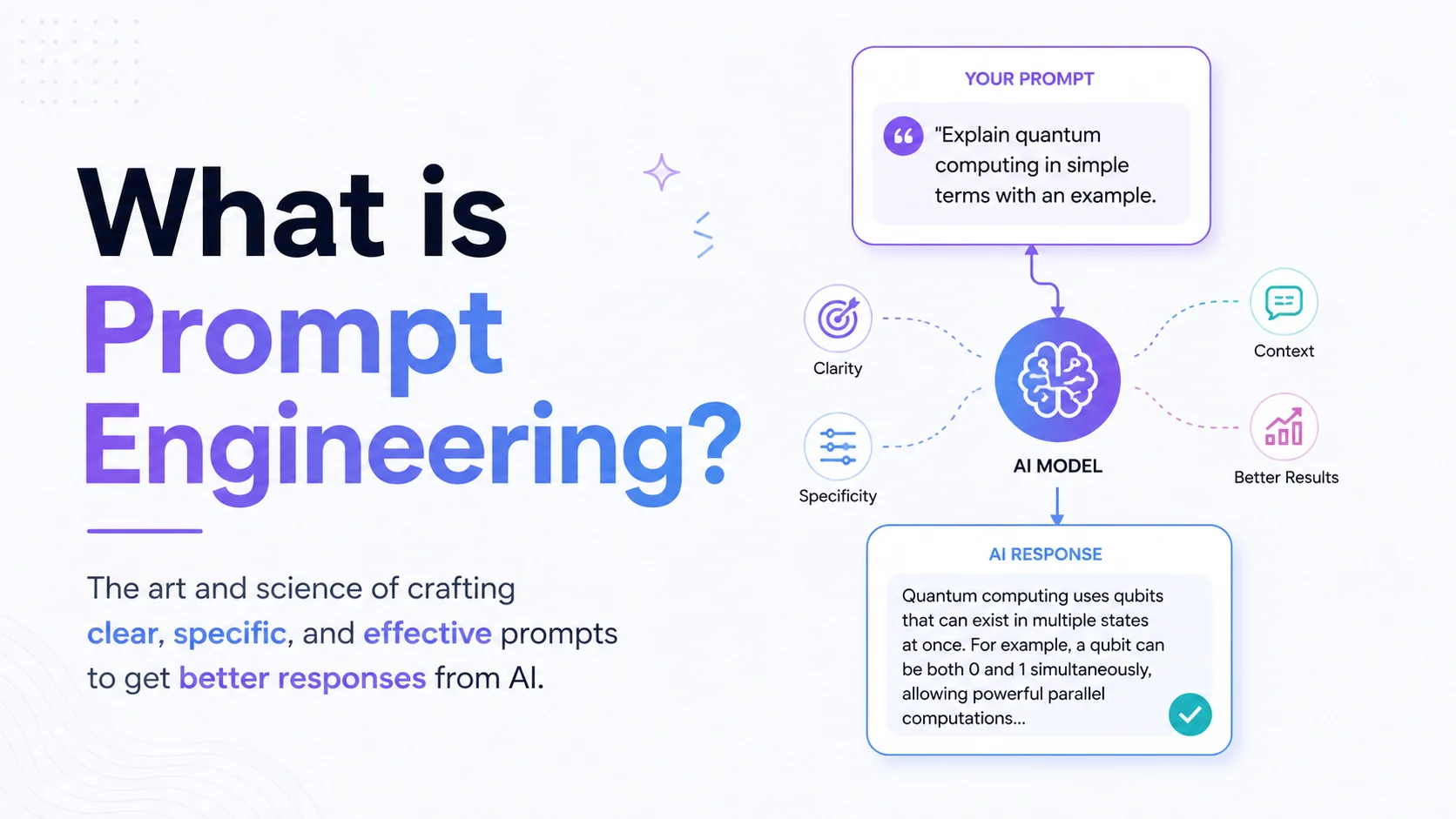
Have you ever wondered what prompt engineering is exactly? At its heart, it is the “art and science” of designing and optimizing instructions to guide generative AI models toward the best possible answers. Think of a “prompt” as the starting message, question, or code snippet you give the computer. The “engineering” part is the skill you use to refine and polish that message so the AI understands exactly what you want!
This skill is incredibly important for writing better AI prompts in tools like ChatGPT! Without clear directions, the AI might give you “sterile,” “shallow,” or even confusing results that do not help you at all. By using prompt engineering, you are essentially providing a “roadmap” for the AI to follow. It helps the model understand your true intent and even the small nuances of your request. This matters because good prompts lead to high-quality results, which saves you tons of time on editing later! It is truly the secret key to unlocking the full power of modern AI systems!
Prompt engineering is the process of creating clear and effective instructions so an AI can give you the most useful and accurate answers.
How It Works
It follows a simple three-step cycle!
- Output: The AI generates a finished response, such as text, code, or an image, based on your instructions!,.
- Input: You provide a specific prompt, question, or set of data to the model.
- AI Processing: The AI uses its complex “transformer architecture” and neural networks to grasp the intricacies of your language.
Why Prompt Engineering is Important
The importance of prompt engineering cannot be overstated because it is the “secret sauce” to getting high-quality work from AI! It directly influences how relevant and accurate the AI’s answers are. Without it, you are just guessing. With it, you ensure the AI understands your nuance and intent perfectly!
One of the best parts is how much it boosts AI productivity. By writing better prompts, you save massive amounts of time because you won’t have to spend hours fixing mistakes or rewriting shallow text! It also helps non-coders use AI to perform complex tasks, like generating code snippets or summarizing technical data, without needing to know a single line of programming! It is truly the bridge between a raw question and a meaningful, professional response!
To see the difference, let’s compare a “lazy” prompt with a “pro” prompt!
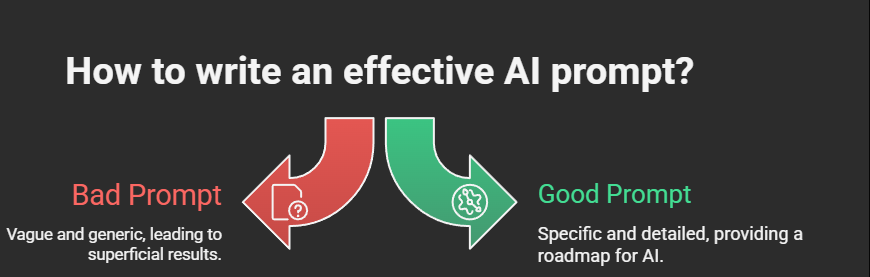
- Bad Prompt: “Write a text about marketing.” This is way too vague! The AI will likely give you a generic, superficial answer because it doesn’t know your audience, platform, or specific goal.
- Good Prompt: “Write a LinkedIn post about the advantages of content marketing for B2B SaaS companies, with a focus on long-term ROI.”
See the difference? The second prompt gives the AI a roadmap to follow, leading to a specific and highly useful result that you can actually use right away!
How Prompt Engineering Works (Step-by-Step)
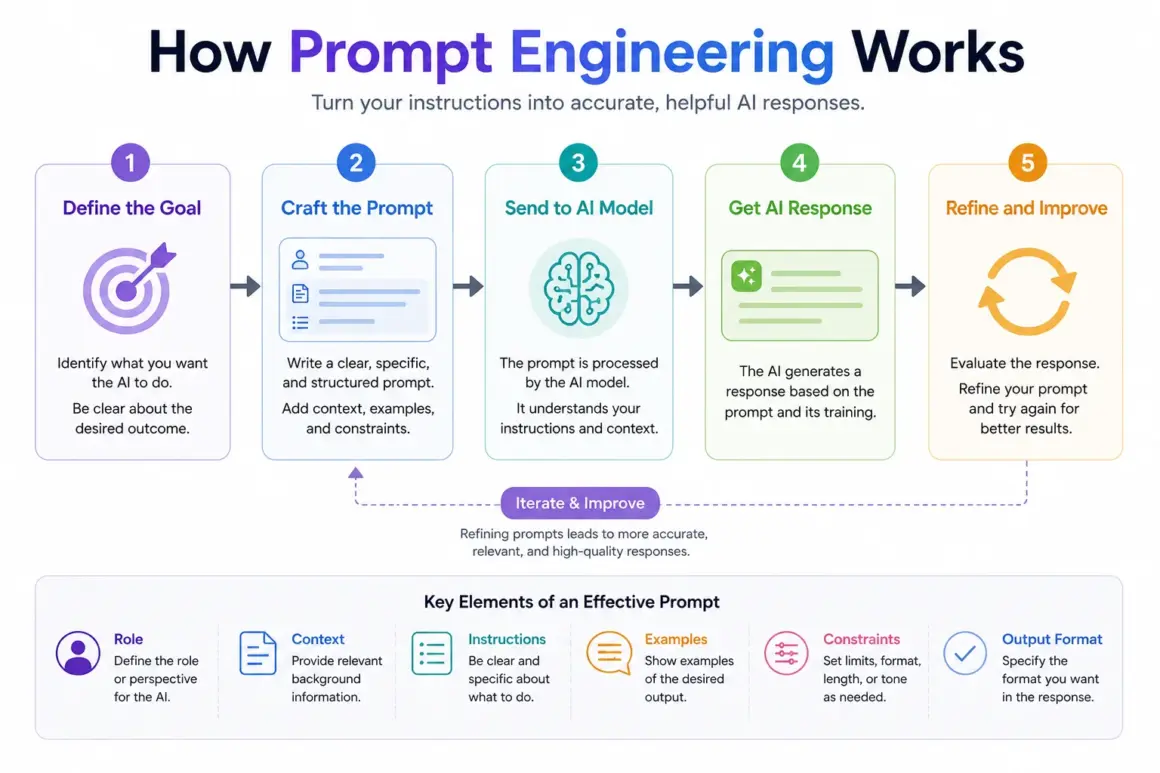
Mastering how to write prompts is not just a one-time task; it is a repeating cycle! Think of it as building a high-quality AI prompt structure that acts as a “roadmap” for the computer. If you follow these four simple steps, you will transform vague, boring answers into professional results every single time!
Step 1: Define Your Goal
The biggest mistake beginners make is being too vague! To get great results, you must know exactly what you want the AI to do before you even start typing. Set clear goals by using specific action verbs. For example, instead of just saying “write about marketing,” try saying “write a 500-word guide about social media for small business owners”. Being specific helps the AI understand your true intent and prevents shallow or off-topic answers.
Step 2: Give Clear Instructions
Once you have a goal, you need to provide direct instructions that tell the AI how to behave. This part of the AI prompt structure should always include your preferred format. Do you want the answer in a bulleted list, a professional table, or a simple step-by-step breakdown?. Specifying the format makes the information much more practical and easier for you to use right away!.
Step 3: Add Context
Context is like the “background story” for your request! You should provide relevant facts, data, or even a specific persona for the AI to adopt. For example, you can tell the AI to “act as a patient math tutor” to get an encouraging and simple tone. Adding context ensures the AI stays on track and provides the most relevant information possible for your specific situation.
Step 4: Iterate and Improve
Remember, the first answer is rarely perfect! Prompt engineering is a process where you refine and polish the output until it is exactly what you need. If the AI misses a step, simply provide a follow-up instruction to fix it. Even small changes in your wording or punctuation can lead to massive improvements in the final result!.
Types of Prompts in AI
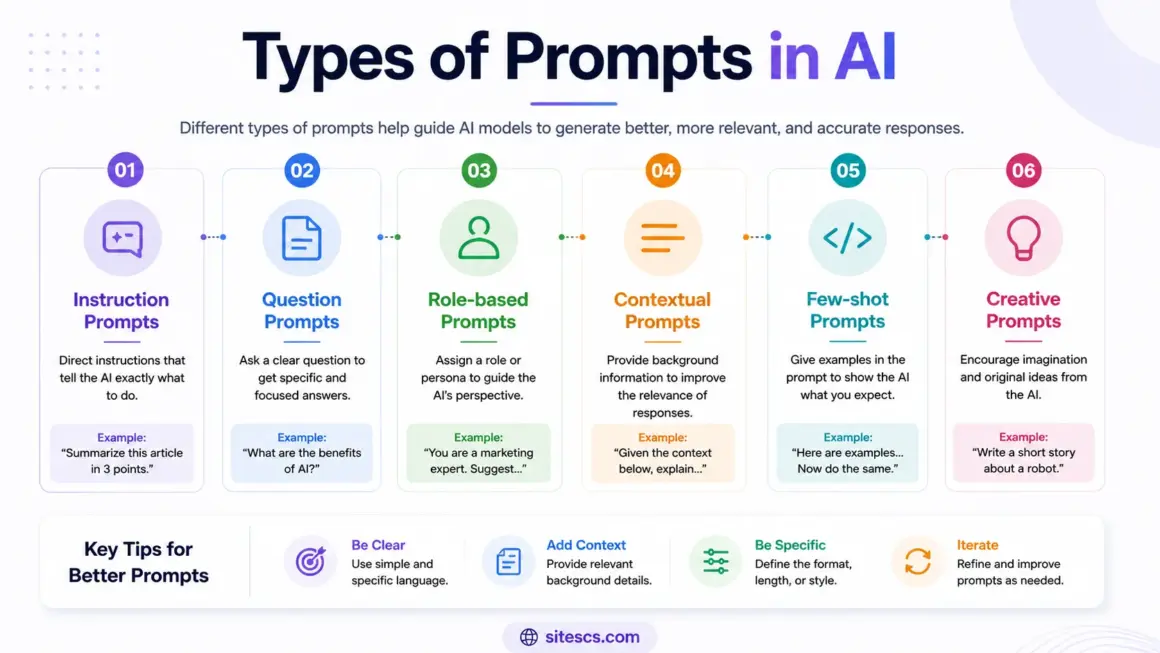
Understanding the different types of prompts is the first step to becoming a pro at using artificial intelligence! Because AI models are designed to generate specific outputs based on what you tell them, using the right AI prompt types ensures you get the most accurate and helpful results every time! Whether you need a simple answer, a creative story, or help solving a difficult math problem, there is a specific prompting style for every task!
1. Instruction-Based Prompts
These are direct commands where you tell the AI exactly what to do! Often called “instruction prompts” or “zero-shot prompts,” they involve giving a task without providing extra examples. While these are great for simple tasks like “Summarize this article,” they can sometimes produce “sterile” or very basic results if you don’t add enough detail!
2. Role-Based Prompts
Role-based prompts (also known as persona prompting) are incredibly powerful because they give the AI an identity!. By telling the AI to “act as a professional manager” or a “patient math tutor,” you are providing a cognitive filter that guides how it reasons and speaks! This technique adds a layer of personality and tone that makes the AI sound much more human and situational!.
3. Creative Prompts
If you want to write a poem, a short story, or a script, you should use creative prompts! These prompts guide the AI by specifying the genre, tone, and plot points you want to see. This helps the model use its vast training data to create engaging and original narratives that match your specific style!
4. Analytical Prompts
For tasks that require logic, you need analytical prompts! These often use “Question prompts” and “Chain-of-Thought” techniques to help the AI break down complex problems into smaller, intermediate steps!,. By asking the model to “show its work” or “reason step-by-step,” you can significantly improve its accuracy on math word problems and symbolic reasoning!
Best Prompt Engineering Techniques
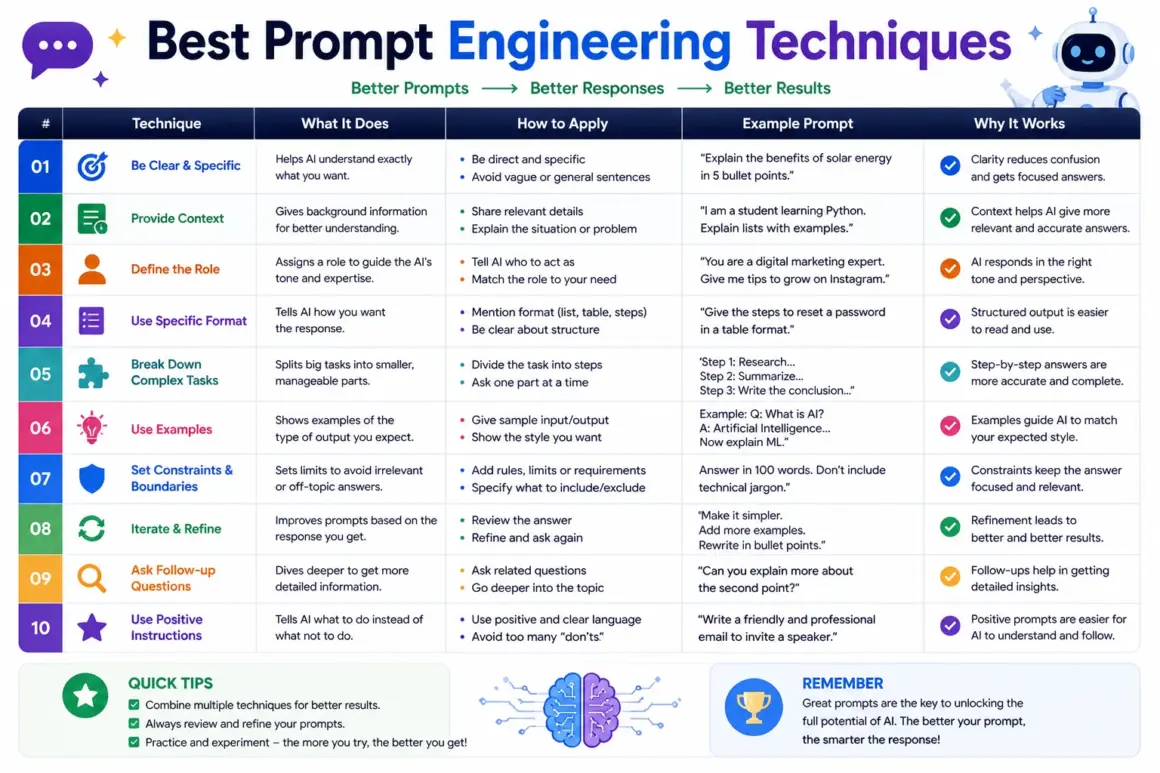
To get the most out of your AI, you need more than just a simple question! Prompt engineering techniques are the specialized strategies used to design and refine inputs so that generative AI can provide the most accurate and useful results. By using these AI prompt tips, you can bridge the gap between a raw query and a professional, high-quality response! These methods help the model understand the nuances of your request, such as the intended tone, logic, and format.
1. Role Prompting
Role prompting, also known as persona prompting, involves telling the AI exactly “who” it is supposed to be! By assigning a specific identity, such as a “professional manager” or a “cybersecurity analyst,” you provide a cognitive filter that guides how the AI reasons and speaks. This technique is incredibly powerful because it injects personality and situational reasoning into the text, preventing it from sounding “sterile” or generic! It ensures the AI sounds empathetic, calm, or formal depending on your needs.
2. Few-Shot Prompting
Few-shot prompting is the process of providing the AI with a few sample examples (or “shots”) to clarify exactly what you want it to do. Instead of just asking for a task, you provide several input-output pairs that demonstrate the desired style, tone, or level of detail. This helps the model learn the task “in-context” without needing any special technical retraining. However, be careful not to “over-prompt” by adding too many examples, as this can sometimes cause the AI’s performance to drop!
3. Step-by-Step Prompting
Also known as Chain-of-Thought (CoT) prompting, this method encourages the AI to break down complex problems into a series of intermediate reasoning steps. By asking the model to “show its work” or “reason step-by-step,” you can significantly improve its accuracy in areas like math and logical reasoning. This creates a “chain of reasoning” that mimics how a human would solve a multi-step problem. It is one of the most effective ways to solve difficult tasks that require deep logic!
4. Constraint-Based Prompting
To avoid vague or off-topic results, you must use constraint-based prompting! This means setting clear limits, such as defining the exact length, the target audience, and the preferred format of the output. You can use action verbs to specify exactly what you want, like “write a 500-word essay” or “provide a bulleted list”. Adding these constraints acts as a roadmap, steering the AI away from shallow answers and toward a precise, actionable result!
Prompt Engineering Examples
Seeing real-world prompt examples is the best way to understand how to talk to a computer! The basic rule is simple: high-quality prompts lead to high-quality results. If your ChatGPT prompts are too vague, the AI will give you boring or shallow answers. However, by adding a specific persona, goal, and format, you can unlock amazing content instantly!. Let’s look at how you can transform simple requests into professional masterpieces!
Example 1: Blog Writing
To get a great article, you must give the AI a “roadmap” to follow. Instead of just asking it to “write,” tell it who to be!.
- Weak Prompt: “Write a text about marketing.”
- Better Prompt: “Imagine you are a content marketing manager at an IT company! Write a guide for small businesses on how to automate email newsletter campaigns on a minimal budget.” By defining the audience and the specific problem, the AI provides much more useful and actionable advice.
Example 2: Social Media & Business Ideas
AI is fantastic for idea generation and creative storytelling. You can even use it to build a full business plan step-by-step!.
- Business Strategy: “First, create a marketing strategy for a brand that sells online courses.. Once that is done, suggest 10 catchy blog titles that target young adults!
- Image Generation: “Create a photorealistic image of a sunset over the ocean with palm trees silhouetted against a purple sky!” Specifying the tone and style helps the AI match your brand perfectly!.
Example 3: Coding Help
You don’t need to be a computer expert to get help with code generation. AI can write, translate, or even fix broken code for you!.
Code Debugging: “Debug the following Java code and explain why it is throwing an error!” Using these techniques saves massive amounts of time and makes complex tasks feel like a breeze!.
Code Completion: “Write a Python function to calculate the factorial of a given number.”
Common Mistakes in Prompt Engineering
Even the most tech-savvy users can run into AI prompt errors if they aren’t careful! Understanding these common prompt mistakes is the best way to ensure you get professional, high-quality results every single time!
One of the biggest traps is being too vague. If you give a general instruction like “Write a text about marketing,” the AI will provide a superficial and generic answer because it doesn’t have a specific roadmap to follow. You must be precise about your audience and goals to get something truly useful!
Another frequent error is ignoring context. If you don’t provide the “background story” or remind the AI of previous steps in a conversation, it can easily lose track and give irrelevant ideas. It is also a mistake to overcomplicate your prompts by cramming too many requests into one message. Asking for a strategy, ten blog titles, and a full article all at once can lead to chaotic and shallow results! In fact, some studies show that “over-prompting” with too many examples can paradoxically degrade the performance of certain AI models.
Finally, never forget the power of refining your outputs. It is a major mistake to assume the first answer is perfect! Prompt engineering is an iterative process, meaning you should always adjust and follow up on responses to guide the AI toward the best possible version. Avoid these traps, and you will see your productivity soar!
Tools That Use Prompt Engineering
There is an incredible list of AI tools available today that relies entirely on your ability to write great instructions! Whether you are writing a school essay or creating a digital painting, these prompt tools are designed to turn your words into reality instantly! Because every AI model is built a little differently, learning how to talk to each one is a vital skill for success!
ChatGPT is perhaps the most famous assistant in the world! It is a powerful tool that excels at summarizing long documents and writing complex computer code. If you want to create stunning art, Midjourney is a top choice! It uses a process called stable diffusion to turn your detailed text descriptions into high-quality, photorealistic images.
Gemini is another fan favorite because it can access up-to-date information through Google Search to help with your daily research. Meanwhile, Claude is a fantastic option for those who need high-speed results and flexible settings through professional APIs. Each of these tools has its own “personality,” so a prompt that works for one might need a little tweaking for another! Knowing which tool to use is the first step toward becoming a pro!
Prompt Engineering as a Career
Is prompt engineering a real job? Yes! It is currently one of the most exciting AI careers you can choose! As we move into 2026, the demand for people who can talk to AI is exploding across every industry. Companies are no longer just looking for “chatters”; they want specialized AI Agent Architects who can build complex, automated workflows. This has quickly turned into a high-paying, prestigious profession because it bridges the gap between raw technology and real-world business solutions.
The best part is the variety of opportunities available! You don’t just have to work for big tech companies; there are incredible freelancing opportunities! You can help startups or small businesses automate their daily tasks even if they have a low computing budget. Because these skills are so new and rare, the salary potential for experts is very high!
But what do you actually need to learn to succeed? To land the best prompt engineering jobs, you need a mix of creative and technical skills:
- LLM Knowledge: You must understand how models like ChatGPT or Gemini think and where they might fail.
- Language Mastery: Every word counts! You need a deep grasp of vocabulary, nuance, and phrasing.
- Technical Basics: Knowing Python is now a baseline for connecting AI models to the real world.
- Creativity: You need to design innovative prompts that solve unique and difficult problems.
If you love technology and clear communication, this is the perfect time to start your journey!
FAQs: Frequently Asked Questions
What is prompt engineering in simple words?
Prompt engineering is the art and science of designing and optimizing instructions, known as prompts, to guide AI models like ChatGPT or Gemini toward the best possible results. You can think of it as providing a roadmap for the AI, steering it to understand your true intent and speak in the right tone. It is the process of refining inputs to achieve more accurate, controlled, and meaningful outputs without needing to retrain the underlying model.
Do I need coding skills for prompt engineering?
While you can start prompt engineering with no technical knowledge by simply using creativity and trial and error, the requirements are changing. By 2026, Python for AI has become a baseline skill for professionals because it is the “glue” that connects AI models to real-world tools and data. High-level roles now require an understanding of orchestration frameworks and data structures to automate complex workflows.
How can beginners learn prompt engineering?
Beginners should start by iteratively testing and refining their questions, observing how small changes in wording or punctuation affect the AI’s response. It is essential to master fundamental strategies like Zero-shot, Few-shot, and Chain-of-Thought prompting. In the 2026 landscape, a solid roadmap for beginners includes learning Python basics and focusing on agentic system design rather than just memorizing lists of “best prompts”.
What are examples of prompt engineering?
- Zero-shot Prompting: Giving a direct command without any examples, such as “Summarize this article”.
- Few-shot Prompting: Providing the AI with sample input-output pairs to demonstrate the exact style or format you want.
- Persona Prompting: Telling the AI to act as a specific character, such as a “patient math tutor” or a “cybersecurity analyst,” to change its perspective and tone.
- Chain-of-Thought (CoT): Instructions that ask the AI to “reason step-by-step” to solve difficult logic or math problems.
Is prompt engineering a good career in 2026?
Yes, it is a high-paying and prestigious profession, but it has evolved into a more technical role called an AI Agent Architect. By 2026, simple prompt engineering is considered a basic digital literacy skill, much like using a search engine. The real career growth is in orchestration, where experts manage a “swarm” of specialized models and build autonomous agentic workflows that can perform real-world actions independently.