How AI Prompts Work: Complete Guide for Beginners (2026)
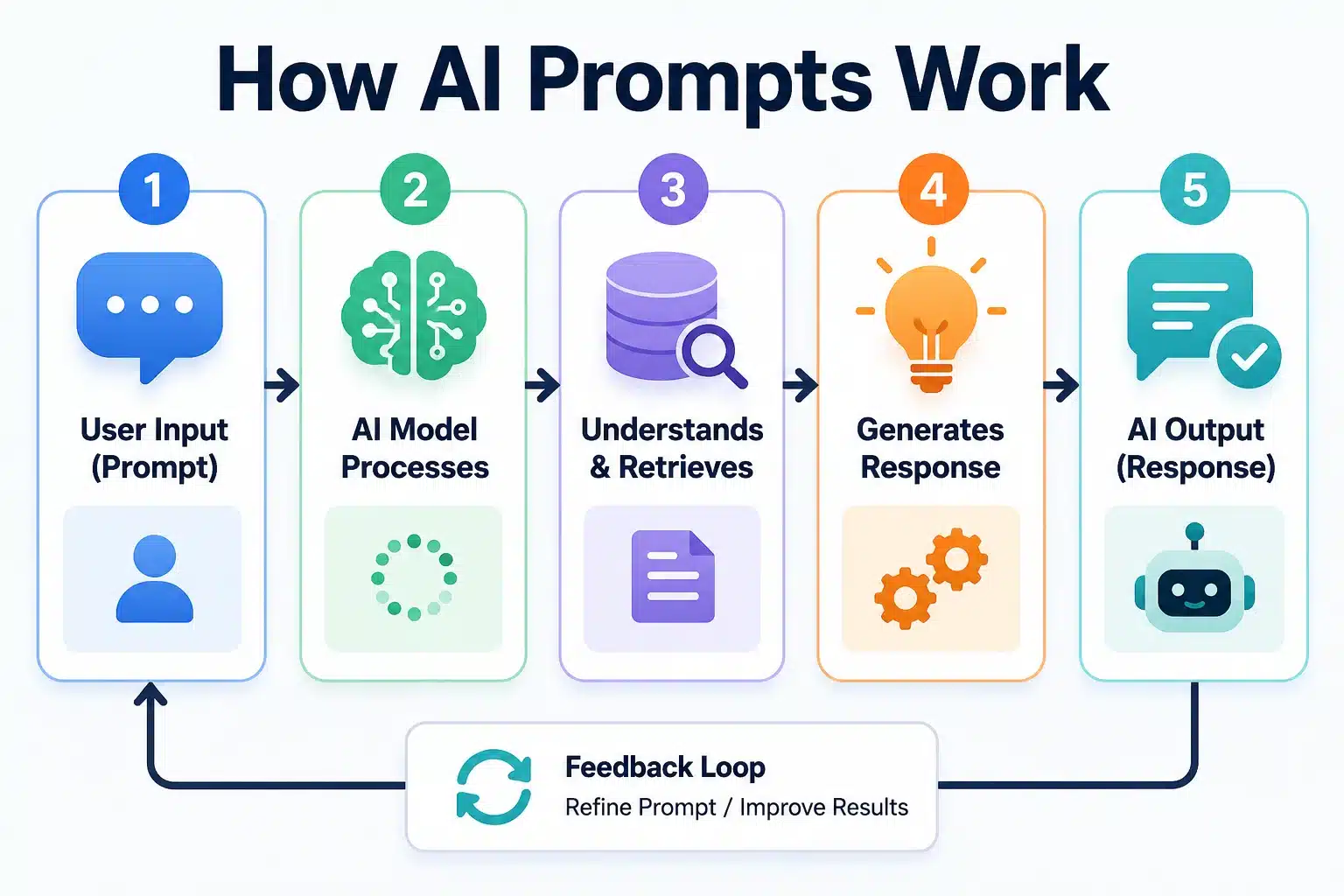
Artificial Intelligence is changing how people write, search, learn, design, code, and even run businesses. But behind every amazing AI response, there is one important thing working quietly in the background — the prompt.
A prompt is simply the instruction you give to an AI system. It can be a question, command, paragraph, or even a conversation. The quality of the prompt often decides the quality of the answer. That is why understanding how AI prompts work has become one of the most valuable digital skills today!
Table of Contents
- What Are AI Prompts?
- How AI Prompts Actually Work
- What Is Prompt Engineering?
- Types of AI Prompts
- Why Good Prompts Matter
- Good Prompt vs Bad Prompt Comparison
- Components of a Powerful AI Prompt
- How AI Understands Human Language
- What Are Tokens in AI?
- Common AI Prompting Techniques
- Real-World Uses of AI Prompts
- Common Mistakes People Make With AI Prompts
- How to Write Better AI Prompts
- Benefits of Learning AI Prompting
- Limitations of AI Prompts
- Future of AI Prompting
- Key Takeaways
- Frequently Asked Questions (FAQs)
- Final Thoughts
Whether you use AI tools for blogging, content writing, coding, marketing, education, research, or automation, learning prompts can save time and improve results dramatically.
In this complete guide, you will learn:
- What AI prompts are
- How prompts work inside AI systems
- Different types of prompts
- Prompt engineering explained simply
- Good vs bad prompt examples
- How AI understands language
- Common mistakes to avoid
- Future of AI prompting
- Best practices for beginners and professionals
Let’s start from the basics!
What Are AI Prompts?
AI prompts are instructions or inputs given to an artificial intelligence model to generate a response.
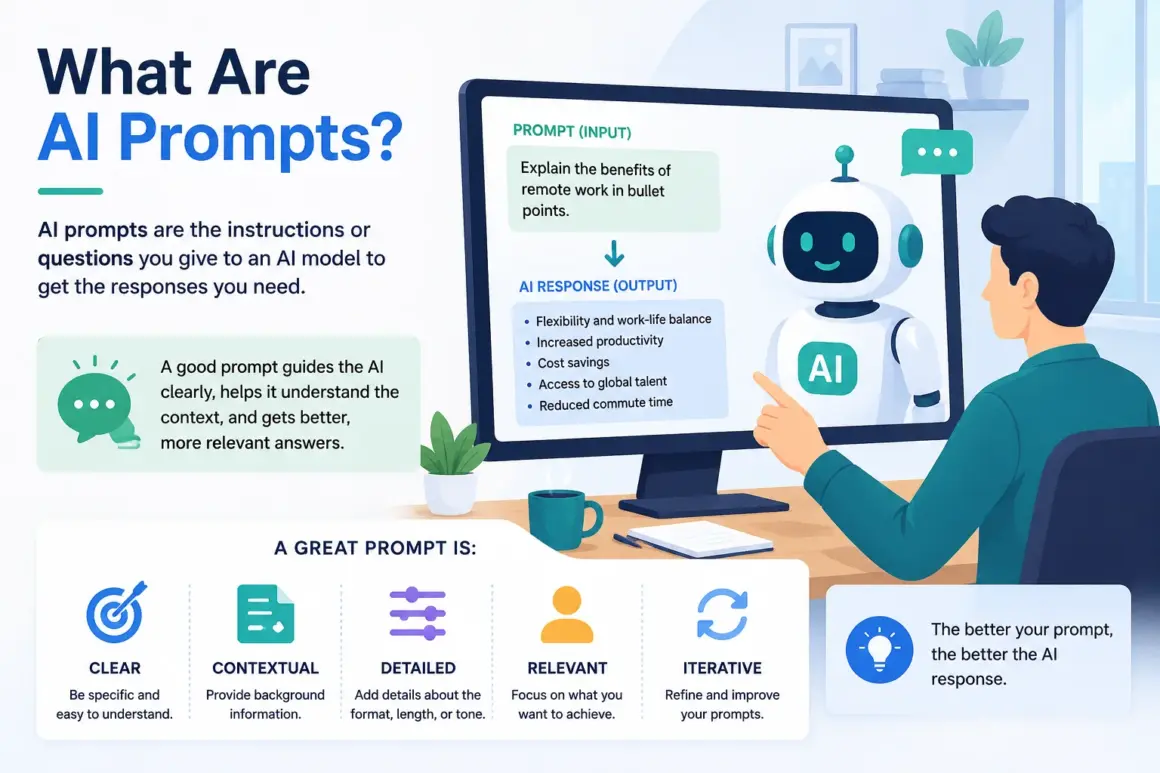
In simple words, a prompt tells AI what you want.
For example:
- “Write a blog post about fitness.”
- “Explain blockchain in simple language.”
- “Create a professional email.”
- “Generate Python code for a calculator.”
These are all prompts.
The AI reads your instruction, analyzes the meaning, predicts the most relevant response, and generates output based on patterns learned during training.
Think about AI like a highly advanced assistant. If your instruction is clear, the result is usually better. If your instruction is confusing, the response may also become confusing.
- Why Your AI Prompts Are Failing (The 7 Mistakes Everyone Makes)
- Prompt Engineer Salary 2026: How Much Can You Really Earn?
- 100 Best ChatGPT Prompts That Actually Work (With Examples)
- Prompt Engineering Guide: Learn AI Prompting Step-by-Step (2026)
- What is chain-of-thought prompting
That is why prompt quality matters a lot!
How AI Prompts Actually Work
AI prompts work through Large Language Models (LLMs). These models are trained using billions of words from books, websites, articles, forums, and other text sources.
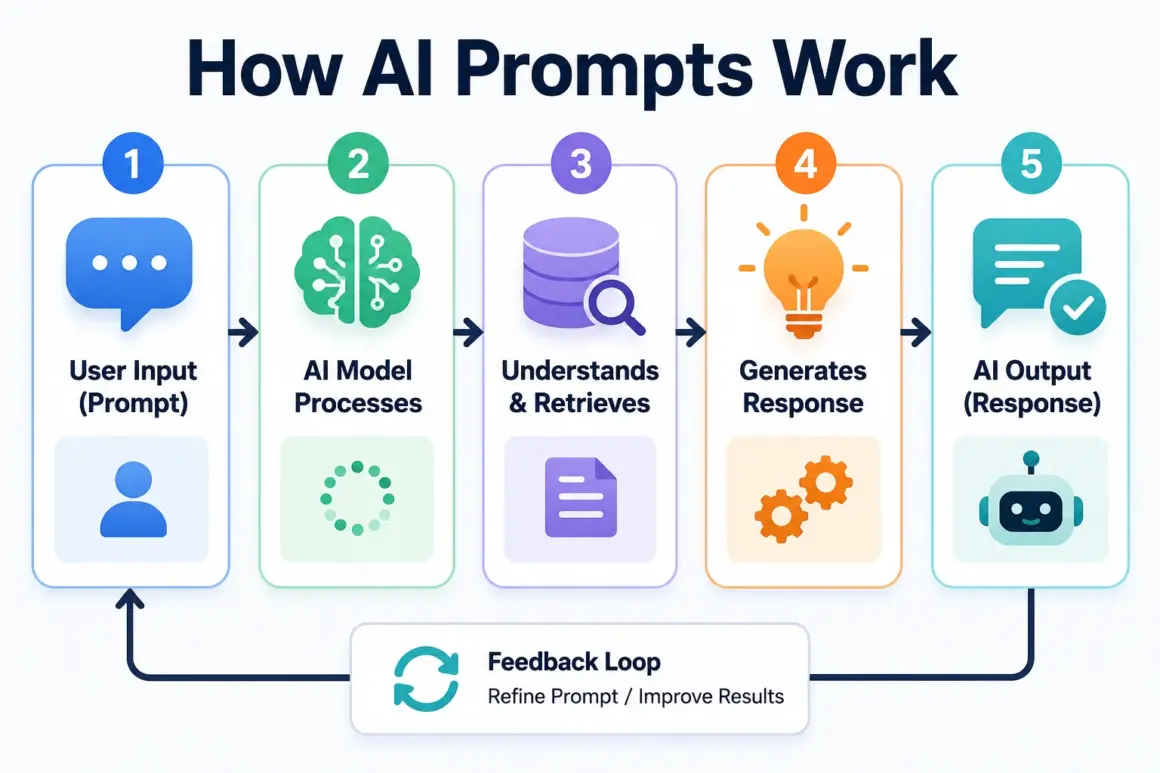
When you enter a prompt, the AI does not “think” like humans. Instead, it predicts the most likely next words based on patterns it learned during training.
Simple Workflow of AI Prompts
1. User Gives a Prompt
You type an instruction like:
“Write a motivational speech for students.”
The AI receives this input as text data.
2. AI Breaks the Prompt Into Tokens
AI converts your sentence into smaller units called tokens.
For example:
- Write
- motivational
- speech
- students
The AI analyzes these tokens to understand context and meaning.
3. Language Model Processes Context
The AI checks:
- Topic
- Tone
- Intent
- Style
- Context
- Relationships between words
This helps the system understand what type of response is expected.
4. AI Predicts the Best Response
The model predicts words one after another until a complete answer is generated.
This happens within seconds!
What Is Prompt Engineering?
Prompt engineering is the process of designing prompts carefully to get better AI results.
It involves:
- Choosing clear instructions
- Adding context
- Defining tone
- Setting output format
- Giving examples
- Using constraints
Prompt engineering helps AI produce:
- More accurate answers
- Better creativity
- Structured responses
- Fewer mistakes
- More useful outputs
Today, prompt engineering is becoming an important skill in:
- Content writing
- AI automation
- Software development
- Marketing
- Education
- Research
- Customer support
Many companies now hire prompt engineers because AI tools are becoming part of daily work!
Types of AI Prompts
AI prompts come in different forms depending on the task.
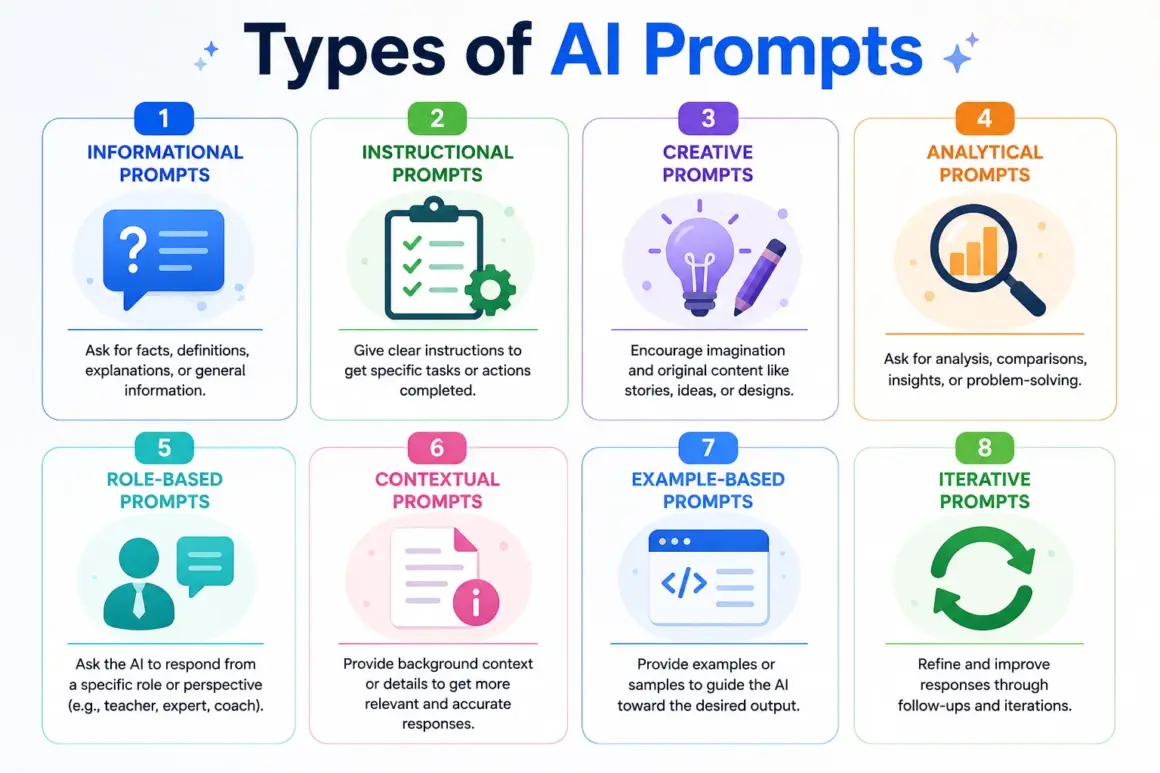
1. Instruction Prompts
These directly tell the AI what to do.
Example:
“Write a 500-word article about climate change.”
This is the most common prompt type.
2. Question Prompts
These ask AI a question.
Example:
“What is machine learning?”
AI generates an informative answer.
3. Conversational Prompts
These create a chat-style interaction.
Example:
“Act as a career coach and help me prepare for interviews.”
This style is popular in AI chatbots.
4. Role-Based Prompts
These assign a role to AI.
Example:
“You are an expert SEO writer.”
Role prompting improves response quality because the AI understands the expected expertise level.
5. Creative Prompts
Used for storytelling, scripts, poems, and creative work.
Example:
“Write a science fiction story about robots on Mars.”
These prompts encourage imagination and creativity.
Why Good Prompts Matter
A strong prompt can completely change AI output quality.
Poor prompts often produce:
- Generic responses
- Wrong information
- Short answers
- Unclear structure
- Irrelevant content
Good prompts usually generate:
- Detailed responses
- Better accuracy
- Professional formatting
- Human-like writing
- Higher relevance
This is why experienced AI users spend time refining prompts carefully.
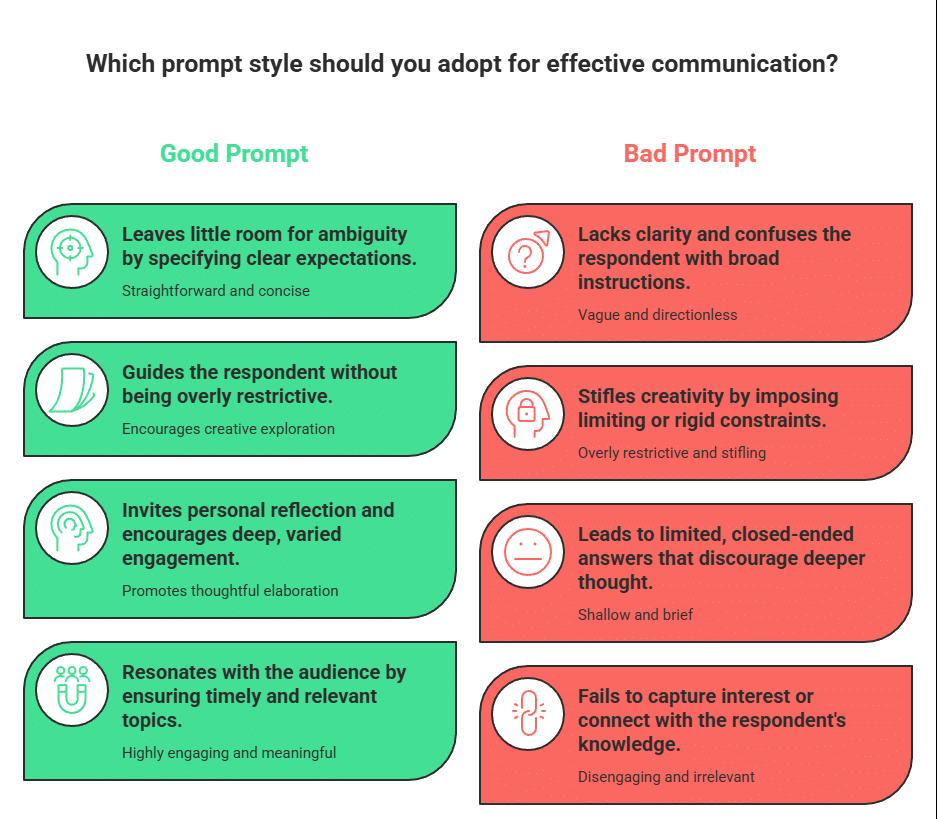
Good Prompt vs Bad Prompt Comparison
| Bad Prompt | Good Prompt |
|---|---|
| Write about AI | Write a beginner-friendly 1000-word article explaining how AI works with examples |
| Create email | Write a formal business email requesting project approval |
| Explain marketing | Explain digital marketing in simple English for beginners with examples |
| Make blog | Write an SEO-optimized blog post on healthy eating tips |
The second prompts are better because they provide:
- Clarity
- Purpose
- Audience
- Tone
- Output expectations
Components of a Powerful AI Prompt
A high-quality AI prompt usually contains several important elements.
1. Clear Objective
Tell the AI exactly what you want.
Bad:
“Tell me something about business.”
Better:
“Explain how small businesses use AI for customer service.”
2. Context
Context improves understanding.
Example:
“Write for beginners who have no technical knowledge.”
Now the AI knows the audience level.
3. Tone and Style
You can control writing style.
Examples:
- Professional
- Friendly
- Casual
- Technical
- Persuasive
- Funny
4. Output Format
Specify formatting requirements.
Example:
“Use bullet points and headings.”
This creates organized content.
5. Constraints
Set limits or conditions.
Example:
- “Use simple English.”
- “Keep under 500 words.”
- “Avoid technical jargon.”
These improve readability.
How AI Understands Human Language
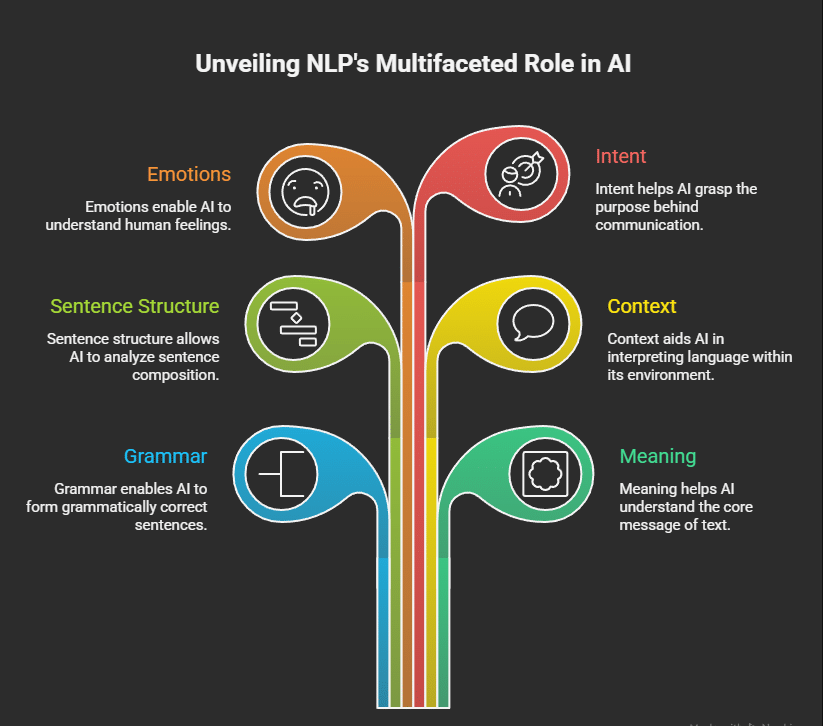
AI models use Natural Language Processing (NLP) to interpret language.
NLP helps AI understand:
- Grammar
- Meaning
- Sentence structure
- Context
- Emotions
- Intent
For example, humans understand that:
“Apple” can mean a fruit or a company.
AI uses context to determine the correct meaning.
That is why context inside prompts matters greatly.
What Are Tokens in AI?
Tokens are small text units AI uses for processing.
A token may be:
- A word
- Part of a word
- Symbol
- Number
For example:
“Artificial Intelligence is powerful”
Could become multiple tokens internally.
AI systems process tokens instead of complete sentences.
The number of tokens affects:
- Response length
- Memory
- Processing cost
- Context understanding
This is why some AI tools have token limits.
Common AI Prompting Techniques
Different prompting techniques improve results in different situations.
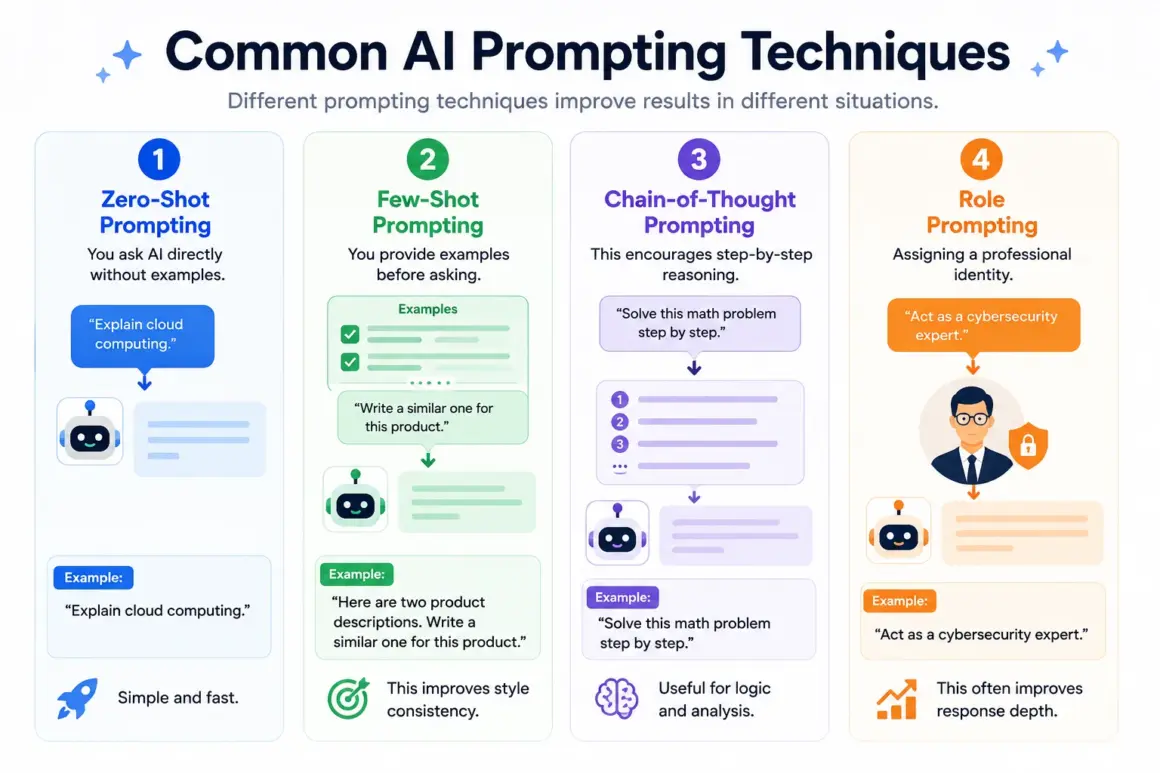
1. Zero-Shot Prompting
You ask AI directly without examples.
Example:
“Explain cloud computing.”
Simple and fast.
2. Few-Shot Prompting
You provide examples before asking.
Example:
“Here are two product descriptions. Write a similar one for this product.”
This improves style consistency.
3. Chain-of-Thought Prompting
This encourages step-by-step reasoning.
Example:
“Solve this math problem step by step.”
Useful for logic and analysis.
4. Role Prompting
Assigning a professional identity.
Example:
“Act as a cybersecurity expert.”
This often improves response depth.
Real-World Uses of AI Prompts
AI prompts are used everywhere today.
Content Creation
Writers use prompts for:
- Blogs
- Social media posts
- Scripts
- Product descriptions
- Emails
Coding Assistance
Developers use prompts to:
- Generate code
- Debug software
- Explain functions
- Build apps
Education
Students and teachers use AI for:
- Notes
- Explanations
- Summaries
- Study guides
Business Automation
Companies use prompts for:
- Customer support
- AI chatbots
- Data analysis
- Reports
- Marketing
Design and Creativity
AI prompts help create:
- Images
- Videos
- Music
- Presentations
- Logos
Common Mistakes People Make With AI Prompts
Many beginners make prompting mistakes that reduce output quality.
1. Being Too Vague
Bad:
“Write something interesting.”
The AI lacks direction.
2. Giving Too Much Confusing Information
Overloading prompts can confuse AI.
Keep prompts focused and organized.
3. Ignoring Audience Type
Content for experts differs from content for beginners.
Always define your audience.
4. Not Specifying Format
Without formatting instructions, responses may become messy.
5. Expecting Perfect Accuracy
AI can still make mistakes or generate incorrect information.
Always fact-check important outputs.
How to Write Better AI Prompts
Here are practical ways to improve your prompts immediately.
Be Specific
Specific prompts produce better outputs.
Instead of:
“Write article.”
Use:
“Write a 1200-word SEO article about remote work productivity tips.”
Context helps AI understand purpose.
Example:
“Write for small business owners.”
Use Step-by-Step Instructions
Breaking tasks into steps improves clarity.
Mention Tone
Examples:
- Friendly
- Formal
- Expert
- Conversational
Ask for Structured Output
Example:
“Use headings, bullet points, and FAQs.”
Benefits of Learning AI Prompting
Prompting is becoming an extremely valuable digital skill.
Saves Time
AI can complete tasks faster with good prompts.
Improves Productivity
Writers, marketers, developers, and students can work more efficiently.
Enhances Creativity
AI can generate fresh ideas instantly.
Helps Businesses Scale
Companies automate repetitive tasks using AI prompts.
Future Career Opportunities
Prompt engineering is becoming a new professional field.
Limitations of AI Prompts
AI prompting is powerful, but not perfect.
AI Can Hallucinate
Sometimes AI generates incorrect information confidently.
Depends on Prompt Quality
Weak prompts produce weak outputs.
Limited Real Understanding
AI predicts patterns but does not truly “understand” like humans.
Bias Issues
AI models may reflect biases from training data.
Requires Human Review
Critical content should always be checked manually.
Future of AI Prompting
AI prompting is evolving rapidly.
In the future, prompts may include:
- Voice commands
- Images
- Videos
- Emotions
- Multimodal instructions
AI systems are also becoming better at understanding natural conversation.
Eventually, prompting may become more intuitive and human-like. Instead of carefully engineered prompts, users may simply talk naturally to AI assistants.
Still, people who understand prompting deeply will continue to have a huge advantage!
Key Takeaways
Here are the most important things to remember:
- AI prompts are instructions given to AI systems
- Better prompts create better outputs
- Prompt engineering improves response quality
- AI uses tokens and NLP to process prompts
- Context and clarity matter greatly
- Different prompting techniques serve different goals
- AI prompting is useful across industries
- Human review remains important
- Prompting is becoming a valuable future skill
Frequently Asked Questions (FAQs)
What is an AI prompt?
An AI prompt is a text instruction or question given to an AI system to generate a response.
Why are prompts important in AI?
Prompts guide AI behavior. Better prompts improve accuracy, relevance, and quality of responses.
What is prompt engineering?
Prompt engineering is the process of designing effective prompts to get better AI outputs.
Can AI prompts improve SEO content?
Yes! Well-structured prompts help generate organized, keyword-rich, SEO-friendly content.
Do AI prompts always produce correct answers?
No. AI can make mistakes or generate inaccurate information. Human verification is important.
What skills are needed for prompt engineering?
Important skills include:
- Clear communication
- Logical thinking
- Creativity
- AI understanding
- Language structuring
Final Thoughts
AI prompts are the foundation of modern AI interaction. Every AI-generated article, image, code snippet, or chatbot reply begins with a prompt.
Learning how prompts work gives you more control over AI systems. It helps you generate smarter outputs, save time, improve productivity, and unlock new opportunities in the AI-powered world.
The best part?
You do not need advanced technical knowledge to start. Even simple improvements in prompt writing can dramatically improve AI responses!
As AI becomes more integrated into everyday life, prompting will become one of the most important digital communication skills of the future.


