How to Master Prompt Engineering Fast
Artificial Intelligence is changing the way people work, learn, and create content. Whether you use AI tools for writing, coding, marketing, research, or business tasks, one skill can dramatically improve your results: Prompt Engineering.
Many people think getting great AI responses is difficult. The truth is much simpler. If you know how to communicate clearly with AI, you can get more accurate, useful, and professional results within seconds.
In this guide, you will learn what prompt engineering is, how it works, why it matters, and the fastest ways to master prompt engineering, even if you are a complete beginner.
Prompt Engineering: The practice of designing and optimizing prompts to improve the quality, accuracy, and relevance of AI-generated responses.
Think of AI as a highly intelligent assistant. The better your instructions are, the better the results will be.
Simple Example
Weak Prompt:
“Write about marketing.”
Strong Prompt:
“Write a 500-word beginner-friendly article about digital marketing. Include benefits, common strategies, and practical examples. Use simple English.”
The second prompt provides more context and direction, which leads to a much better response.
Why Prompt Engineering Matters
Prompt engineering is becoming one of the most valuable skills in the AI era.
When you learn how to create effective prompts, you can:
- Generate higher-quality content
- Save time and effort
- Improve productivity
- Get more accurate answers
- Create better marketing campaigns
- Produce better code and technical solutions
- Improve AI-generated images and designs
The difference between average and excellent AI output often comes down to the quality of the prompt.
How Prompt Engineering Works
Understanding the basic process makes learning much easier.
When you enter a prompt:
- AI analyzes your instructions.
- It identifies context and intent.
- It predicts the most relevant response.
- It generates output based on patterns learned from training data.
The more specific your instructions are, the easier it becomes for AI to understand what you want.
The Formula for Better Prompts
A high-quality prompt usually contains:
- Goal
- Context
- Instructions
- Format
- Audience
Example
Instead of saying:
“Explain SEO.”
Try:
“Explain SEO to a beginner in simple English. Use examples and bullet points. Keep the explanation under 500 words.”
This small improvement can significantly enhance the output.
Prompt Engineering vs Traditional Search
Many beginners use AI the same way they use search engines.
| Traditional Search | Prompt Engineering |
|---|---|
| Finds information | Generates customized responses |
| Uses keywords | Uses detailed instructions |
| Returns existing pages | Creates new content |
| Limited interaction | Interactive conversation |
| Static results | Dynamic results |
Prompt engineering allows you to guide AI toward specific outcomes rather than simply finding information.
Essential Skills to Master Prompt Engineering Fast
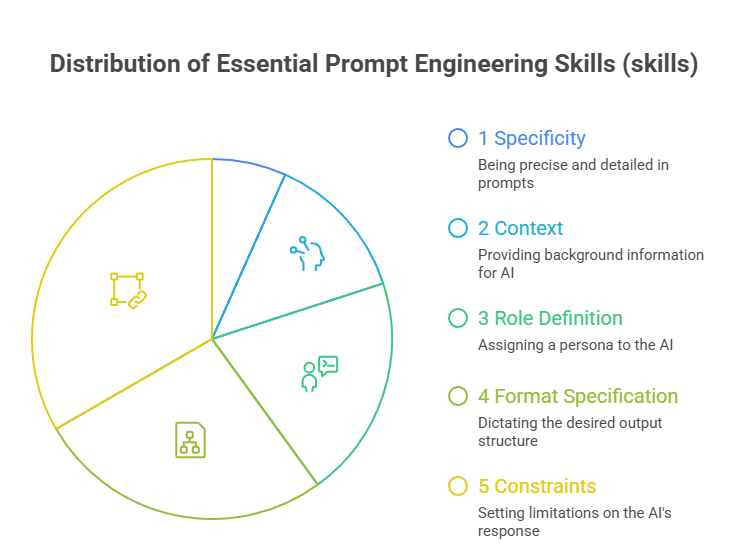
To become skilled quickly, focus on the following core techniques.
1. Learn to Be Specific
Specific prompts almost always outperform vague prompts.
Instead of:
“Write a blog.”
Use:
“Write a 1000-word blog post about email marketing for small businesses. Use simple language and practical examples.”
Specificity improves clarity and output quality.
2. Provide Context
AI performs better when it understands the situation.
Example:
“I run a small online store. Suggest five email marketing strategies to increase customer retention.”
The added context helps generate more relevant suggestions.
3. Define the Role
One of the most powerful techniques is assigning a role.
Example:
“Act as an SEO expert and create a keyword strategy for a new fitness website.”
This tells AI how to approach the task.
4. Specify the Format
Tell AI exactly how you want the response.
Examples:
- Bullet points
- Table format
- Step-by-step guide
- Blog post
- Checklist
- FAQ section
The clearer the format, the more usable the output becomes.
5. Set Constraints
Constraints help control the response.
Examples:
- Use simple English.
- Keep under 500 words.
- Include five examples.
- Avoid technical jargon.
These instructions improve consistency.
The Best Prompt Structure for Beginners
A simple framework can dramatically improve your results.
Goal + Context + Instructions + Format
Example:
“Create a beginner-friendly guide about content marketing for small business owners. Explain the benefits, common mistakes, and best practices. Use simple language and bullet points.”
This framework works for almost every AI task.
Read Also:
- Why Your AI Prompts Are Failing (The 7 Mistakes Everyone Makes)
- What is Prompt Engineering? Beginner Guide with Examples
- What is LLM in AI? Explained Simply
- What is Generative Ai? Explained
- What is chain-of-thought prompting
Common Prompt Engineering Techniques
Professional users often rely on these proven methods.
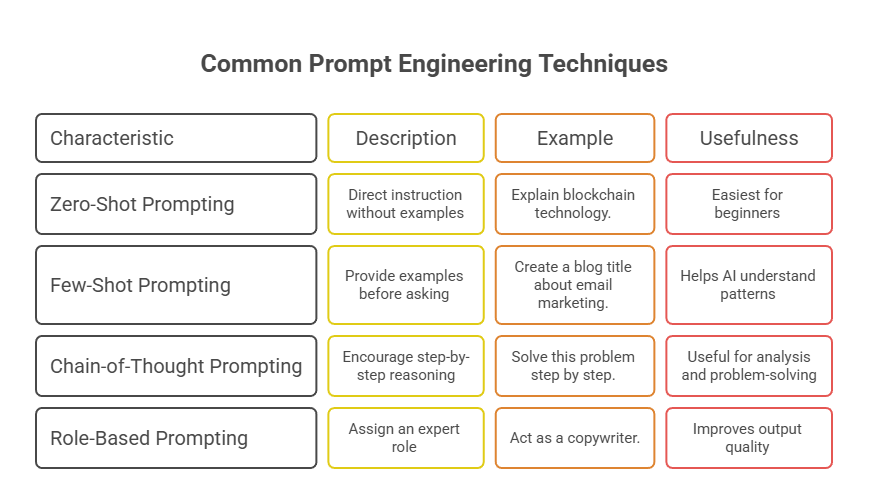
1. Zero-Shot Prompting
The AI receives a direct instruction without examples.
Example:
“Explain blockchain technology in simple terms.”
This is the easiest technique for beginners.
2. Few-Shot Prompting
You provide examples before asking for a result.
Example:
Example Title:
“10 SEO Tips for Beginners”
Example Title:
“7 Content Marketing Strategies That Work”
Now create a similar blog title about email marketing.
This helps AI understand the pattern you want.
3. Chain-of-Thought Prompting
This technique encourages step-by-step reasoning.
Example:
“Solve this problem step by step and explain your reasoning.”
It is particularly useful for analysis, coding, and problem-solving tasks.
4. Role-Based Prompting
Assigning an expert role often improves output quality.
Example:
“Act as a professional copywriter and create a persuasive product description.”
Many experienced AI users rely on this method daily.
Common Mistakes That Slow Down Learning
Avoiding these mistakes will help you master prompt engineering faster.
1. Using Very Short Prompts
Short prompts often produce generic responses.
Provide enough detail to guide the AI effectively.
2. Giving Conflicting Instructions
Avoid prompts like:
“Write a detailed article under 100 words.”
Conflicting requirements confuse the model.
3. Ignoring Audience
Always specify who the content is for.
Examples:
- Beginners
- Students
- Business owners
- Developers
- Marketers
Audience information improves relevance.
4. Not Testing Variations
Prompt engineering is an iterative process.
Small changes can produce significantly better results.
Experiment and compare outputs.
Practical Examples of Effective Prompts
For Content Writing
“Act as an experienced blog writer. Create a 1000-word article about social media marketing for beginners. Use simple English, headings, and practical examples.”
For SEO
“Act as an SEO specialist. Generate 20 long-tail keywords related to email marketing with low competition and high search intent.”
For Coding
“Act as a senior Python developer. Explain this code line by line and suggest improvements.”
For Business
“Act as a business consultant. Create a 30-day growth strategy for a new online store with a limited budget.”
These examples can be adapted for countless situations.
Tools That Can Help You Learn Faster
Several AI platforms allow you to practice prompt engineering skills.
Popular options include:
Using different platforms helps you understand how prompts perform across various AI models.
How Long Does It Take to Master Prompt Engineering?
The basics can be learned within a few days.
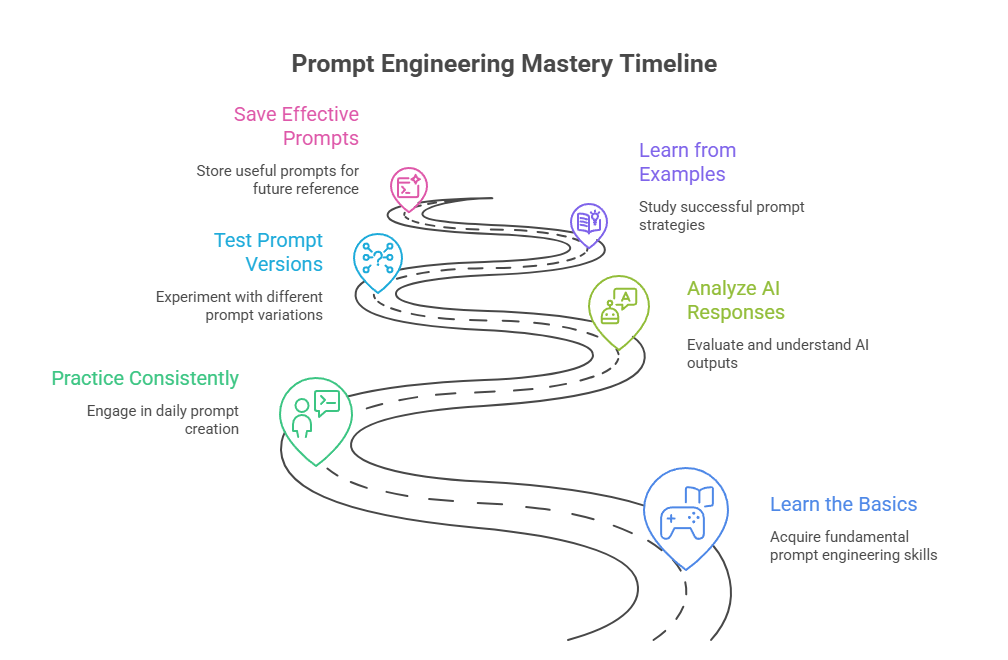
Most people become comfortable with prompt creation after a few weeks of consistent practice.
To accelerate your progress:
- Practice daily
- Analyze AI responses
- Test multiple prompt versions
- Learn from successful examples
- Save effective prompts for future use
Like any skill, improvement comes through repetition and experimentation.
Final Thoughts
Prompt engineering is one of the most practical and valuable AI skills available today. The good news is that you do not need a technical background to get started.
To master prompt engineering fast, focus on writing clear instructions, providing context, defining goals, and experimenting with different prompt structures. Small improvements in your prompts can lead to dramatically better AI-generated results.


