What is LLM in AI? Explained Simply
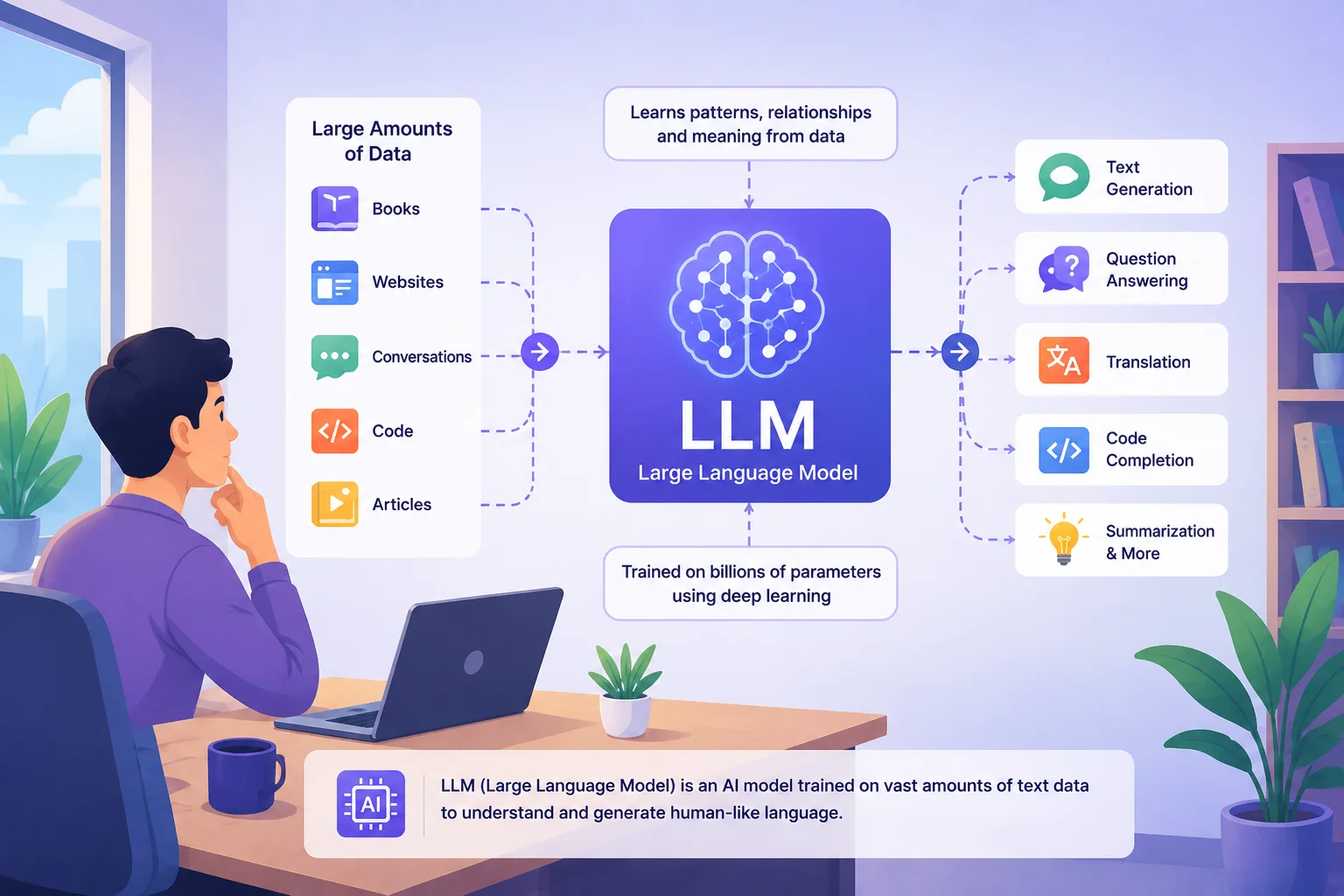
Artificial Intelligence is changing the world very fast! From smart chatbots to AI writing tools, people everywhere are talking about one big technology called LLM. Tools like ChatGPT, AI assistants, and automated customer support systems are becoming more popular every day. But many beginners still ask one simple question — What is LLM in AI?
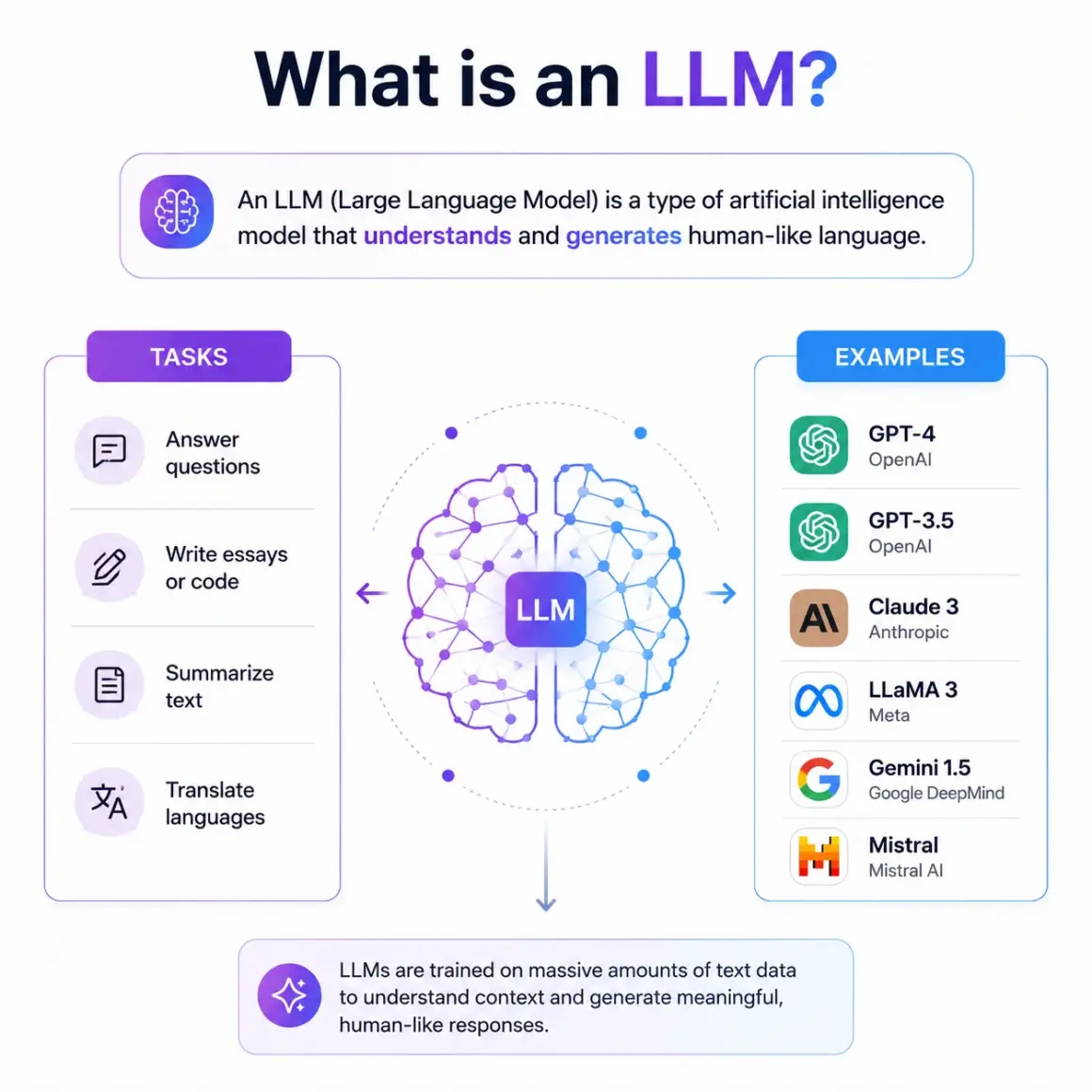
LLM stands for Large Language Model. It is a type of AI model that can understand, generate, and respond to human language in a natural way. In simple words, LLMs are trained using huge amounts of text data so they can read, write, answer questions, summarize content, translate languages, and even help in coding!
Today, LLMs are one of the biggest reasons behind the AI revolution. Businesses, students, bloggers, developers, and marketers are using them to save time and improve productivity. From content creation to customer service, LLMs are transforming almost every industry.
In this article, you will learn:
- What LLM means in AI
- How Large Language Models work
- Real-life examples of LLMs
- Benefits and limitations of LLMs
- Why LLMs are shaping the future of Artificial Intelligence
Let’s understand everything in the simplest way possible!
What is an LLM?
An LLM, or Large Language Model, is a powerful type of Artificial Intelligence that is trained using massive amounts of text data from books, websites, articles, and online conversations. Its main job is to understand human language and generate meaningful responses just like a real person.
In simple words, an LLM is an AI system that learns patterns from language. After training, it can answer questions, write articles, summarize text, translate languages, generate code, and even have human-like conversations.
For example, when you ask an AI chatbot a question and it gives a smart reply within seconds, there is a high chance that it is powered by an LLM.
The term LLM stands for Large Language Model. Let’s break it down in a very easy way:
- Large = The AI is trained on a huge amount of data collected from many sources.
- Language = It focuses on understanding and generating human language.
- Model = It is a mathematical and machine learning system trained to predict and generate text.
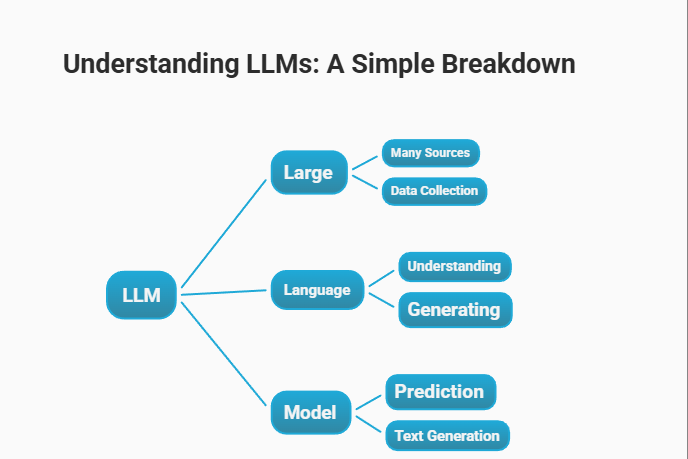
Together, a Large Language Model becomes an AI system that can understand words, sentences, meanings, and context very effectively.
Key Characteristics of LLMs
LLMs have several powerful features that make them useful in modern AI applications:
- Context Understanding – They understand the meaning behind sentences instead of just reading words.
- Text Generation – They can create human-like content, emails, blogs, stories, and replies.
- Adaptability Across Tasks – One LLM can perform multiple tasks like translation, coding, summarization, and chatbot conversations.
These capabilities make LLMs one of the most important technologies in today’s AI industry.
How LLMs Work
Large Language Models are trained using huge amounts of text collected from the internet, books, blogs, research papers, articles, forums, and even computer code. This training data helps the AI learn how humans write and communicate.
Instead of memorizing sentences, LLMs learn patterns in language. They understand how words are connected and which words usually appear together in a sentence.
For example, if someone writes “The sky is…”, the model learns that the next word is often “blue.” This pattern-learning process is the foundation of how LLMs work.
LLMs use a technology called deep learning, which is based on artificial neural networks. These networks are inspired by the human brain and help AI process information in layers.
Modern LLMs mainly use something called the Transformer architecture. It helps the model understand relationships between words, even if the words are far apart in a sentence.
This architecture makes LLMs faster, smarter, and better at understanding context compared to older AI systems.
Before understanding text, LLMs break sentences into smaller parts called tokens. A token can be a word, part of a word, or even a punctuation mark.
For example, the sentence “AI is amazing” may be split into tokens like “AI,” “is,” and “amazing.”
After tokenization, the model predicts the next token step-by-step. It keeps generating words based on probability and context until it forms a complete response.
This prediction process is what allows AI chatbots to create human-like conversations, articles, and answers instantly.
Fine-Tuning and Human Feedback
After basic training, LLMs go through a process called fine-tuning. In this stage, the model is trained for specific tasks and improved using expert guidance.
One important method is called Reinforcement Learning with Human Feedback (RLHF). Humans review AI responses and teach the model which answers are helpful, safe, and accurate.
This process helps reduce harmful content, improve response quality, and make AI systems more trustworthy for real-world use.
Today, fine-tuning and human feedback play a major role in making modern AI assistants smarter and more user-friendly.
Types of LLMs
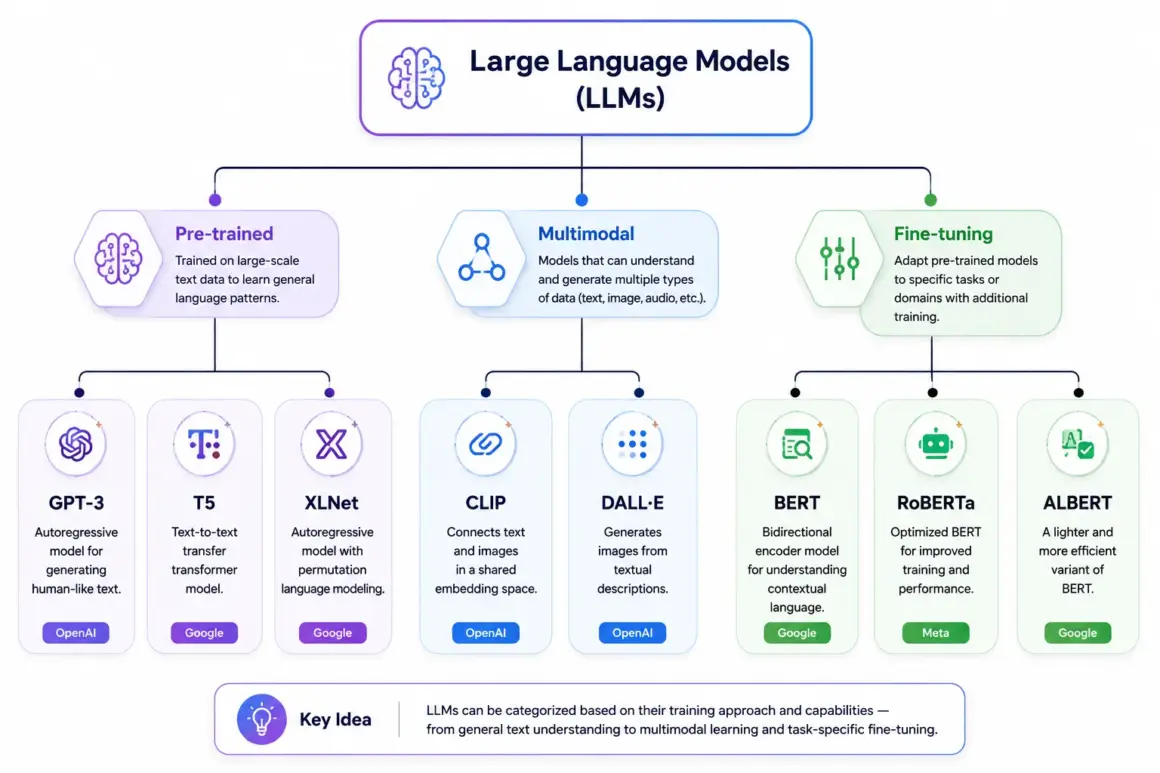
1. General-Purpose LLMs
General-purpose LLMs are designed to handle many different tasks. These models can answer questions, write content, summarize information, generate code, and chat naturally with users.
They are commonly used in AI chatbots, virtual assistants, and productivity tools. Popular examples include ChatGPT and other conversational AI systems used by businesses and individuals worldwide.
These models are flexible and useful for everyday tasks because they are trained on a wide variety of topics and language patterns.
2. Domain-Specific LLMs
Domain-specific LLMs are trained for particular industries or professional fields. Instead of general knowledge, these models focus on specialized information and terminology.
For example, healthcare LLMs can assist doctors with medical documentation and research. Legal AI models help lawyers analyze contracts and legal documents, while finance-based models support market analysis and reporting.
These LLMs usually provide more accurate results in their specific field because they are trained using industry-related datasets.
3. Open Source vs Proprietary Models
LLMs can also be divided into open-source and proprietary models.
Open-source LLMs allow developers to access, modify, and customize the model freely. They offer flexibility and innovation for researchers and businesses. Examples include models available on platforms like Hugging Face.
Proprietary models are owned and controlled by companies. These models are usually more secure, optimized, and commercially supported but may require paid access.
Both types of LLMs are important in the AI industry. Open-source models encourage experimentation, while proprietary models focus more on performance, safety, and enterprise use.
Real-World Applications of LLMs
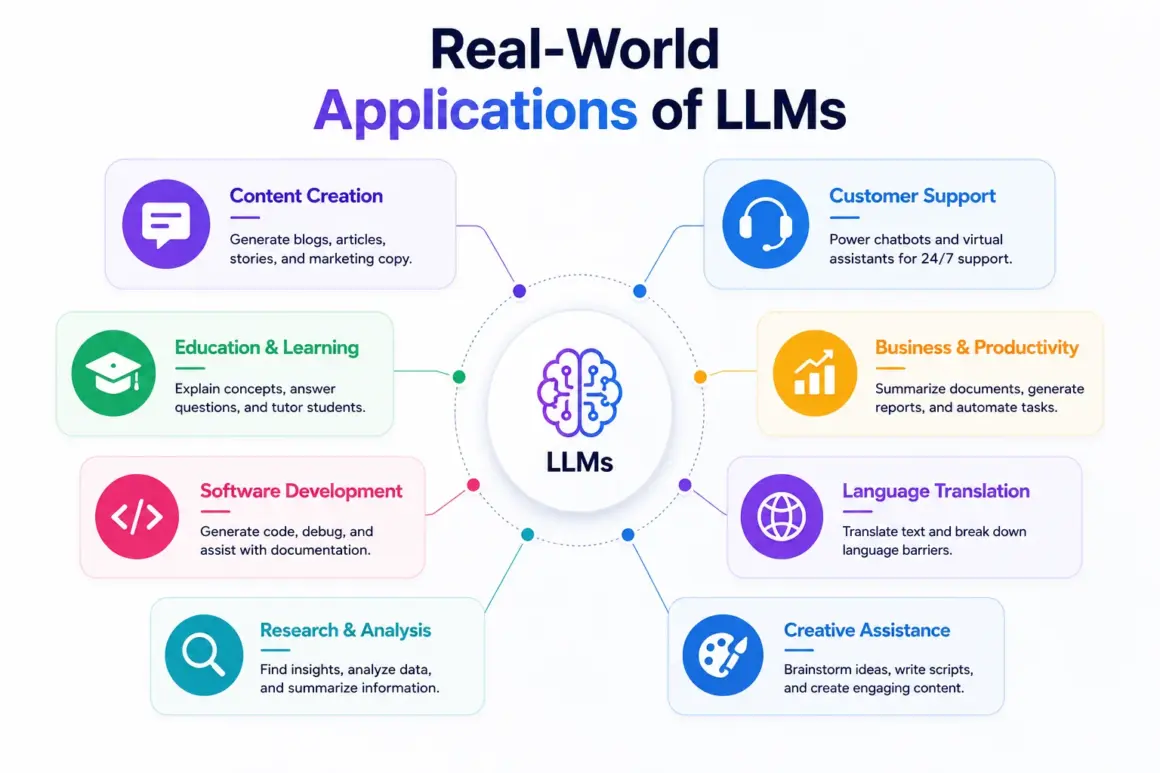
1. Chatbots and Virtual Assistants
One of the most popular uses of LLMs is AI chatbots and virtual assistants. Businesses use them to automate customer support and answer user questions instantly.
These AI systems can handle thousands of conversations at the same time, saving both time and operational costs. They are available 24/7 and improve customer experience.
Today, many websites, apps, and online services use LLM-powered chatbots for support and communication.
2. Content Creation
LLMs are widely used for creating digital content. They can write blog posts, emails, product descriptions, social media captions, scripts, and marketing copy within seconds.
Content creators and marketers use AI tools to speed up writing tasks and improve productivity. This makes content creation faster and more efficient.
However, human editing is still important to maintain originality, accuracy, and brand voice.
3. Code Generation
Modern LLMs can also understand programming languages and help developers write code. AI coding assistants can suggest functions, detect errors, and generate code snippets automatically.
This helps programmers save time and improve workflow efficiency. Beginners can also learn coding faster using AI-powered coding tools.
AI-assisted development is becoming increasingly common in software engineering and app development.
4. Translation and Summarization
LLMs can translate text between multiple languages and summarize long documents into short, clear explanations.
This helps businesses communicate globally and allows users to understand information more quickly. Language barriers are becoming smaller because of AI-powered translation systems.
Students, researchers, and professionals use summarization tools to save time when reading large amounts of information.
5. Education and Learning
LLMs are transforming the education sector by creating personalized learning experiences. AI tutors can explain concepts, answer questions, and provide practice exercises based on student needs.
Students can learn at their own pace with instant feedback and guidance. This makes education more interactive and accessible.
Many online learning platforms now use AI-powered systems to improve teaching and student engagement.
Benefits of LLMs
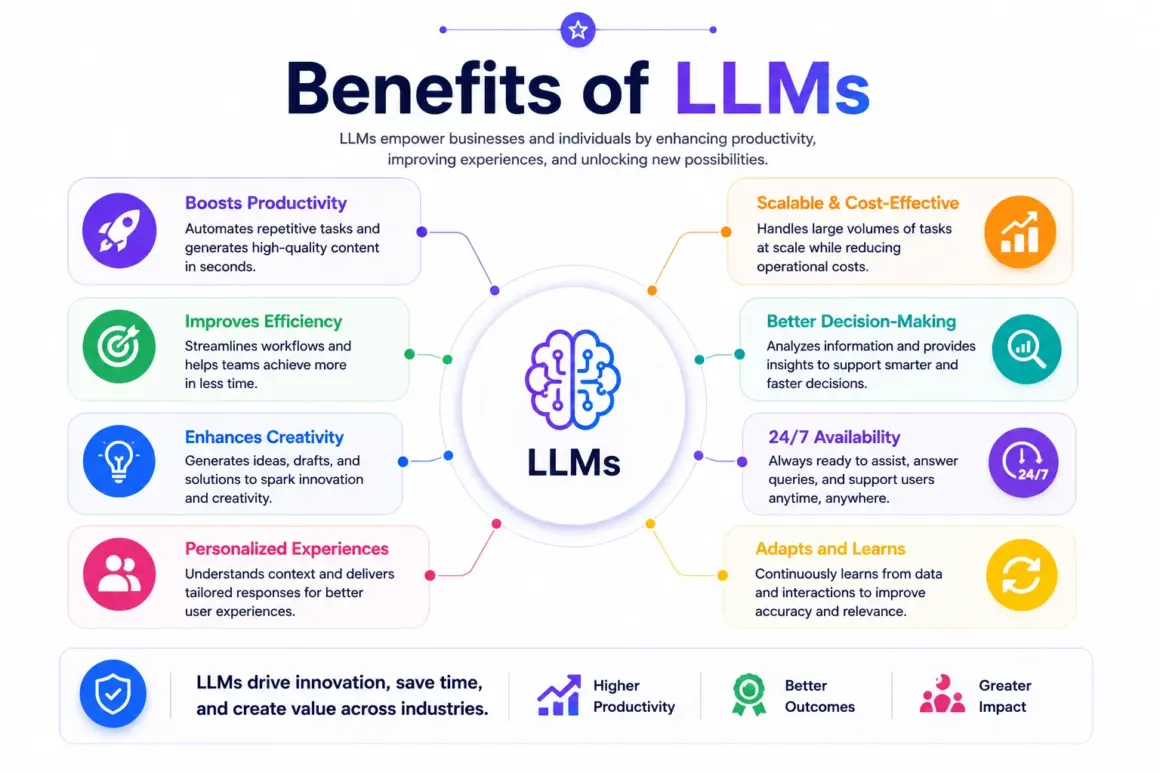
1. Automation and Efficiency
One of the biggest advantages of Large Language Models is automation. LLMs can handle repetitive tasks like answering customer queries, writing emails, generating reports, and creating content within seconds.
This helps businesses save time, reduce manual effort, and improve productivity. Employees can focus more on important tasks instead of spending hours on routine work.
AI-powered automation is especially useful for companies that manage large amounts of data and communication daily.
2. Scalability
LLMs can work across many industries and applications. A single model can support healthcare, education, finance, marketing, software development, and customer service.
Businesses can scale their operations without hiring large teams for every task. AI systems can manage thousands of users and requests at the same time.
This flexibility makes LLMs highly valuable for startups, enterprises, and digital platforms worldwide.
3. Human-Like Interaction
Modern LLMs can generate natural and conversational responses that feel very similar to human communication. They understand context, tone, and sentence structure effectively.
This makes interactions smoother and more engaging for users. AI chatbots and assistants powered by LLMs can provide quick and personalized support anytime.
Human-like conversations improve user experience and make AI technology easier for everyone to use.
Limitations of LLMs
Even though LLMs sound intelligent, they do not truly “think” like humans. They mainly predict the next word based on patterns learned during training.
This means the AI may generate confident answers without actually understanding the real meaning behind the information.
As a result, users should not blindly trust every response generated by an LLM.
LLMs learn from huge datasets collected from the internet and other sources. If the training data contains bias or harmful information, the model may also produce biased responses.
This can create fairness and ethical concerns in sensitive areas like hiring, healthcare, or law.
Developers continuously work on reducing bias, but completely removing it remains a challenge.
Sometimes LLMs generate false or completely fabricated information. This problem is known as an AI hallucination.
The model may provide incorrect facts, fake references, or misleading answers while sounding very confident.
Because of this, fact-checking is important when using AI-generated content for professional or educational purposes.
Training and running large language models require powerful computers, advanced hardware, and massive amounts of energy.
Developing advanced AI models can cost millions of dollars and consume significant computing resources.
This makes LLM development expensive and limits access for smaller organizations with lower budgets.
LLM vs Traditional AI Models
| Feature | LLMs (Large Language Models) | Traditional AI Models |
|---|---|---|
| Definition | Advanced AI models trained on massive text datasets to understand and generate human-like language | AI systems designed for specific tasks using predefined rules or structured data |
| Main Purpose | Understand, generate, and interact using natural language | Solve narrow or specific problems |
| Training Data | Huge amounts of unstructured text data from books, websites, articles, etc. | Structured datasets focused on a single task |
| Flexibility | Highly flexible and multi-purpose | Usually task-specific |
| Learning Ability | Learns patterns, context, reasoning, and language relationships | Learns fixed patterns for one objective |
| Human-like Responses | Can generate conversational and natural responses | Limited conversational ability |
| Examples | ChatGPT, Claude, Gemini, Llama | Spam filters, recommendation systems, fraud detection models |
| Input Type | Mainly text, but can also support images, audio, and video (multimodal) | Mostly numerical or structured data |
| Output Type | Text generation, summaries, coding, conversations, analysis | Predictions, classifications, or simple outputs |
| Adaptability | Can perform many tasks without retraining | Often requires retraining for new tasks |
| Context Understanding | Strong contextual understanding | Limited context awareness |
| Creativity | Can create stories, code, emails, scripts, ideas, etc. | Low creativity |
| Complexity | Very complex architecture with billions of parameters | Usually simpler architectures |
| Computing Power | Requires high computational resources | Lower computational requirements |
| Training Cost | Extremely expensive to train | Comparatively cheaper |
| Real-Time Interaction | Excellent for chatbots and assistants | Limited real-time conversational support |
| Fine-Tuning | Can be fine-tuned for many industries and tasks | Fine-tuning usually limited to one use case |
| Common Use Cases | Chatbots, content writing, coding, research, automation | Image recognition, forecasting, fraud detection |
| Strength | General intelligence-like behavior across many tasks | High efficiency in narrow tasks |
| Weakness | Expensive, can hallucinate, resource-heavy | Less flexible and limited understanding |
1. Rule-Based Systems vs LLMs
Traditional AI systems were mostly rule-based. Developers manually added fixed instructions and conditions for every task the system needed to perform.
These systems could only respond to predefined commands and situations. If the input changed slightly, the AI often failed to give the correct response.
LLMs are very different because they learn patterns from data instead of following only fixed rules. This makes them more flexible and capable of handling natural conversations.
2. Machine Learning vs LLMs
Traditional machine learning models are usually designed for specific tasks like spam detection, image classification, or recommendation systems.
These models are often called narrow AI because they focus on one problem at a time.
LLMs are more advanced because they can perform many tasks using a single model. They can write content, answer questions, summarize text, translate languages, and generate code.
This broader capability makes LLMs closer to generalized intelligence compared to older AI models.
3. Why LLMs Are a Breakthrough
LLMs became a major breakthrough because they understand context much better than previous AI systems.
They can generate natural, human-like responses by analyzing sentence structure, meaning, and conversation flow.
This context-aware generation makes modern AI tools more useful, interactive, and intelligent for real-world applications.
Popular Examples of LLMs
GPT Models
GPT models are among the most popular Large Language Models today. They are widely known for powering conversational AI tools like ChatGPT.
These models can answer questions, create content, summarize information, and support many business applications.
GPT-based systems are used by students, developers, marketers, and companies worldwide for productivity and automation.
BERT
BERT is another important language model developed for understanding the meaning and context of words in search queries.
It helped improve search engines by making search results more accurate and relevant to user intent.
BERT focuses more on understanding language rather than generating long conversational responses.
Other Notable Models
Many organizations have developed powerful LLMs for different purposes. Some models are open-source, while others are designed for enterprise use.
Platforms like Hugging Face provide access to many open-source AI models for developers and researchers.
These models continue to improve AI innovation across industries such as healthcare, education, coding, and customer support.
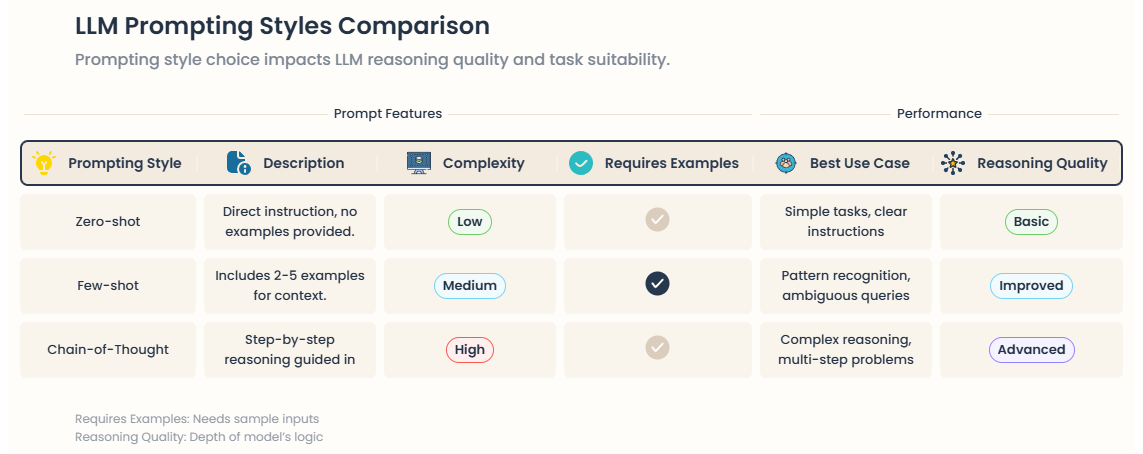
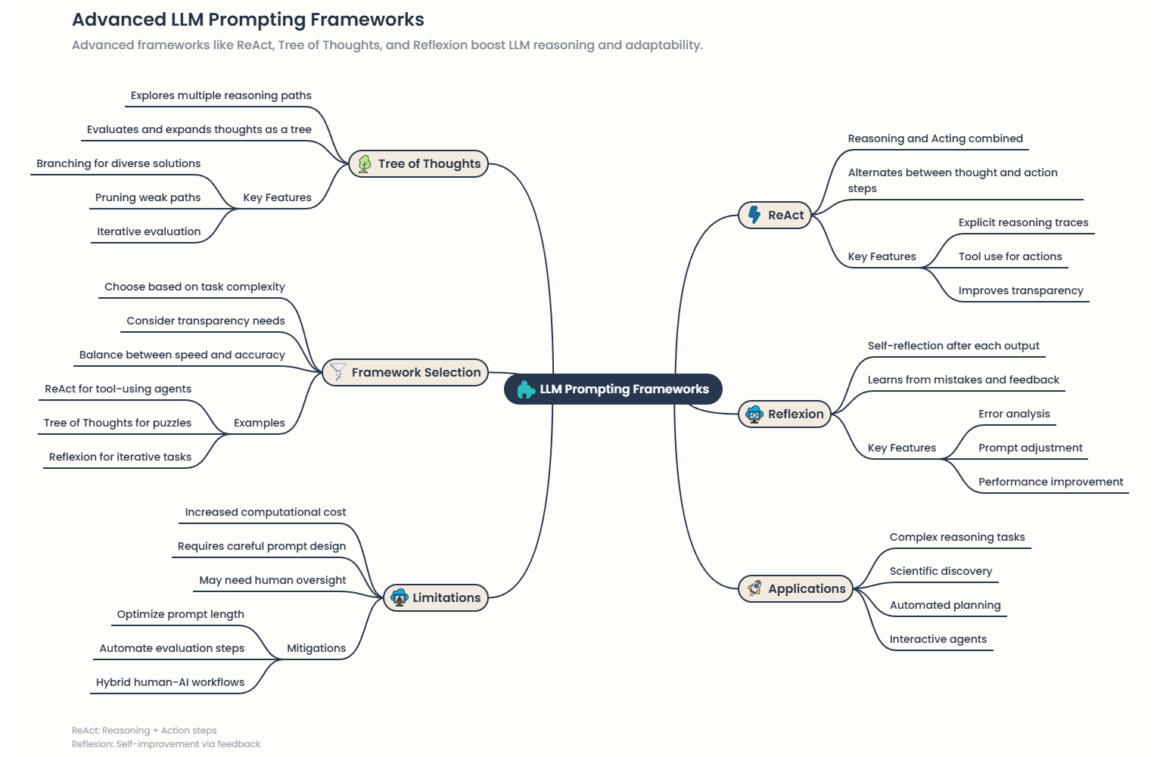
Advanced LLM Prompting Frameworks
Future of LLMs in AI
The future of LLMs is moving toward multimodal AI, where models can understand not only text but also images, audio, and video.
This means future AI systems will be able to analyze photos, create videos, and understand visual information along with language.
Multimodal technology will make AI more interactive and closer to human-like understanding.
Researchers are also developing smaller and more efficient LLMs that require less computing power.
These lightweight models can run on smartphones, laptops, and edge devices without needing expensive servers.
This improvement will make AI technology faster, cheaper, and more accessible for everyday users.
As AI becomes more powerful, ethical development is becoming increasingly important.
Companies and researchers are focusing on responsible AI practices such as reducing bias, improving transparency, and protecting user privacy.
Building safe and trustworthy AI systems will play a major role in the future success of LLM technology.
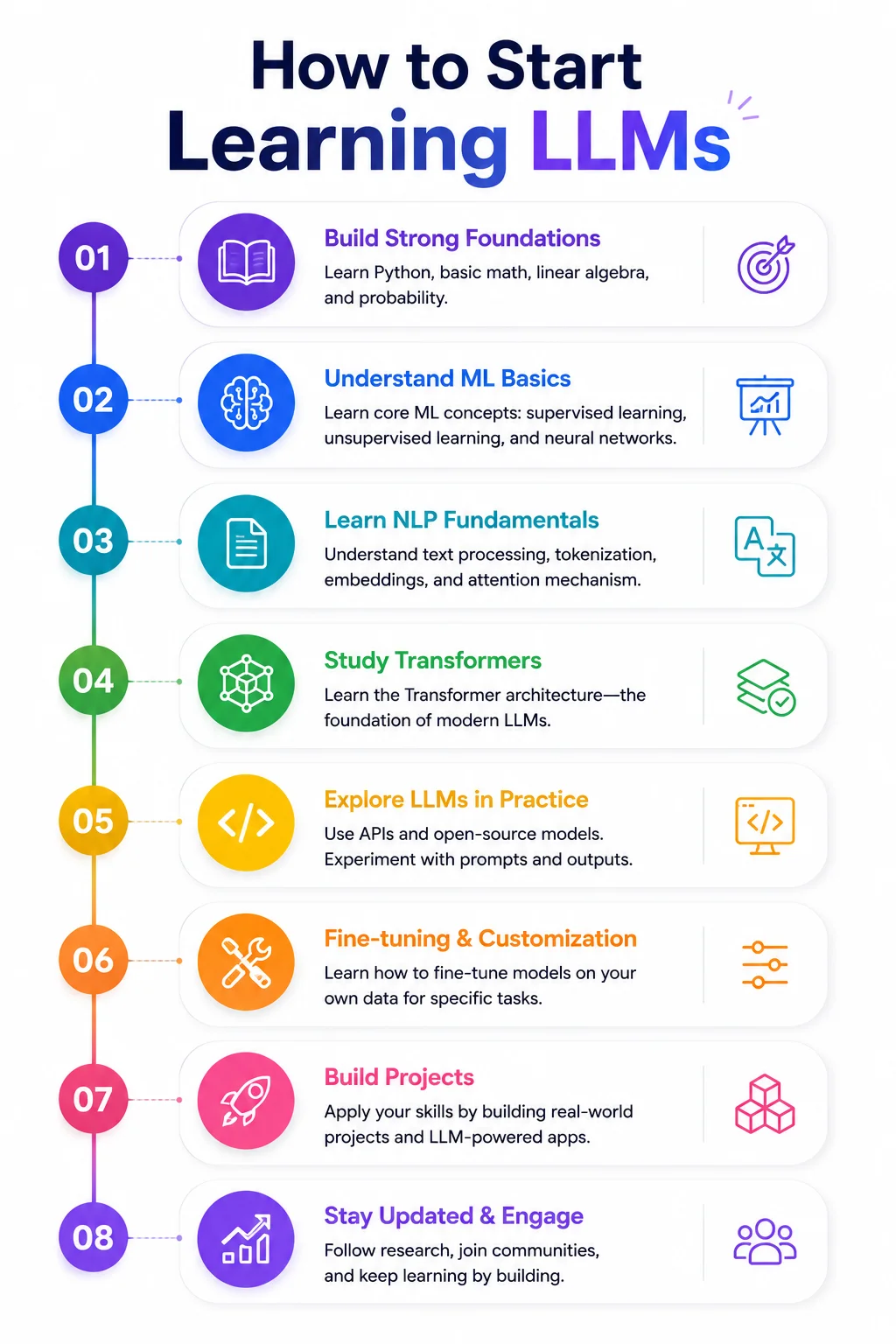
How to Start Learning LLMs
To start learning LLMs, it is helpful to understand basic programming and Artificial Intelligence concepts.
Learning Python is highly recommended because it is the most popular programming language used in AI development.
Basic knowledge of Natural Language Processing (NLP) and machine learning will also make learning easier.
Many online platforms help beginners explore Large Language Models and AI development.
Popular platforms like Hugging Face and OpenAI API Platform provide tools, models, and documentation for building AI applications.
These platforms are beginner-friendly and widely used in the AI industry.
A good learning path starts with Python programming and basic AI concepts.
After that, learners can move to NLP, deep learning, transformer models, and prompt engineering.
With regular practice and real-world projects, beginners can gradually become advanced AI developers and LLM specialists.
FAQs About LLMs
What is LLM in simple words?
An LLM, or Large Language Model, is an AI system trained on huge amounts of text data to understand and generate human language. It can answer questions, write content, and have natural conversations.
How does an LLM learn?
LLMs learn by analyzing massive datasets such as books, websites, articles, and online text. They identify language patterns and predict the next word in a sentence during training.
Is LLM the same as AI?
No, an LLM is not the same as AI. Artificial Intelligence is a broad field, while LLMs are a specific type of AI focused on understanding and generating human language.
Can LLMs think like humans?
LLMs do not truly think or understand emotions like humans. They generate responses based on patterns and probabilities learned from data. Even though their replies may sound intelligent, they do not have real consciousness or reasoning abilities.
Are LLMs difficult to learn?
No! Beginners can start learning LLMs with basic Python programming and AI concepts. Many online courses, tutorials, and platforms make learning easier for students and developers. With regular practice and curiosity, anyone can gradually understand how Large Language Models work.
Sources:
OpenAI Documentation
Useful for understanding GPT models, APIs, and Large Language Models. Google AI Research
Official Google AI research papers, innovations, and transformer-related technologies. Hugging Face Documentation
Beginner-friendly resource for open-source LLMs, NLP, and transformers. Stanford University Human-Centered AI
Trusted academic source for AI trends, ethics, and research. IBM Artificial Intelligence Guide
Simple explanations and enterprise-level insights about AI and LLM technologies.


