Prompt Engineering: The Easiest Way to Get Better Results from AI

Everyone is talking about coding, artificial intelligence, and cybersecurity. If you ask anyone what skills matter in 2026, you will hear the same answers again and again.
Learn to code.
Understand AI.
Study cybersecurity.
This advice is not wrong—but it is incomplete.
There is a fourth skill quietly transforming how people work with AI. It is not flashy. It does not require a degree. And most people are still ignoring it.
That skill is prompt engineering.
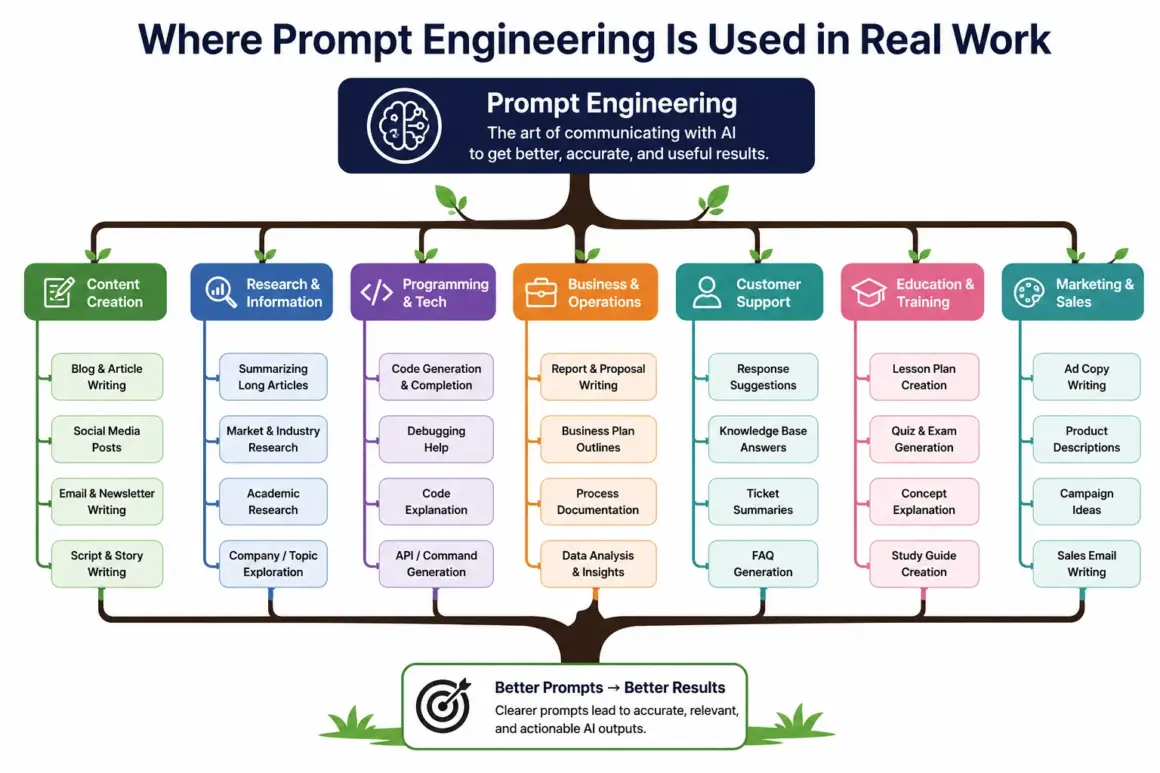
Table of Contents
- What Is Prompt Engineering?
- Why Prompt Engineering Matters in 2026
- The Reality Behind the Job Market
- What Employers Are Paying in 2026
- Where Prompt Engineering Is Used in Real Work
- The Honest Truth About Prompt Engineering
- The AI Boom Is Real
- How to Learn Prompt Engineering for Free
- The Fastest Way to Improve
- 5 Powerful Prompt Engineering Techniques
- Quick Practice Exercise
- The Bottom Line
- Frequently Asked Questions
What Is Prompt Engineering?
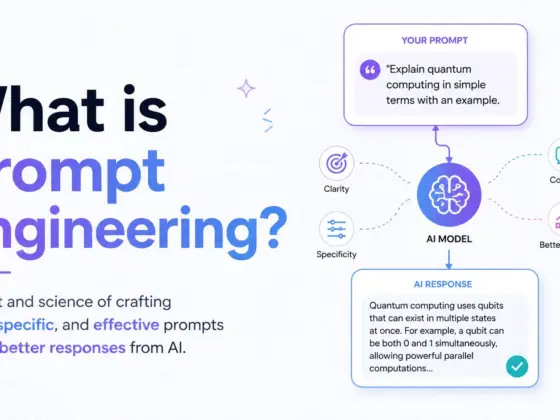
Prompt engineering is the ability to give clear, structured instructions to AI tools so they produce better results.
Tools like ChatGPT, Google Gemini, and Claude respond directly to what you ask them. If your instructions are vague, the output will be generic. If your instructions are clear and detailed, the output becomes useful, relevant, and often impressive.
Think of it like ordering food at a restaurant.
You could say:
“Give me something to eat.”
Or you could say:
“I want something warm, slightly spicy, vegetarian, and quick to prepare.”
Which one do you think gives a better result?
That gap—the difference between vague and precise instructions—is where prompt engineering lives.
Why Prompt Engineering Matters in 2026
Prompt engineering is no longer just a “nice-to-have” skill. It is becoming a core digital skill, just like using email or Excel once was.
According to industry hiring data, demand for prompt engineering skills has increased by 135.8% in 2026.
But something interesting is happening.
The job title “Prompt Engineer” is actually declining.
Does that mean the skill is becoming irrelevant?
Not at all.
The Reality Behind the Job Market
Here is what is actually happening:
- Jobs requiring prompt engineering skills have tripled since 2024
- The title “Prompt Engineer” has dropped by around 30%
- The skill has been absorbed into higher-paying roles
Instead of hiring “Prompt Engineers,” companies are hiring:
- AI Engineers
- Machine Learning Engineers
- Content Strategists with AI specialization
- Product Managers working with AI
In simple words, the title is fading, but the skill is becoming more valuable.
What Employers Are Paying in 2026
Even though prompt engineering is rarely a standalone job, it significantly increases earning potential.
Here’s what professionals using AI skills are earning:
- Entry Level (0–2 years): $62,000 – $90,000/year
- Mid Level (2–5 years): $100,000 – $145,000/year
- Senior Roles: $145,000 – $206,000/year
- Top Companies: $245,000+ total compensation
These numbers are based on reports from Glassdoor, ZipRecruiter, and industry job boards (April 2026).
Even outside the US, the impact is clear.
Freelancers with strong prompting skills are earning more on platforms like Upwork and through direct client work. The advantage is real—even if the job title has not caught up yet.
Where Prompt Engineering Is Used in Real Work
This is not a skill limited to tech companies. It is spreading across almost every industry.
1. Content and Marketing
Writers and marketers use AI to:
- Generate blog drafts
- Rewrite content for different audiences
- Speed up research
A good prompter can save hours every week.
2. Healthcare
In healthcare, accuracy matters.
A wrong AI response can have serious consequences. That is why professionals who know how to control AI output are highly valued—and often paid more.
3. Legal and Finance
Law firms and banks are using AI for:
- Contract analysis
- Document summaries
- Compliance checks
These industries move slowly, but they are actively adopting AI now.
4. Software Development
Developers use AI daily to:
- Generate code
- Fix bugs
- Understand errors
A developer who writes better prompts works faster and more efficiently.
5. Education and Training
Teachers and educators use AI to:
- Create lesson plans
- Design quizzes
- Adapt content for different learners
Prompting is becoming a basic skill in education technology.
The Honest Truth About Prompt Engineering
Let’s be clear.
Prompt engineering alone will not get you a high-paying job.
It is not a shortcut.
It is a multiplier.
- If you are a writer → it makes you faster
- If you are a developer → it makes you more efficient
- If you are a marketer → it improves your output
But it does not replace real skills.
Also, AI models are improving. Basic prompts are getting better results automatically.
Does that mean prompt engineering will disappear?
No.
Because as AI becomes more powerful, tasks become more complex. And complex tasks require better instructions.
Understanding how AI “thinks” will always be valuable.
The AI Boom Is Real
The AI industry is growing at an incredible speed.
A recent example:
- A startup called Ineffable Intelligence reached a $5.1 billion valuation
- It raised $1.1 billion in funding
- It has no product yet
Investors are betting on the future of AI.
That tells you one thing clearly:
Knowing how to work with AI is not a future skill—it is a present skill.
How to Learn Prompt Engineering for Free
One of the biggest advantages of this skill is accessibility.
You do not need:
- A college degree
- Expensive courses
- Special hardware
You only need:
- Access to an AI tool
- Consistent practice
Best Free Resources
Here are some of the best free learning options:
- ChatGPT Prompt Engineering for Developers (DeepLearning.AI + OpenAI)
- Prompt Engineering for ChatGPT (Vanderbilt University – Coursera)
- Google Prompting Essentials
- Learn Prompting (Open-source textbook)
- Anthropic Prompting Guide
- Microsoft Generative AI Fundamentals
But here is the truth:
Courses alone will not make you good. Practice will.
The Fastest Way to Improve
Instead of just learning theory, apply prompting to your daily tasks:
- Write emails
- Summarize articles
- Create social media posts
- Generate ideas for your blog
Real-world usage forces you to improve faster than any course.
5 Powerful Prompt Engineering Techniques
These techniques consistently produce better results.
1. Assign a Role
Start with:
“You are a marketing expert…”
“You are a financial advisor…”
This changes how AI responds.
2. Add Context
Explain your situation clearly.
Bad prompt:
“Write an article”
Better prompt:
“Write a beginner-friendly article on AI for students”
Context improves quality.
3. Specify Output Format
Tell AI exactly what you want:
- Bullet points
- Short paragraphs
- Simple language
Without instructions, AI defaults to average.
4. Use Examples (Few-Shot Prompting)
Show AI what you want.
If you want a specific style or format, give a sample.
This dramatically improves results.
5. Treat Output as a Draft
Never accept the first response.
- Refine it
- Ask follow-up questions
- Improve it step by step
Prompt engineering is not one message—it is a conversation.
Quick Practice Exercise
Try this right now:
- Ask AI to explain prompt engineering to a 12-year-old
- Then ask it to explain the same thing to a hiring manager
You will see completely different outputs.
That is control.
That is prompt engineering.
The Bottom Line
Prompt engineering will not replace coding or expertise.
But it will make everything:
- Faster
- Smarter
- More efficient
For students, freelancers, and professionals, it is one of the most accessible skills you can learn today.
The tools are free.
The resources are free.
The opportunity is real.
The only cost is your time.
Frequently Asked Questions
Do I need coding knowledge?
No.
Many prompt engineers come from writing, marketing, and education backgrounds. Coding helps for advanced use cases, but it is not required.
Will AI replace this skill?
Unlikely.
AI will improve, but better tools require better instructions. Skilled users will always stand out.
Is this useful outside the US?
Yes.
AI tools work globally. Freelancers worldwide are already benefiting from strong prompting skills.
How long does it take to learn?
- Basics: Few hours
- Practical improvement: 1–2 weeks
- Advanced mastery: Ongoing
Which AI tool should I use?
Start with any:
- ChatGPT
- Google Gemini
- Claude
The principles are the same across all tools.