7 Advanced Prompt Engineering Techniques for Experts
If you are just typing simple questions into an AI tool, you are barely scratching the surface of what it can do. It is time to level up! Writing basic prompts is easy, but mastering advanced prompt engineering techniques is what truly separates beginners from professionals.
Today, AI models are incredibly powerful. However, they need the right instructions to give you the best results. Have you ever felt frustrated because the AI gave you a generic answer? We have all been there! The good news is that with the right Prompt Engineering Techniques, you can force the AI to think deeper, reason better, and produce top-tier work.
If you are ready to get the absolute best out of your AI tools, grab a notebook. We are diving into seven expert-level strategies that will completely change the way you write prompts!
Also Read | Best Prompt Engineering Frameworks: Explained
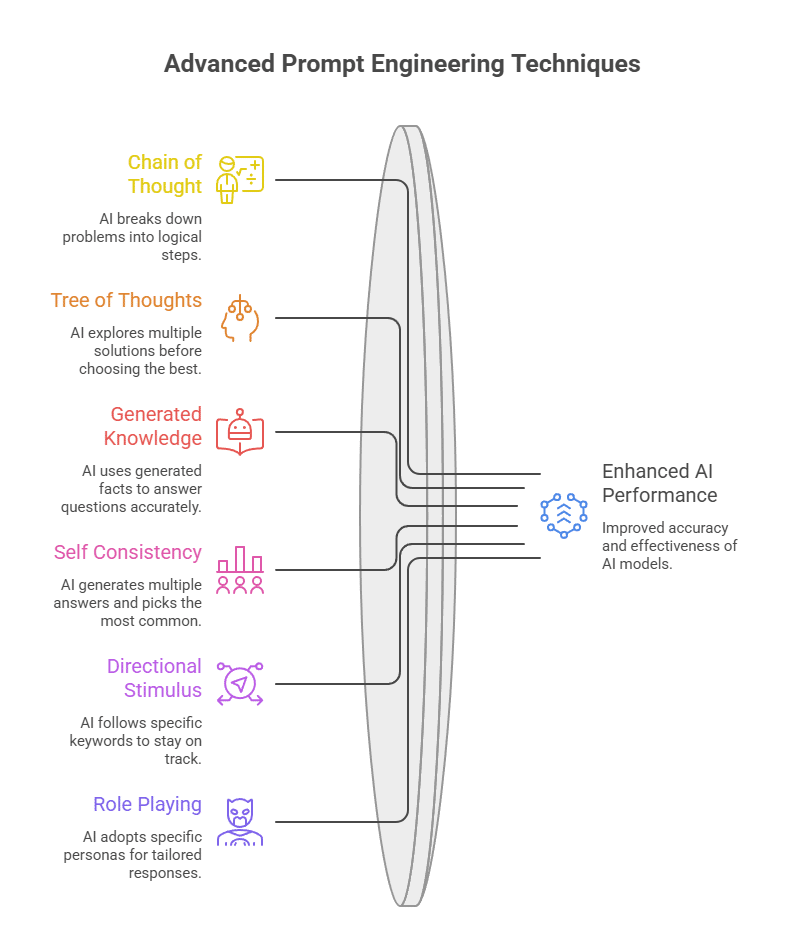
1. Chain of Thought Prompting
One of the most famous advanced prompt engineering techniques is called Chain of Thought (CoT). Normally, if you ask an AI a complex math problem or logic puzzle, it tries to guess the final answer immediately. Sometimes, it gets it wrong because it skips the thinking process.
With Chain of Thought, you force the AI to show its work! You simply tell the AI to break the problem down into smaller, logical steps. For example, instead of asking, “What is the marketing budget if we spend 20% of 50,000?” you add a magic phrase: “Think step by step before giving the final answer.”
By forcing the model to explain its reasoning, the accuracy of the final answer skyrockets! It acts just like a human student solving a problem on a whiteboard.
2. Tree of Thoughts Prompting
What if a problem is so complex that one single path of logic is not enough? That is where the Tree of Thoughts technique comes in! This is a massive upgrade over the basic step-by-step method.
Imagine you are playing chess. You do not just think about your next move; you think about three possible moves and what will happen after each one. You can ask the AI to do the exact same thing! You prompt the AI to generate multiple different ideas or “paths,” evaluate each one, and then choose the absolute best option.
For example, you could write:
“Imagine three different experts are trying to solve this problem. Have them discuss their different approaches, point out the flaws in each other’s ideas, and then agree on the best final solution.” This forces the AI to check its own work and guarantees a much smarter answer!
3. Generated Knowledge Prompting
Sometimes, an AI makes a mistake because it lacks specific context before answering a question. Generated Knowledge Prompting fixes this completely!
Instead of asking a question right away, you first ask the AI to generate facts, data, or context about the topic. Once the AI has written out all the factual knowledge, you then ask your actual question and tell the AI to use the knowledge it just wrote!
For instance, if you want an article about a rare medical condition, you first say:
“Write down five scientifically proven facts about this condition.” After the AI provides the facts, your next prompt is: “Now, using only the facts you just provided, write a short summary.” This dramatically reduces hallucinations and keeps the AI grounded in reality!
4. Self Consistency Prompting
Have you ever noticed that if you ask an AI the exact same question three times, you might get three slightly different answers? That inconsistency can be annoying! The Self-Consistency technique is how experts solve this problem.
Instead of accepting the very first answer the AI gives, you instruct the AI to generate multiple different answers internally and pick the most common one. It is like taking a vote!
You can write a prompt like:
“Solve this logic puzzle by generating five different possible answers. Then, look at all five answers and give me the one that appears the most often as your final conclusion.” This is one of the safest Prompt Engineering Techniques when you need mathematical or logical perfection!
5. Directional Stimulus Prompting
Sometimes, you need the AI to focus on very specific keywords or rules without writing a giant, confusing paragraph. Directional Stimulus Prompting uses “hints” to steer the AI in the exact direction you want!
Instead of just asking for a summary of a long article, you give the AI a list of mandatory keywords it must include. You are essentially giving the AI a map.
You could say:
“Write a short story about a brave astronaut. Directional hints to include: black hole, oxygen leak, friendly alien, successful rescue.” By providing these strict guideposts, the AI stays completely on track. It will not wander off and write something irrelevant because it knows exactly what targets it needs to hit!
6. Role Playing and Persona Adoption
While role-playing sounds basic, experts use it on a completely different level! You do not just say, “Act like a lawyer.” You build a deeply complex persona that limits how the AI is allowed to speak and think.
When you use advanced persona adoption, you define the AI’s background, tone, biases, and formatting rules. The more specific you are, the better the output will be!
Try a prompt like this:
“Act as a senior cybersecurity analyst with 20 years of experience working for banks. You speak in a highly professional, serious tone. You never use emojis. Explain the importance of two-factor authentication to a board of directors.” This instantly transforms the AI from a friendly chatbot into a seasoned corporate professional!
7. Meta Prompting
We have saved the most advanced trick for last! Meta-Prompting is when you ask the AI to write the prompt for you! If you are ever stuck and do not know how to word your instructions, just let the machine do the heavy lifting.
You can ask the AI to evaluate your goal and suggest the best possible way to ask the question.
You simply say:
“I want you to act as an expert Prompt Engineer. I need to write a prompt that will generate a high-converting sales email for a new shoe brand. What specific instructions, constraints, and keywords should I include in my prompt to get the best result?” The AI will hand you a perfectly engineered prompt on a silver platter. It feels like magic!
Taking Your Skills to the Next Level
Mastering these advanced prompt engineering techniques will completely transform your daily workflow. You will save time, eliminate bad outputs, and unlock the true creative power of Large Language Models.
Before wrapping up, it is incredibly helpful to understand the underlying mechanics of how these AI models process your prompts. This short video breaks down the technical functionality of the self-attention mechanism and explains why the structure of your input is so vital for success:
Remember, AI is not just a search engine; it is a reasoning engine. By using tools like Chain of Thought, Tree of Thoughts, and Meta-Prompting, you are teaching the AI exactly how you want it to think. Start testing these strategies today, and you will be amazed at the professional-grade results you can achieve!
Good and Bad Prompts
1. Scenario: Writing a Sales Email (Technique: Advanced Persona)
- Bad Prompt: Write a sales email to sell my new fitness app.
- Perfectly Engineered Prompt: Act as an expert conversion copywriter who specializes in direct-response marketing. Write a cold sales email for busy office professionals aged 25 to 40. The goal is to get them to sign up for a 7-day free trial of a new 15-minute home workout app. Use an empathetic but highly energetic tone! Keep the email under 200 words, use short paragraphs, and include a single, clear call-to-action link at the very end. Do not use generic subject lines!
2. Scenario: Solving a Complex Problem (Technique: Chain of Thought)
- Bad Prompt: How should I invest $10,000 this year?
- Perfectly Engineered Prompt: I want to invest $10,000 but I have a low risk tolerance and want to buy a house in three years. Before giving me a final asset allocation suggestion, think step by step! First, list the safest investment vehicles available today. Second, analyze the pros and cons of each option regarding a three-year timeline. Finally, provide a recommended percentage breakdown for my portfolio based on that exact step-by-step reasoning.