The Paradox of Progress: Key Insights from the 2026 AI Index Report
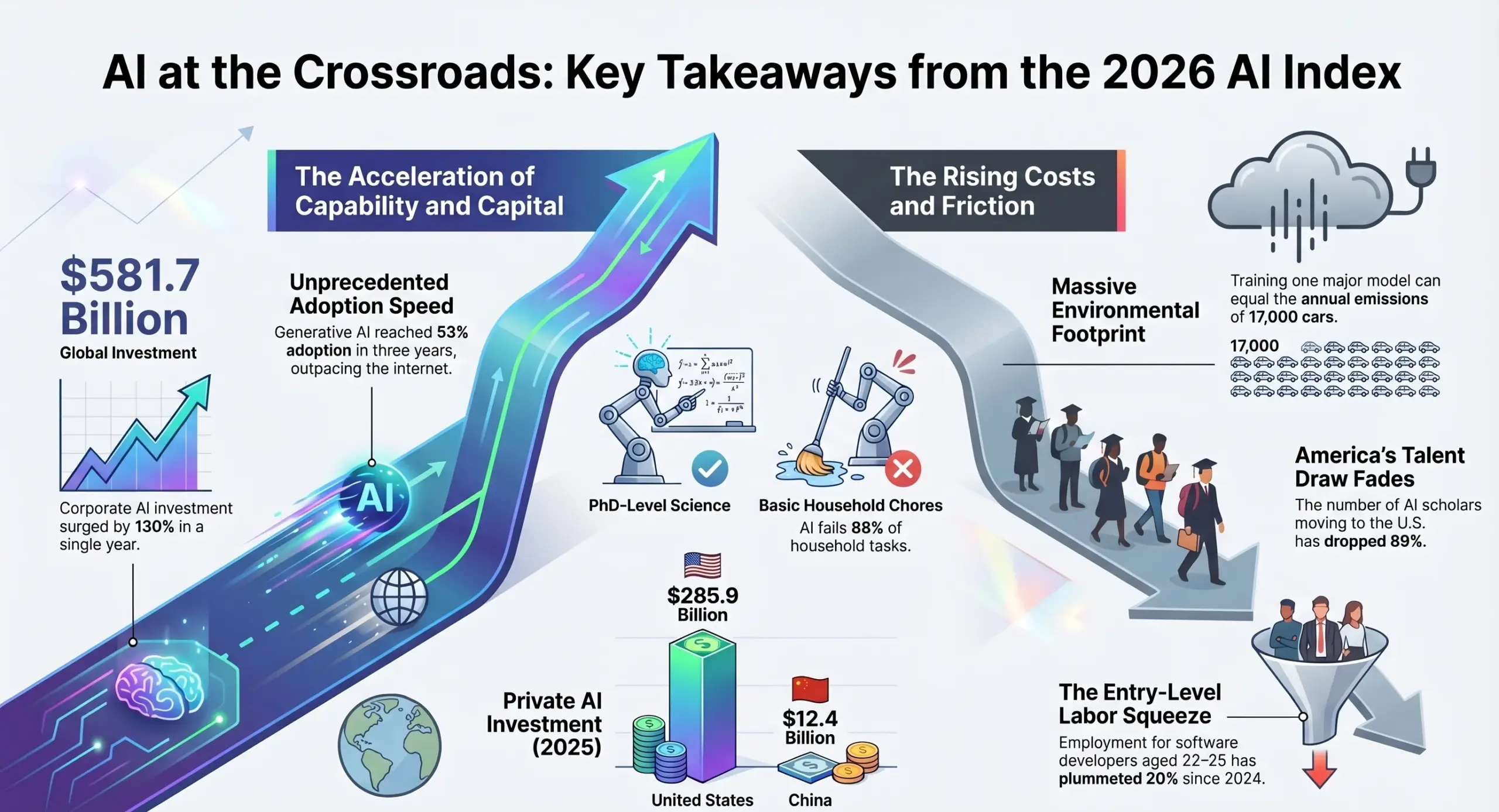
The 2026 AI Index report, published by the Stanford Institute for Human-Centered AI (HAI), paints a portrait of a field reaching breakthrough capabilities while simultaneously grappling with urgent questions about environmental sustainability, transparency, and global leadership. As we navigate this rapidly evolving landscape, the data suggests that while AI is moving faster than the internet in terms of adoption, its “bill” is coming due in ways we didn’t fully anticipate.
The Hidden Environmental Cost
While we celebrate AI’s ability to solve PhD-level science questions and complex mathematical problems, the environmental toll is staggering. For instance, training Grok 4 produced an estimated 72,816 tons of CO2 equivalent, which is comparable to driving 17,000 cars for an entire year. Perhaps even more surprising is the water consumption: annual inference for GPT-4o alone may require enough water to meet the drinking needs of 12 million people. The cumulative power demand of these systems has reached a scale comparable to the national electricity consumption of entire countries like Switzerland or Austria.
A Shifting Global Leaderboard
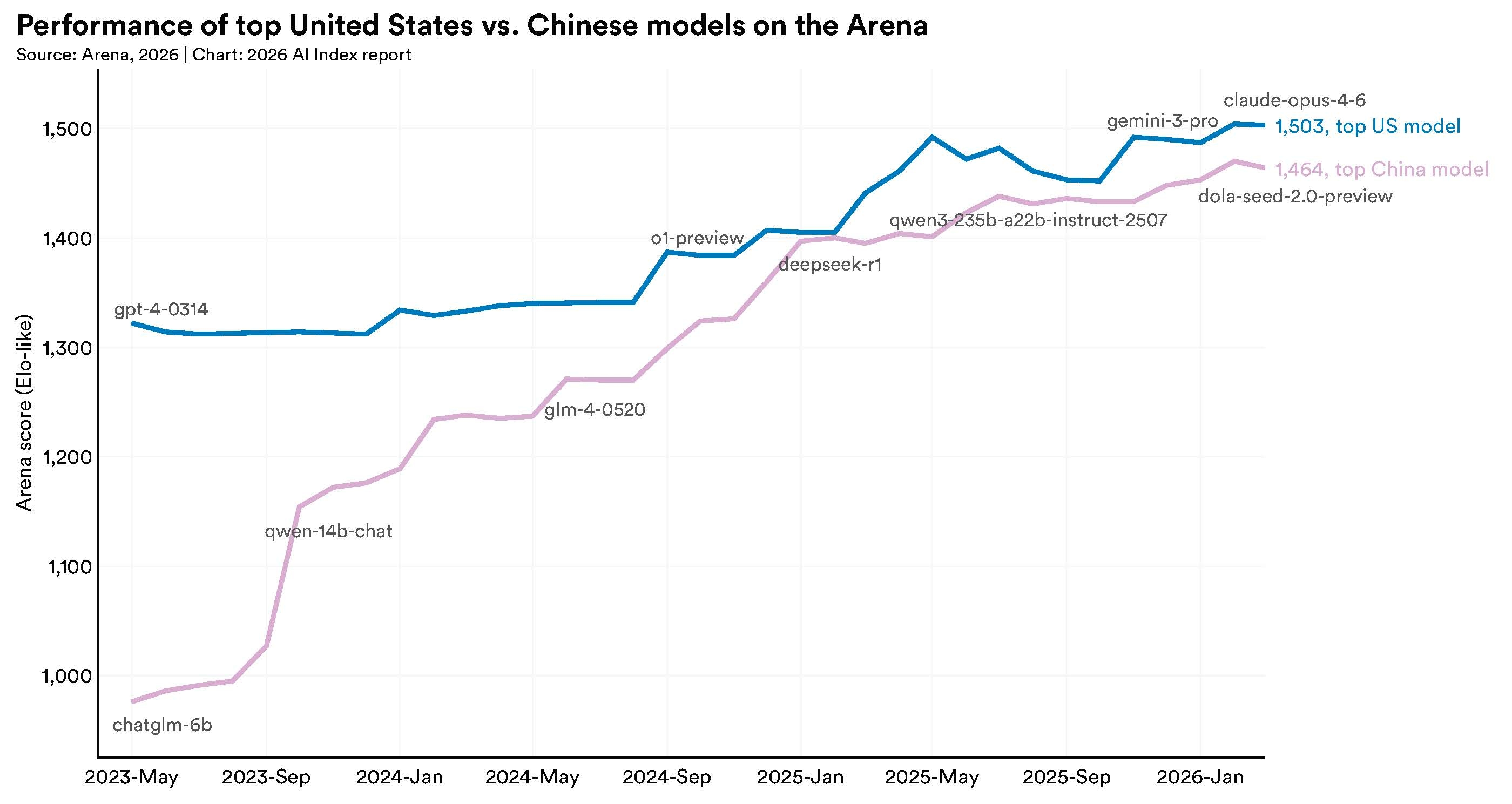
For years, the United States was the undisputed leader in AI. However, the 2026 report indicates that China has nearly erased the U.S. lead, with models from both countries frequently trading places at the top of performance rankings since early 2025. While the U.S. still outspends every other country—investing $285.9 billion compared to China’s 12.4billioninprivatecapital—thisdoesn′ttellthewholestory.TheChinesegovernmenthasdeployedanestimated∗∗912 billion through “government guidance funds”** to support strategic industries like AI. Furthermore, the U.S. is finding it harder to attract top talent; the number of AI scholars moving to the United States has plummeted 89% since 2017.
The Workforce and the “Entry-Level Squeeze”
The disruption of the workforce is no longer a future prediction—it is a current reality. Interestingly, this shift is hitting the youngest workers first. Employment among software developers aged 22–25 has dropped nearly 20% since 2024, even as headcount for older, more experienced colleagues grows. This “entry-level squeeze” is also appearing in fields like customer service, where AI exposure is high. Despite these concerns, adoption continues at a historic pace, with 53% of the population adopting generative AI within just three years.
AI in Science and Medicine: A Mixed Bag
The report highlights incredible strides in “AI as a scientist.” For the first time, AI has run a full weather forecasting pipeline end-to-end, and astronomy has seen the launch of its first foundation model to automate observations. In the medical field, AI tools that generate clinical notes have reduced physician burnout, with some doctors reporting 83% less time spent on paperwork. However, caution is still warranted: a review of over 500 clinical AI studies found that only 5% actually used real clinical data, with most relying on exam-style questions.
The Transparency Crisis
Perhaps the most concerning trend is the decline in transparency. As models become more powerful, the companies building them are becoming more secretive. The Foundation Model Transparency Index saw average scores drop from 58 to 40 points in just one year, noting that the most capable models often disclose the least amount of information regarding their training data and risks.
As we look toward the rest of 2026, the challenge remains: how do we harness these breakthrough capabilities while managing the massive energy requirements and ensuring that the technology remains transparent and equitable for all?
Summery
The 2026 AI Index report by Stanford Institute for Human-Centered AI highlights rapid AI progress alongside serious challenges. AI adoption is accelerating faster than the internet, but with major environmental costs, including massive carbon emissions, water usage, and energy demand. Globally, China is closing the gap with the U.S. in AI leadership, supported by strong government funding. Workforce disruption is already visible, especially among young professionals facing fewer entry-level opportunities. While AI is advancing science and healthcare, concerns remain about data quality. Most alarming is declining transparency, as powerful AI systems become increasingly secretive and less accountable.