13 Prompt Engineering Basics Every Creator Should Know
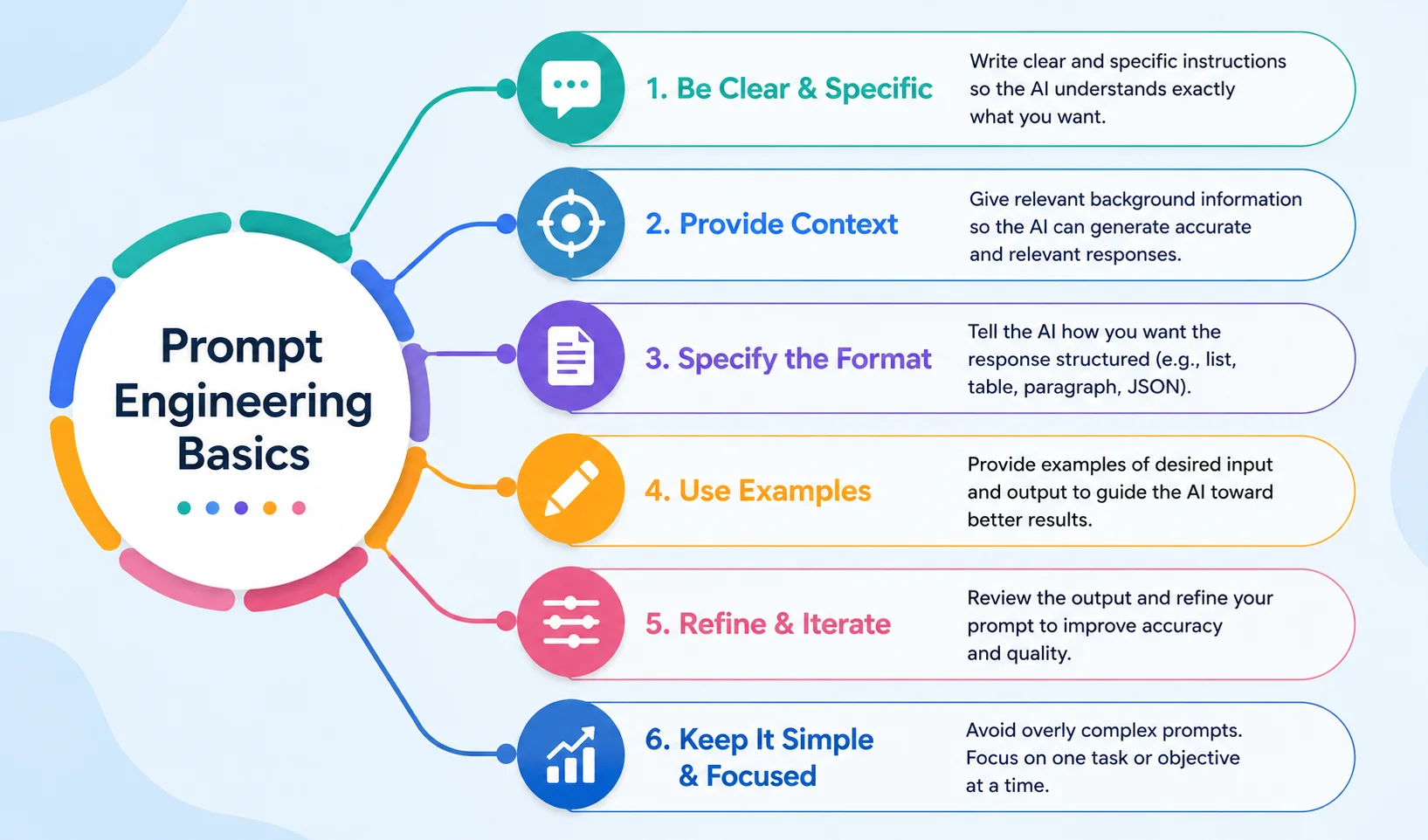
Artificial Intelligence has rapidly moved from a niche technology into a practical tool that creators, marketers, developers, educators, and business professionals use every day. Whether you’re generating content, automating workflows, analyzing data, or building AI-powered products, one skill has become increasingly valuable: prompt engineering.
I still remember my first experience using AI chatbots. Like many beginners, I typed a vague question, received an average response, and assumed the technology was overhyped. The problem wasn’t the AI—it was my prompt. Once I understood how prompts work and how modern AI models interpret instructions, the quality of results improved dramatically.
That experience taught me one important lesson: learning the Prompt Engineering Basics can often make a bigger difference than switching between AI tools.
In this guide, I’ll explain the fundamentals every creator should understand, including the AI prompt meaning, what are prompts in AI, common mistakes to avoid, and practical techniques that can help you get more accurate and useful outputs from modern AI systems.
Table of Contents
- What Is Prompt Engineering?
- Why Prompt Engineering Matters Today
- 13 Prompt Engineering Basics Every Creator Should Know
- Basic, Advanced, and System-Level Prompting
- A Simple Step-by-Step Prompt Writing Framework
- Real-World Prompt Engineering Use Cases
- Common Mistakes Beginners Make
- When AI Should NOT Be Trusted Completely
- Common Myths About Prompt Engineering
- Future Trends in Prompt Engineering
- Try This Prompt Yourself
- References and Trusted Sources
- Conclusion
- How This Article Was Created
What Is Prompt Engineering?
Before diving deeper, let’s start with the basics.
Prompt engineering is the process of designing clear instructions that help artificial intelligence systems generate better responses. A prompt can be a question, command, context description, task request, or a combination of all these elements.
Simply put, prompts act as communication bridges between humans and AI.
When people ask about the AI prompt meaning, I often explain it this way:
A prompt is the information you provide to an AI model so it can understand what you want and generate an appropriate response.
The better your instructions, the better the results are likely to be.
Modern AI systems such as GPT-based models from OpenAI, Claude from Anthropic, Gemini from Google, and open-source models from Hugging Face all rely heavily on prompts to understand user intent.
Why Prompt Engineering Matters Today
As AI tools become integrated into daily work, prompt engineering is becoming a valuable digital skill.
According to the Stanford AI Index and industry research from organizations such as Microsoft, Google, and McKinsey, businesses are increasingly adopting generative AI for content creation, software development, customer support, research, and workflow automation.
However, successful AI adoption depends on effective human guidance.
AI models do not truly “understand” tasks the way humans do. Instead, they predict the most likely response based on patterns learned during training.
That means the quality of outputs often depends heavily on the quality of inputs.
Good prompts help AI:
- Understand objectives clearly
- Reduce ambiguity
- Improve accuracy
- Generate more useful outputs
- Save editing time
- Support workflow automation
13 Prompt Engineering Basics Every Creator Should Know
1. Start With a Clear Objective
Before writing any prompt, define your goal.
Ask yourself:
- What outcome do I want?
- Who is the audience?
- What format should the answer follow?
Unclear objectives often produce inconsistent results.
2. Provide Context
AI performs better when it understands the situation.
Instead of saying:
“Write an email.”
Try:
“Write a professional follow-up email to a potential client who attended a product demo but has not responded in one week.”
Context improves relevance significantly.
3. Define the Audience
Audience information helps shape tone, complexity, and structure.
Examples:
- Beginners
- Students
- Executives
- Software developers
- Small business owners
The more specific the audience, the more targeted the response.
4. Specify the Desired Format
AI can generate many formats.
Examples include:
- Blog posts
- Bullet points
- Tables
- Checklists
- Reports
- Emails
- Social media captions
If format matters, mention it explicitly.
5. Use Role-Based Prompting
One of my favorite techniques is assigning a role.
For example:
“Act as a cybersecurity consultant.”
Or:
“Act as a senior SEO strategist.”
Role instructions help guide expertise and perspective.
6. Break Complex Tasks Into Steps
Large requests often perform better when divided into smaller tasks.
Instead of asking for an entire marketing strategy immediately, start with:
- Market analysis
- Audience research
- Content plan
- Campaign recommendations
This structured approach often improves output quality.
7. Be Specific Instead of Generic
Specific prompts reduce confusion.
Compare:
“Explain AI.”
With:
“Explain artificial intelligence to a high school student using simple examples from daily life.”
The second version creates a clearer target.
8. Include Constraints
Constraints guide the model.
Examples:
- Maximum word count
- Reading level
- Writing style
- Output format
- Industry focus
Constraints help maintain consistency and reduce unnecessary information.
Basic, Advanced, and System-Level Prompting
As your experience grows, you’ll encounter different levels of prompting.
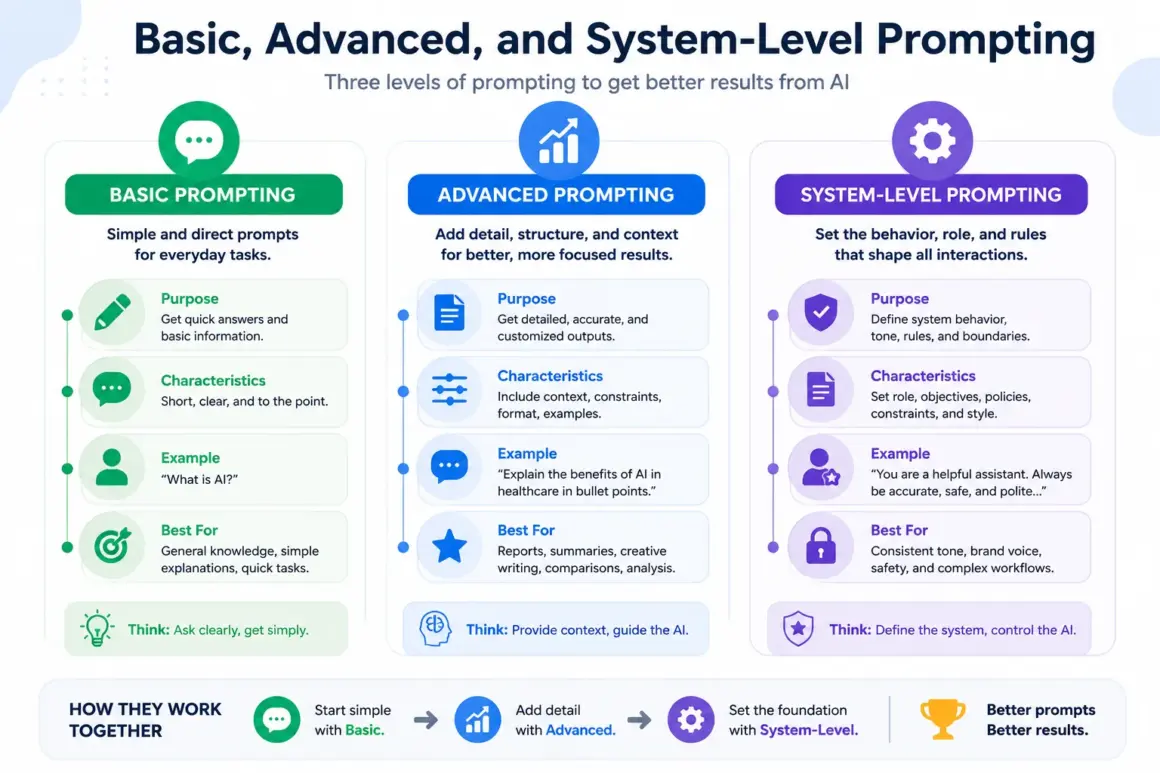
Basic Prompts
Simple instructions or questions.
Example:
“What is machine learning?”
These are ideal for quick answers.
Advanced Prompts
These include context, objectives, examples, and formatting requirements.
Example:
“Create a beginner-friendly guide explaining machine learning concepts with real-world business examples.”
Advanced prompts generally produce more detailed outputs.
System and Workflow Prompts
Organizations increasingly use system-level instructions to define AI behavior across entire workflows.
Examples include:
- Customer support automation
- AI content generation systems
- Internal knowledge assistants
- Business process automation
These prompts often work behind the scenes and help maintain consistency across multiple tasks.
Chain-of-Thought and Structured Reasoning
Modern prompt engineering often uses structured reasoning techniques.
Instead of requesting only an answer, users may ask AI to:
- Analyze information
- Compare options
- Evaluate trade-offs
- Explain reasoning
This approach can improve problem-solving performance for complex tasks.
However, users should still verify important outputs independently, especially for business, legal, financial, or medical decisions.
9. Use Examples Whenever Possible
One of the most effective prompt engineering techniques is providing examples.
AI models learn patterns from the context you provide. If you show the model exactly what you want, the quality of responses often improves significantly.
For example:
Prompt:
“Write product descriptions similar to this example:
Example: ‘This wireless keyboard combines comfort, durability, and long battery life for everyday productivity.’
Now write a description for a wireless mouse.”
This technique, often called few-shot prompting, is widely used in professional AI workflows because it helps reduce ambiguity and improves consistency.
10. Refine Through Iteration
Many beginners expect perfect results from their first prompt.
In reality, prompt engineering is an iterative process.
I rarely get exactly what I need from the first prompt. Instead, I improve the output by adding clarification, context, and follow-up instructions.
For example:
- First prompt: Generate a blog outline.
- Second prompt: Expand section 3 with examples.
- Third prompt: Simplify language for beginners.
Small refinements often lead to dramatic improvements.
11. Verify Facts Before Publishing
AI can generate convincing but incorrect information.
This issue is commonly known as an AI hallucination.
Even advanced models can occasionally:
- Invent sources
- Misquote studies
- Create fictional statistics
- Provide outdated information
Whenever I use AI for research or content creation, I verify important claims using trusted sources before publishing.
12. Combine AI With Human Expertise
Prompt engineering is not about replacing human judgment.
The best results usually come from collaboration.
AI can help with:
- Drafting
- Brainstorming
- Research assistance
- Summarization
- Idea generation
Humans still provide:
- Strategic thinking
- Domain expertise
- Critical analysis
- Ethical judgment
- Final quality control
Treat AI as an assistant, not a replacement for expertise.
13. Focus on Outcomes, Not Tools
Many creators spend too much time comparing AI platforms and not enough time improving their prompts.
Whether you’re using ChatGPT, Claude, Gemini, Microsoft Copilot, or another model, strong prompt engineering skills transfer across platforms.
The ability to communicate clearly with AI is often more valuable than loyalty to any specific tool.
Suggested Read:
- Why Your AI Prompts Are Failing (The 7 Mistakes Everyone Makes)
- Prompt Engineer Salary 2026: How Much Can You Really Earn?
- 100 Best ChatGPT Prompts That Actually Work (With Examples)
- Prompt Engineering Guide: Learn AI Prompting Step-by-Step (2026)
- What is chain-of-thought prompting
A Simple Step-by-Step Prompt Writing Framework
If you’re new to AI, I recommend using this simple framework:
Step 1: Define the Goal
Ask:
“What specific result do I want?”
Step 2: Add Context
Explain the situation, audience, and purpose.
Step 3: Specify Format
Tell AI whether you need:
- Article
- Checklist
- Table
- Report
- Summary
Step 4: Add Constraints
Include:
- Length
- Tone
- Reading level
- Style requirements
Step 5: Review and Improve
If the output isn’t ideal, refine the prompt rather than starting over.
Real-World Prompt Engineering Use Cases
Prompt engineering is no longer limited to AI researchers.
Today, professionals across industries use prompts daily.
Marketing and SEO
Marketers use AI for:
- Content planning
- Keyword research assistance
- Meta descriptions
- Email campaigns
- Social media content
Strong prompts help maintain brand voice and improve content quality.
Software Development
Developers use AI to:
- Generate code snippets
- Explain errors
- Debug programs
- Create documentation
- Review logic
Prompt quality often determines whether AI provides useful code or generic suggestions.
Education
Teachers and students use AI for:
- Study guides
- Lesson planning
- Concept explanations
- Practice questions
- Research assistance
Educational prompts benefit greatly from clear audience and difficulty-level instructions.
Business Operations
Organizations increasingly use AI for:
- Internal knowledge management
- Customer support
- Meeting summaries
- Process documentation
- Workflow automation
According to reports from McKinsey and Microsoft, generative AI is becoming a significant productivity tool across many industries.
Content Creation
Content creators use AI to:
- Brainstorm topics
- Build outlines
- Repurpose content
- Generate ideas
- Improve readability
The best creators combine AI efficiency with human creativity and editorial judgment.
Common Mistakes Beginners Make
Over the years, I’ve noticed several recurring mistakes.
Being Too Vague
“Write something about AI.”
This leaves too much room for interpretation.
Asking Multiple Unrelated Questions
Combining several tasks into one prompt often creates confusion.
Ignoring Context
Without context, AI may generate generic responses.
Blindly Trusting Outputs
AI-generated content always requires review.
Chasing Complexity
Many beginners assume longer prompts automatically produce better results.
Clear prompts usually outperform complicated ones.
When AI Should NOT Be Trusted Completely
Despite its capabilities, AI has limitations.
Understanding these limitations is essential.
Hallucinations
AI can generate false information confidently.
Bias
Models may reflect biases present in training data.
Privacy Concerns
Avoid sharing:
- Sensitive business information
- Private customer data
- Confidential documents
Unless you fully understand the platform’s data handling policies.
Lack of Real Understanding
AI predicts language patterns.
It does not possess human judgment, experience, or common sense.
High-Stakes Decisions
AI should never be the sole source for:
- Medical advice
- Legal guidance
- Financial decisions
- Safety-critical recommendations
Human expertise remains essential.
Common Myths About Prompt Engineering
Myth 1: Prompt Engineering Is Only for Programmers
False.
Writers, marketers, educators, entrepreneurs, and students all benefit from prompt engineering skills.
Myth 2: AI Always Knows the Right Answer
False.
AI generates predictions, not guaranteed facts.
Myth 3: Better Models Eliminate the Need for Good Prompts
False.
Even advanced models perform better when given clear instructions.
Myth 4: Prompt Engineering Is Temporary
False.
As AI adoption grows, human-AI communication skills are becoming increasingly valuable.
Future Trends in Prompt Engineering
The future of prompt engineering is evolving rapidly.
Several trends are becoming increasingly important:
Multimodal AI
Users can now interact with AI using:
- Text
- Images
- Audio
- Video
Prompting will extend beyond text alone.
AI Agents
Agent-based systems can perform multiple actions across tools and applications.
Prompt design will increasingly focus on workflow orchestration.
Personalized AI Systems
Future AI assistants will become more context-aware and customized to individual users.
Enterprise Automation
Organizations are building AI-powered systems that rely heavily on structured prompts, workflows, and governance frameworks.
Prompt engineering is likely to remain an important skill even as interfaces become more user-friendly.
Try This Prompt Yourself
If you’re just getting started, test this prompt:
“Act as an experienced productivity coach. Create a practical weekly plan for improving focus while working remotely. Include daily actions, common mistakes to avoid, and measurable goals.”
Run the prompt, review the output, then improve it by adding more context.
Notice how each refinement changes the result.
That’s prompt engineering in action.
References and Trusted Sources
The concepts discussed in this article align with research and guidance from:
- OpenAI Documentation
- Anthropic Research
- Google DeepMind Research Publications
- Stanford AI Index Report
- Microsoft Work Trend Index
- McKinsey Generative AI Reports
- NVIDIA AI Research
- Hugging Face Documentation
- Peer-reviewed AI and machine learning research papers
Readers are encouraged to consult these sources directly for the latest developments and benchmarks.
Conclusion
Understanding the Prompt Engineering Basics is one of the highest-leverage skills you can develop in today’s AI-driven world.
Knowing the AI prompt meaning and understanding what are prompts in AI allows you to communicate more effectively with modern language models, improve productivity, and generate higher-quality results.
From content creation and software development to education and business automation, prompt engineering helps bridge the gap between human intent and AI capability.
The technology will continue to evolve, but one principle remains constant: clear instructions produce better outcomes.
The creators who learn how to guide AI effectively today will be better positioned to leverage the next generation of intelligent tools tomorrow.
How This Article Was Created
This article was created using practical experience working with AI systems, prompt engineering workflows, content automation strategies, and modern large language models. Information was cross-referenced with trusted industry sources including OpenAI, Google DeepMind, Anthropic, Microsoft, NVIDIA, Stanford AI Index, Hugging Face documentation, McKinsey research, and publicly available peer-reviewed AI studies.
The goal of this article is educational accuracy, practical usefulness, and alignment with current AI industry standards. No exaggerated claims, fabricated statistics, or unsupported predictions have been included. Readers should always verify important information using authoritative sources, especially when making business, financial, legal, or technical decisions.


