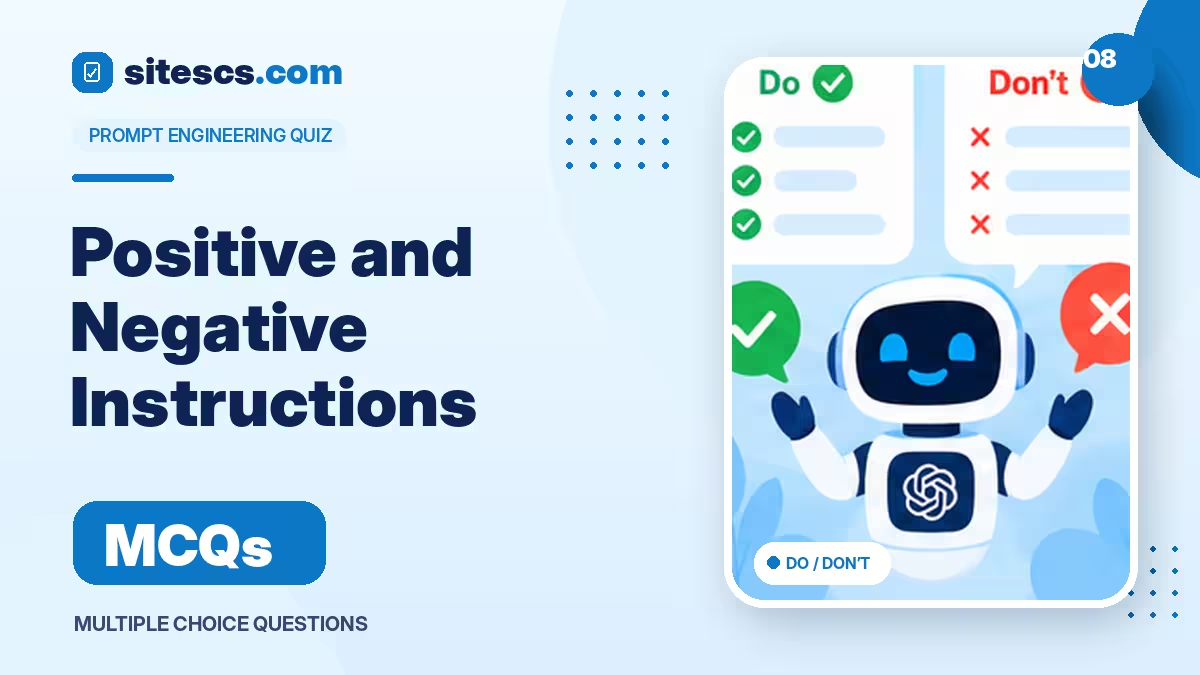
Positive and negative instructions are important concepts in prompt engineering that help users control how artificial intelligence models respond to different tasks. These instructions communicate desired behaviors and identify actions or content that should be avoided.
Positive instructions explain what an AI model should do, while negative instructions explain what it should not do. Both approaches can help establish clear expectations when interacting with large language models.
Understanding these instruction types is essential for developing effective AI prompts, improving content quality, and preparing for prompt engineering multiple-choice questions.
What Are Positive Instructions?
Positive instructions are explicit directions that describe the actions, characteristics, or outcomes expected from an AI model.
They focus on the desired response rather than prohibited behavior.
For example:
“Explain cloud computing in three short paragraphs using beginner-friendly language and one practical example.”
This instruction tells the model what topic to explain, how to organize the answer, and which communication style to follow.
Positive instructions are commonly used in summarization, translation, educational content generation, programming assistance, and structured data extraction.
Clear positive instructions can reduce uncertainty by establishing specific requirements for task completion.
What Are Negative Instructions?
Negative instructions define actions, information, or response characteristics that the AI model should avoid.
For example:
“Explain cloud computing without using complicated technical jargon or unrelated examples.”
This instruction restricts certain response characteristics rather than directly describing every desired feature.
Negative instructions are useful for excluding unnecessary details, limiting inappropriate language, reducing irrelevant content, and defining task boundaries.
However, negative instructions alone may not clearly communicate the preferred alternative. For this reason, they are often more effective when combined with positive instructions.
Positive vs Negative Instructions
The key difference lies in their objectives. Positive instructions specify the desired behavior, while negative instructions identify behavior that should be avoided.
For example, “Use simple English” is a positive instruction. “Do not use advanced technical terminology” is a negative instruction.
Both instructions address the readability of AI-generated content, but they communicate the requirement differently.
A combined prompt might say: “Explain artificial intelligence in simple English using a real-world example. Avoid unexplained technical abbreviations.”
This approach provides useful guidance while establishing a clear restriction.
Importance of Instruction Clarity
Clear instructions help AI models identify important requirements and produce responses that better match user expectations.
Ambiguous negative instructions can cause problems when the prohibited behavior is not clearly defined. For example, “Do not make the answer bad” offers little practical guidance.
A more effective prompt identifies measurable expectations, such as an approximate word count, preferred terminology, or required content structure.
Users should also avoid contradictory directions because conflicting requirements can make successful task completion difficult.
Benefits and Limitations
Positive instructions encourage goal-oriented responses and help communicate the desired output. Negative instructions help establish boundaries and exclude unwanted characteristics.
Together, they can improve response relevance, readability, and consistency.
However, neither type guarantees that an AI model will follow every requirement. The generated response may still contain factual errors, formatting mistakes, or unexpected content.
Testing prompts against different inputs remains necessary.
Practice Positive and Negative Instructions MCQs
Our Positive and Negative Instructions MCQs examine definitions, practical examples, instruction differences, prompt constraints, effective wording, and common mistakes.
Attempt the quiz below to improve your understanding of AI instruction design and prepare for prompt engineering assessments, interviews, and certification examinations.
Positive and Negative Instructions MCQs | AI Quiz
Practice Positive and Negative Instructions MCQs with definitions, examples, key differences, prompt constraints, and effective AI prompting techniques.
