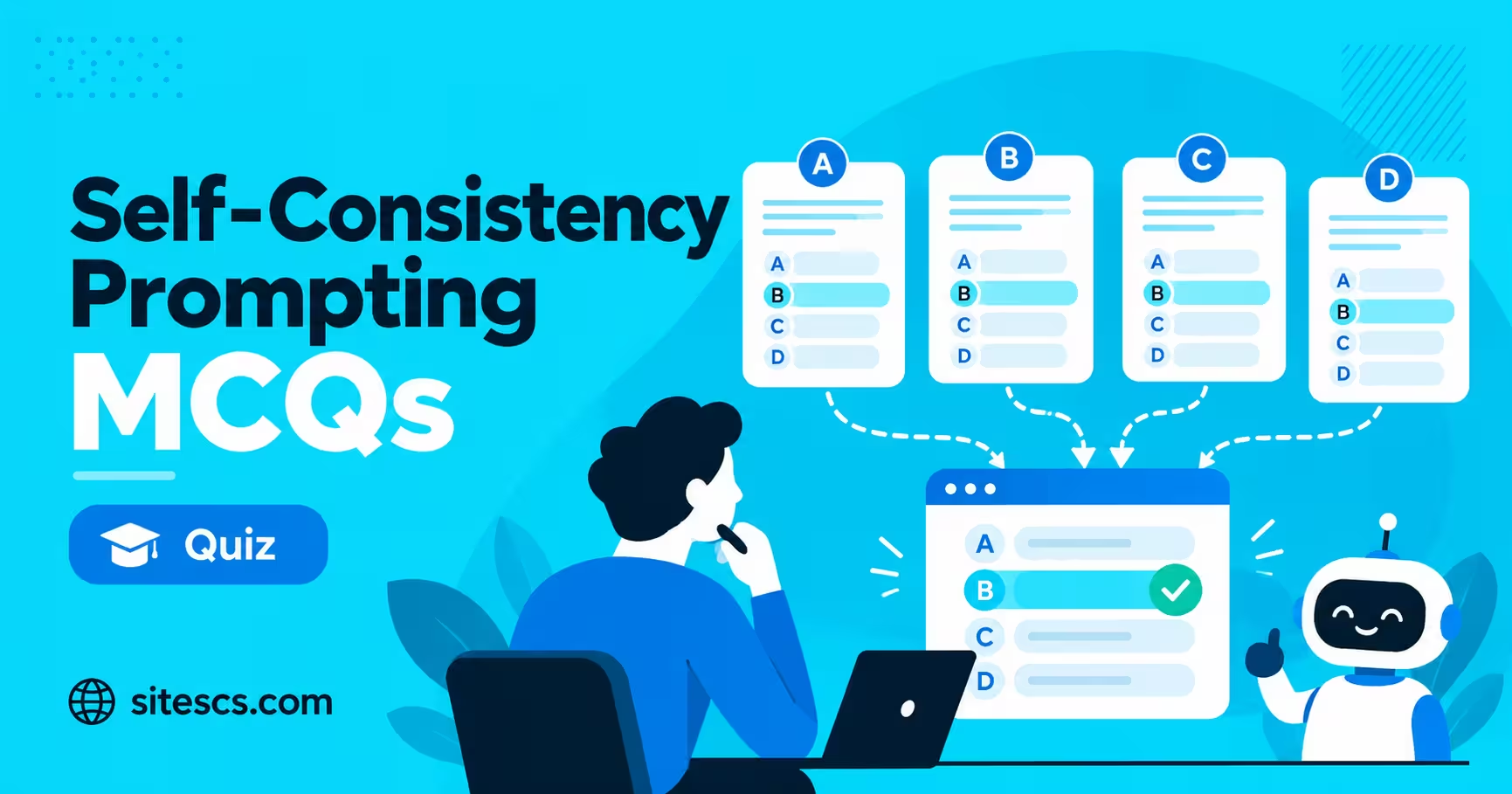
Self-Consistency Prompting MCQs help students and AI enthusiasts understand an advanced prompt engineering technique designed to improve answer reliability in reasoning tasks. Self-consistency generates multiple potential reasoning paths for the same problem and selects an answer based on agreement among the generated results.
This technique is particularly useful for mathematical reasoning, logical problem-solving, and questions where different approaches can lead to the same correct answer.
The following Self-Consistency Prompting quiz helps learners evaluate their knowledge of this technique and its relationship with Chain-of-Thought Prompting.
What Is Self-Consistency Prompting?
Self-Consistency Prompting is a reasoning technique that generates several diverse solutions to a problem and identifies the answer that appears most consistently across those solutions.
It was introduced by researchers including Xuezhi Wang and Jason Wei in work presented at ICLR 2023.
The central idea is that complex questions may have several valid reasoning approaches. If different approaches independently produce the same answer, agreement among their results may provide a useful signal when selecting a final response.
Self-consistency is commonly used alongside Chain-of-Thought Prompting.
How Does Self-Consistency Prompting Work?
Self-consistency typically begins by providing a question that requires reasoning. Instead of generating only one solution, the system samples multiple responses using a language model.
These responses may follow different reasoning paths while addressing the same problem.
After generating the candidate solutions, the system extracts their final answers and identifies the most frequently occurring answer.
This approach is often called majority-vote answer selection, although more sophisticated aggregation methods are possible.
Unlike simply asking the AI to repeat an answer, genuine self-consistency involves generating diverse candidate solutions.
Example of Self-Consistency Prompting
Suppose an AI model receives the following question:
Question: A shop sells 12 pencils for ₹60. What is the price of five pencils?
The system generates multiple solutions.
One solution finds the price of a single pencil and multiplies it by five. Another uses a proportional calculation. A third applies the unit-rate method.
All three approaches produce ₹25 as the answer.
Since the independently generated solutions agree, the system selects ₹25 as the final result.
This example demonstrates how agreement across different approaches can support answer selection.
Benefits of Self-Consistency Prompting
Self-Consistency Prompting can improve reasoning performance on tasks where several solution strategies are possible.
It reduces reliance on a single generated response and can help identify answers supported by multiple candidate solutions.
The technique is useful in mathematical problem-solving, structured reasoning, educational assessments, and AI applications requiring greater consistency.
It can also reveal uncertainty when generated answers disagree significantly.
Limitations of Self-Consistency Prompting
Self-consistency requires multiple model generations, which can increase processing time, token consumption, and API costs.
Moreover, majority agreement does not guarantee correctness. Several responses may share the same misconception or calculation error.
The technique may also provide limited benefits when questions are highly subjective or do not have a clearly defined correct answer.
Independent validation remains important.
Test Your Knowledge with Self-Consistency Prompting MCQs
The following Self-Consistency Prompting MCQs cover the definition, working mechanism, multiple reasoning paths, answer aggregation, benefits, limitations, and relationship with Chain-of-Thought Prompting.
These questions are useful for students preparing for AI examinations, prompt engineering interviews, and technical assessments.
Attempt the quiz below to test your understanding of Self-Consistency Prompting and learn how multiple reasoning approaches can support AI problem-solving.
Self-Consistency Prompting MCQs with Answers | AI Quiz
Explore Self-Consistency Prompting MCQs with answers. Understand multiple reasoning paths, answer selection, benefits, examples, and limitations.
