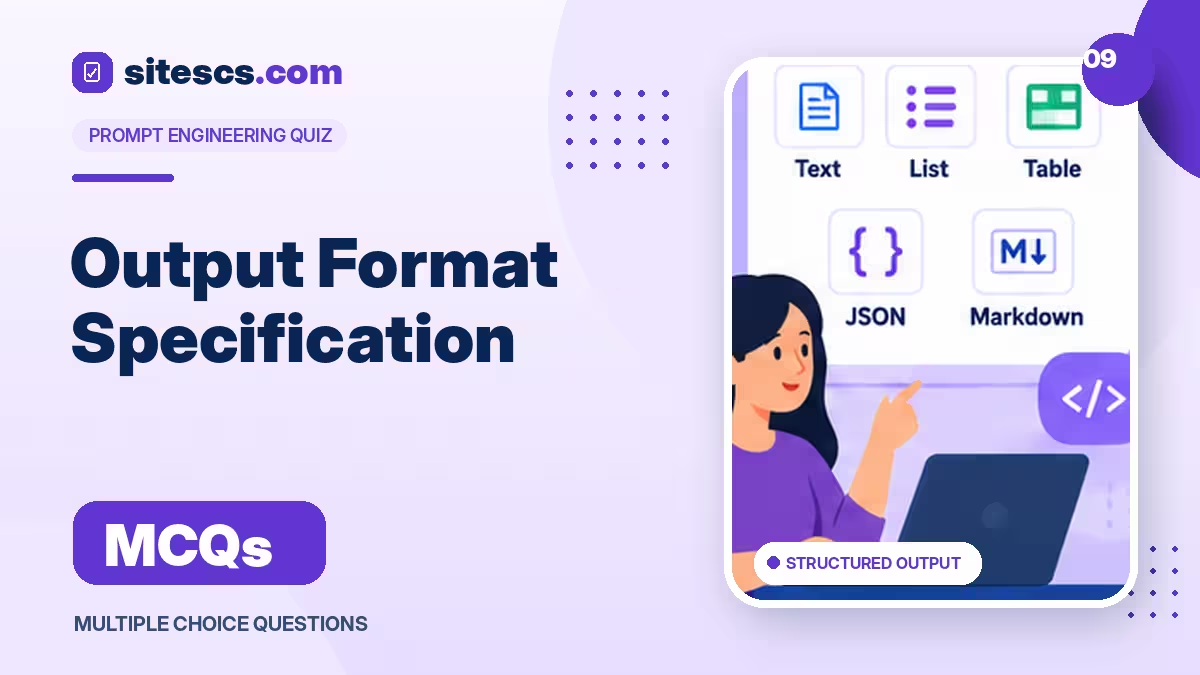
Output format specification is an important prompt engineering technique that defines how an artificial intelligence model should organize and present its generated response. Instead of allowing the model to choose any response structure, users specify the required layout, data fields, presentation style, or output format.
This technique is widely used in large language model applications involving content generation, structured data extraction, chatbot development, automated reporting, and software integration.
Understanding output format specification is essential for students, developers, and professionals who want to create consistent and easily usable AI-generated responses.
What Is Output Format Specification?
Output format specification refers to providing explicit instructions about the structure or representation of an AI model’s response.
Common output formats include plain text, paragraphs, numbered steps, Markdown, HTML, CSV, JSON, and tables.
For example, consider the following instruction:
“List five programming languages in a Markdown table with the columns Language, Common Use, and Learning Difficulty.”
This prompt establishes the required content and presentation format.
Another example is requesting customer information in JSON with fields such as name, email, and city.
By specifying the output format, users communicate how the response should be organized before the model begins generating it.
How Does Output Format Specification Work?
Output format specification works by defining structural requirements within the prompt. The AI model attempts to follow these requirements while completing the requested task.
For simple tasks, users may only need to specify a paragraph count or table layout. More complex applications may require defined field names, data types, nested objects, or formatting constraints.
For instance, an application extracting information from invoices might require JSON containing invoice_number, invoice_date, and total_amount.
Consistent field names allow downstream applications to process model-generated data more easily.
When strict machine-readable output is required, developers can use supported structured-output features and schema validation rather than relying only on natural-language formatting instructions.
Common Output Formats in Prompt Engineering
Plain text is useful for simple explanations and short answers. Markdown provides readable formatting for headings, tables, and documentation.
JSON is commonly used when AI-generated information must be processed by software systems. CSV can represent tabular data intended for spreadsheet applications.
HTML may be appropriate when the generated response is intended for web presentation.
Choosing the correct output format depends on how the generated information will be consumed, stored, displayed, or processed.
Advantages of Output Format Specification
The main advantage is improved structural consistency. Clear formatting requirements make responses easier to read, compare, and integrate into workflows.
Output specification can also reduce manual editing when repeated tasks require similar layouts.
For example, an AI system generating product records in a consistent format can simplify later review and processing.
Structured formats are particularly valuable for automation, although they still require appropriate validation.
Challenges and Best Practices
AI models may occasionally generate incomplete fields, invalid syntax, incorrect data types, or content that does not match the requested format.
A response that appears to be JSON is not necessarily valid JSON. Similarly, syntactically valid JSON may still contain incorrect information.
Effective prompts should therefore identify required fields, allowed values, relevant constraints, and handling rules for missing information.
Developers should validate outputs before using them in applications.
Practice Output Format Specification MCQs
Our Output Format Specification MCQs test definitions, common formats, JSON, Markdown, tables, schema concepts, formatting constraints, and practical applications.
Complete the quiz below to strengthen your understanding of structured AI responses and prepare for prompt engineering interviews, assessments, and technical examinations.
Output Format Specification MCQs with Answers
Explore Output Format Specification MCQs with definitions, JSON examples, Markdown, tables, structured outputs, formatting rules, and prompt engineering concepts.
