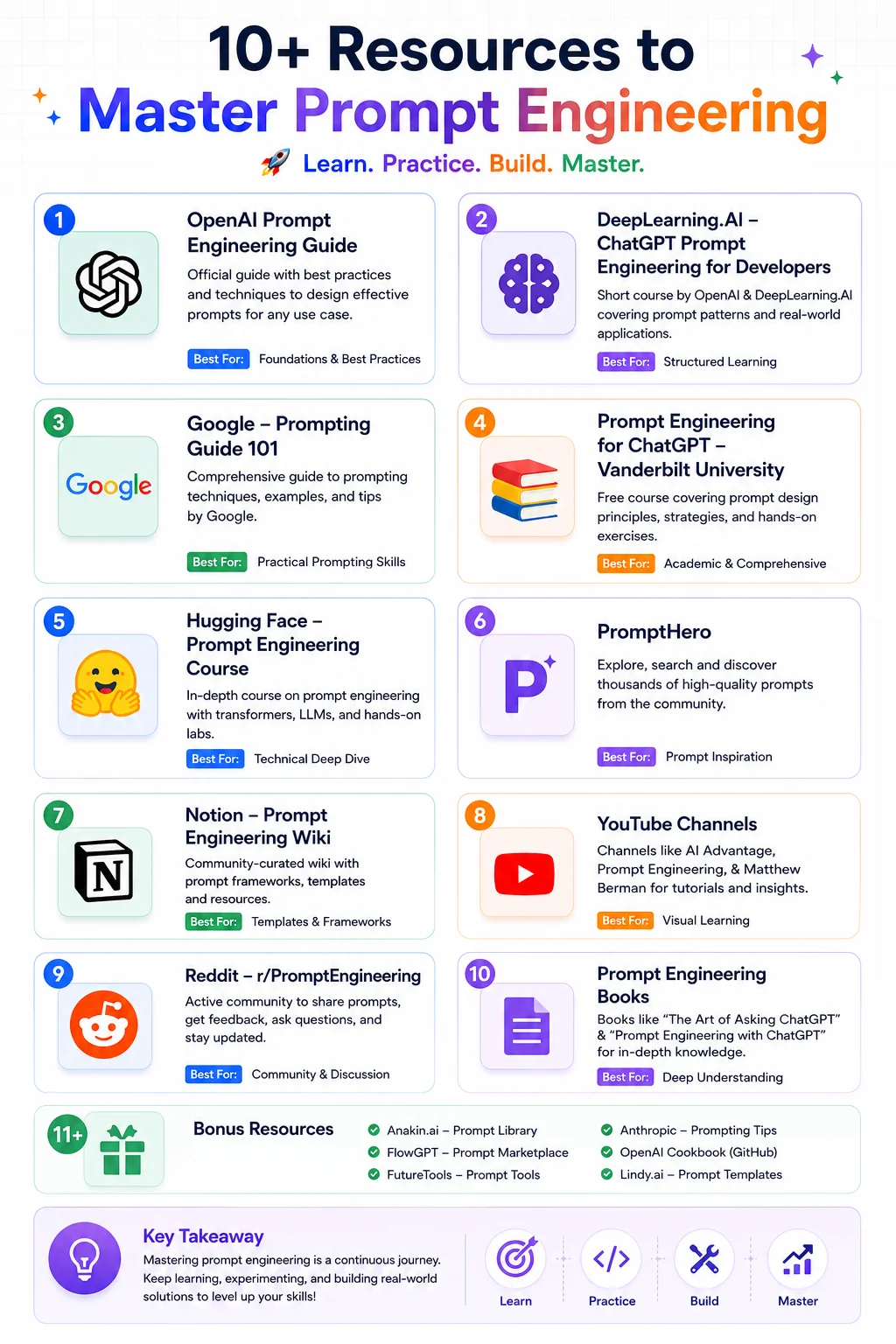
10+ Resources to Master Prompt Engineering

The world of Artificial Intelligence is moving at light speed! New models drop almost every week, and it can feel impossible to keep up. But here is a secret: while tools change, the fundamentals of talking to AI stay the same. This is called prompt engineering, and mastering it will transform your career!
If you want to move beyond just “chatting” and start building real systems, you need the right tools. Whether you are a student, a business owner, or a developer, these resources will help you master prompt engineering in 2026. Let’s dive into the best books, guides, and research papers available today!
Key Takeaways
- Prompt engineering is now a required skill for anyone working with AI, ranging from casual users to professional software developers.
- The best resources focus on repeatable patterns and systems rather than just single “magic” phrases.
- Mastery requires a mix of foundational books, interactive roadmaps, and hands-on practice.
- Top-tier books like Prompt Engineering for Generative AI and The LLM Engineering Handbook are essential for scaling AI solutions.
- Understanding reasoning techniques like Chain-of-Thought (CoT) and Tree of Thoughts (ToT) is critical for solving complex problems.
10+ Resources to Master Prompt Engineering
1. Prompt Engineering for Generative AI (Phoenix & Taylor)
If you only read one book this year, make it this one! James Phoenix and Mike Taylor argue that prompt engineering works best as a repeatable operating system rather than a list of clever tricks.
This book is perfect because it teaches you five core principles: Give Direction, Specify Format, Provide Examples, Evaluate Quality, and Divide Labor. It covers everything from text to image generation, making it a truly future-proof resource. It is the strongest overall pick for workplace users who want reliable results every time.
2. AI Prompt Engineering Absolute Beginner’s Guide (Michael Miller)
Are you feeling a bit lost when you open ChatGPT? Don’t worry! Michael Miller’s guide is the clearest first read for anyone who is brand new to AI.
The book uses very easy English to explain “prompt anatomy”. It breaks prompts down into tasks, topics, tones, and constraints. You will learn how to move from simple “zero-shot” prompts to more advanced “few-shot” examples without needing to know any computer code. It is like a friendly map for your first AI journey!
3. The Prompt Engineering Guide (DAIR.AI)
This is perhaps the most famous online resource in the world! The Prompt Engineering Guide is a massive, free collection that contains the latest papers, learning guides, and tools.
It is updated constantly with new LLM capabilities. If you want to learn about “Self-Consistency” or “Retrieval Augmented Generation” (RAG), this is the place to go. It even offers courses for beginners and advanced practitioners to help you get the most out of models like GPT-4 and Claude.
4. Prompt Engineering for LLMs (Berryman & Ziegler)
Once you understand the basics, you might want to start building your own apps. This book is written by the experts who helped create GitHub Copilot, so they know exactly what works in the real world!
They teach you that LLMs are basically “text completion engines” that mimic what they saw during training. By learning to empathize with how the model “thinks,” you can guide it to generate high-quality content for any application. This is a must-read for software engineers who want to build the next generation of AI tools.
5. The Prompt Engineering Roadmap (roadmap.sh)
Do you like visual learning? The Prompt Engineering Roadmap is an incredible step-by-step guide that shows you exactly what to learn and in what order.
It covers everything from “What is a Prompt?” to advanced topics like “AI Red Teaming” and “Prompt Injection”. It even gives you best practices, such as keeping prompts concise and using delimiters like triple backticks to organize your text. It is a fantastic way to track your progress as you work toward complete mastery!
6. The LLM Engineering Handbook (Iusztin & Labonne)
This resource is often called the “LLM Bible” for practitioners. It is written like an operations manual for people who actually ship products to millions of users.
You will learn about prompt engineering at scale, how to measure AI performance, and how to optimize costs. If you are serious about moving from simple demos to production-ready systems, this is a foundational resource you cannot skip. It bridges the gap between theoretical AI and real-world implementation.
7. Prompt Engineering Jumpstart (GitHub eBook)
If you want a “zero-to-hero” guide that is totally free and open-source, check out this eBook on GitHub. It is designed for absolute beginners and uses simple analogies to explain the “grammar” of talking to AI.
The book covers 14 core patterns used by experts, such as the “Persona Pattern” and “Chain-of-Thought”. It even includes “Before vs. After” examples so you can see exactly how a small change in your wording can lead to a much better answer!
8. Chain-of-Thought Prompting Research (Wei et al.)
Sometimes, the best way to master a topic is to go straight to the source! The original research paper on Chain-of-Thought (CoT) prompting is a game-changer.
The researchers discovered that if you ask an AI to “think step-by-step,” its ability to do math and solve logic puzzles improves dramatically. This is because CoT allows the model to decompose complex problems into smaller intermediate steps. Reading this paper will help you understand the scientific reason why certain prompts work better than others!
9. Tree of Thoughts: Deliberate Problem Solving (Yao et al.)
If Chain-of-Thought is like a single path, the Tree of Thoughts (ToT) is like a whole map! This advanced technique allows the AI to explore multiple different reasoning paths at once.
The AI can self-evaluate its choices and even “backtrack” if it realizes it made a mistake. This is critical for very hard tasks like creative writing or complex planning. Understanding ToT will put you in the top 1% of prompt engineers who can solve the toughest AI challenges!
10. OWASP LLM Prompt Injection Prevention Cheat Sheet
Safety first! As you become an expert, you must learn how to protect your AI from “prompt injection”. This happens when a malicious user tries to trick the AI into ignoring its original instructions.
The OWASP Cheat Sheet is the gold standard for learning how to build secure AI systems. It teaches you how to sanitize user input and use structured formats to keep your AI on the right track. Being a master prompt engineer also means being a responsible one!
11. Hands-On Large Language Models (Alammar & Grootendorst)
For those who learn by doing, this book is a treasure chest! Jay Alammar is one of the most respected voices in AI education.
This resource teaches you to build with LLMs using modern tools like LangChain and Hugging Face. It is full of hands-on examples that show you how to apply prompting patterns to real NLP workflows. It is ideal for developers who want to improve their “AI intuition” through practice.
12. Least-to-Most Prompting (Zhou et al.)
This is another brilliant technique for your toolkit! Least-to-Most prompting helps AI solve problems that are even harder than the examples you give it.
It works by breaking a big problem into a series of easier subproblems and solving them in order. This is especially helpful for symbolic reasoning and math. Learning this method will help you teach humans how to better teach language models!
Sources:
- GSM8K (Math Word Problems): https://github.com/openai/grade-school-math
- ASDiv (Diverse Math Problems): https://github.com/chaochun/nlu-asdiv-dataset
- AQuA (Algebraic Word Problems): https://github.com/deepmind/AQuA
- SayCan (Robotic Affordances): https://say-can.github.io/
- StrategyQA (Commonsense Reasoning): https://github.com/google/BIG-bench/tree/main/bigbench/benchmark_tasks/strategyqa


