Prompt Engineering Basics: Learn Step-by-Step

Have you ever wondered how some people get those amazing, detailed answers from AI while others just get boring replies? It is not magic—it is prompt engineering basics! In 2026, knowing how to talk to a neural network is the most important skill you can have for your career! As we move into the era of autonomous agents, being able to give clear AI prompts is like having a superpower that makes you indispensable in any job.
Prompt engineering is simply the art of asking the right way to get the best results from AI tools. These tools are incredibly smart, but they are not mind-readers! If you use a “bad” prompt like “Write an article,” you will likely get a bland, directionless wall of text. But a “good” prompt like “Write a 500-word blog post on SEO for beginners in a casual tone” gives the AI something real to work with! This beginner guide will help you stop feeling frustrated and start getting high-quality results immediately.
Table of Contents
- What is Prompt Engineering?
- Why Prompt Engineering is Important?
- Types of Prompts You Should Know
- Step-by-Step Guide to Writing Effective Prompts
- Common Mistakes in Prompt Engineering
- Best Prompt Engineering Techniques
- Tools You Can Use for Prompt Engineering
- Advanced Tips to Master Prompt Engineering
- Summary
- FAQ Section
What is Prompt Engineering?
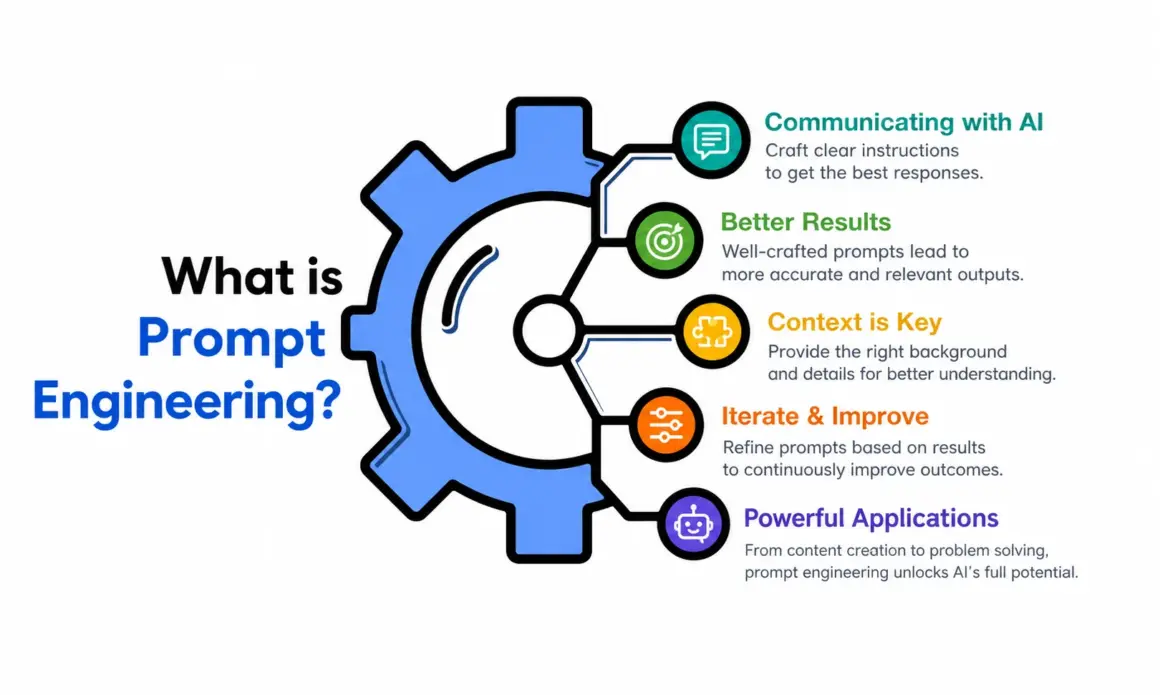
So, what is prompt engineering exactly? Let’s break it down into very easy English! Think of the AI as a powerful tool and the prompt meaning as the specific instruction you give to that tool. Just like a hammer needs a person to swing it, an AI needs your prompt to know what to build! At its heart, it is the process of designing and refining inputs to help you get the most accurate and controlled outputs possible without needing to be a computer programmer.
How AI Understands Prompts
AI operates on a simple AI input output relationship. When you provide a prompt (the input), the AI looks at massive amounts of data to find patterns and predict the best response (the output). The most important thing to remember is clarity! If your instructions are vague, the AI will give you generic filler. But if you provide context and specific details, the AI can act like a subject matter expert just for you!
Real-Life Examples
You can see prompting in action everywhere today! Here are three common ways we use it:
- ChatGPT: You might ask it to “Write a humorous email to my boss about a meeting” to save time on your daily chores.
- AI Image Tools: Artists use prompts to describe “a photorealistic sunset with palm trees” to create stunning visuals instantly.
- Voice Assistants: When you tell your phone to “remind me to buy milk,” you are giving it a basic prompt to perform a task!
Mastering these instructions is the best way to stay ahead in our fast-changing world!
Why Prompt Engineering is Important?
Prompt engineering is the secret to unlocking the full power of modern AI tools! Even though you might use the same AI model as everyone else, your results will be much better if you ask the right way. This is the true importance of prompt engineering; it turns generic, shallow filler into expert-level content. By using high-quality instructions, you can ensure the AI understands your specific intent and produces accurate results every single time. Well-crafted prompts lead to much better model performance and more relevant information.
This process also saves you huge amounts of time and effort because you won’t have to spend hours manually reviewing or editing bad responses. You can easily automate tasks like writing long professional emails or summarizing huge reports in just a few seconds! As we look toward the future, these are the essential AI skills 2026 employers will search for! By 2026, being able to talk to AI correctly will be a basic skill just like knowing how to use a search engine. Whether you are freelancing or working in a big business, mastering these techniques makes you a “Digital Office Director” who can manage autonomous agents. It is a prestigious and high-paying career path that keeps you ahead in a fast-changing world. Mastering these skills means you are no longer just a user, but an architect of the future!
Types of Prompts You Should Know
To become a true AI expert, you need to understand the different prompt categories used to guide these models!
The first type is Instruction-Based Prompts, which are direct commands telling the AI exactly what action to take. For example, you might say, “Write a bulleted list that summarizes this research paper”. These are great for getting fast, specific work done without any extra fluff.
Next are Question-Based Prompts, where you ask the AI for facts or its perspective on a topic. A common AI prompt examples for this would be asking, “What are the main causes of deforestation?” to get a detailed explanation from the AI’s knowledge base.
One of the coolest types of prompts is the Role-Based Prompt, where you tell the AI to “Act as a…” specific character or expert. You could tell the AI, “You are a patient math tutor,” to help you learn complex problems step-by-step. This identity acts like a cognitive filter that changes the tone and vocabulary the AI uses to match a real professional.
Then we have Contextual Prompts, which involve giving the AI background information or specific constraints. If you tell the AI who your target audience is or define exactly how long the text should be, the quality of the output improves almost immediately! Providing this context reduces ambiguity and prevents the model from getting confused about your goal.
Finally, there are Creative Prompts for when you want the AI to “create stuff” like stories, poems, or brand-new ideas. You can ask it to “Write a short story about a magical portal found in an old attic” to see its imagination in action. AI can even help you brainstorm catchy titles for a blog or ideas for a new business. By mixing these different styles, you can handle any task from data analysis to storytelling! Learning these categories is the perfect way to start your journey into the exciting world of generative AI!
Step-by-Step Guide to Writing Effective Prompts
Are you ready to create perfect instructions for your AI? Learning how to write prompts is just like giving clear directions to a new teammate! Even though AI is powerful, it needs a roadmap to understand your specific goals. Follow this prompt engineering step by step guide to get the best results every time!
Step 1: Be Clear and Specific
The most common mistake beginners make is being too vague or open-ended. If you just say “Write an article,” the AI might give you a bland wall of text that does not meet your needs. Instead, treat your prompt like instructions to a freelance writer. You should always include details like the specific topic, your target audience, the desired tone, and even a word count. Using precise language helps avoid ambiguity so the AI doesn’t have to guess what you want.
Step 2: Define the Role
One of the most powerful tricks is telling the AI “who” it should be. When you say “Act as a senior marketing strategist,” you set a cognitive filter that changes the AI’s vocabulary and perspective. Assigning a role, like a teacher or a software engineer, helps the model narrow its knowledge and focus on the right details. This simple step makes the response feel much more professional and relevant!
Step 3: Add Context
AI tools are not mind-readers, so providing background information is essential. Adding facts, data, or a summary of previous conversations helps the AI maintain continuity. Without context, the model might produce generic filler or lose track of your main goal. The more relevant background you provide, the higher the quality of the final output will be!
Step 4: Specify Format
Don’t forget to tell the AI how you want the answer to look! You can ask for information in a table, a bulleted list, a code block, or a simple paragraph. Specifying the format makes the answer practical and much easier to read. For example, asking for a “content marketing strategy in a table” ensures you get an organized response you can use immediately!
Step 5: Iterate and Improve
Rarely is your first prompt perfect, and that is okay! Prompting is a structured, step-by-step process of refining your instructions. If the output is a bit dry, follow up by saying “make it more engaging” or “add a quick example”. Treat the AI like a collaborator in a conversation, not a vending machine. By asking follow-up questions and adjusting your constraints, you will eventually reach the perfect result!
Common Mistakes in Prompt Engineering
Even though prompt engineering looks easy, many people make small mistakes that reduce the quality of AI responses. Avoiding these common prompt mistakes can help you get faster and more accurate results.
A very common AI prompt error is writing unclear or short prompts. For example, “Explain marketing” is too general. AI will give a broad answer that may not be useful. Instead, clearly define what type of marketing, audience, and purpose you want.
AI performs better when it understands the situation. If you don’t provide enough background, the answer may feel incomplete or off-topic. For example, instead of saying “Write a blog,” mention the topic, target audience, tone, and goal. Context improves relevance.
Many users forget to mention how they want the answer. Should it be a list, table, paragraph, or steps? Without format instructions, the output may be messy. Always guide AI on structure to save editing time.
AI rarely gives the perfect answer in one attempt. Expecting perfection instantly is unrealistic. Prompt engineering is a process where you refine your input step by step. Small improvements can lead to much better results.
Learning through prompt examples is one of the best ways to improve. Below are simple comparisons of good vs bad prompts to help you understand what works better.
Example 1
Bad Prompt:
“Write about business”
Good Prompt:
“Write a 500-word article about small business ideas for beginners in India. Include 5 ideas with short explanations and use simple language.”
The good prompt clearly defines the topic, audience, word count, and structure.
Example 2
Advanced Structured Prompt:
“Act as an expert content writer. Create a detailed blog outline on ‘Digital Marketing Basics’ for beginners. Include an introduction, H2 and H3 headings, and 5 FAQs. Keep the tone simple and beginner-friendly.”
This structured prompt uses role, format, and clear instructions, which leads to high-quality output.
Best Prompt Engineering Techniques
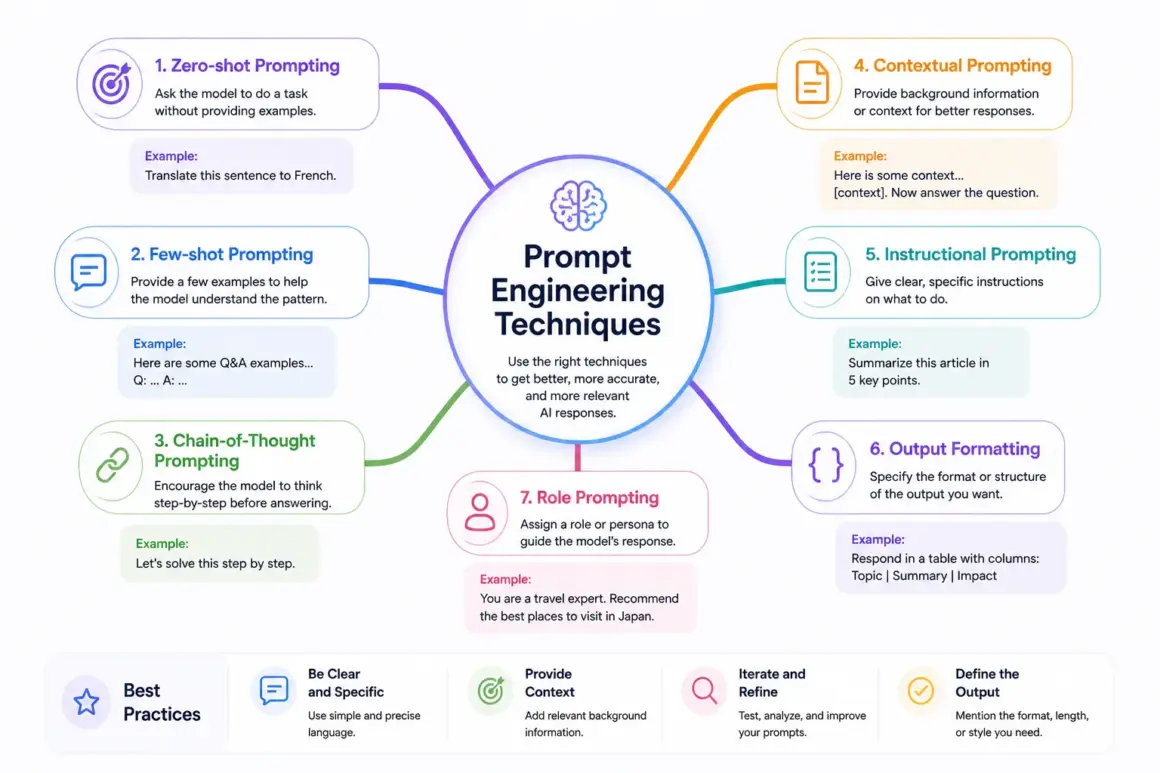
To truly master AI, you should experiment with different prompt techniques! Each technique helps the model handle different types of tasks with better accuracy. Here are the four most important ones you need to know.
1. Zero-Shot Prompting
Zero-shot prompting is the simplest method where you give a direct command without providing any examples. This is great for quick tasks like “Summarize this news article” or “Translate this sentence to Spanish”. It relies entirely on the AI’s pre-trained knowledge to understand your intent.
2. Few-Shot Prompting
If you want the AI to follow a specific pattern, use few-shot prompting! This involves giving the AI a few examples (or “shots”) of the desired input and output before asking your question. For instance, you could show the AI three examples of how to classify customer feedback so it understands the exact style you expect. This technique is much more accurate for complex tasks than zero-shot prompting.
3. Chain-of-Thought Prompting
For difficult math problems or logical puzzles, chain-of-thought prompting is a lifesaver! This technique forces the AI to break down complex reasoning into a series of intermediate steps. You can trigger this by adding instructions like “Solve this problem step by step” or “Let’s think step by step”. By showing its work, the AI is less likely to make logical errors and gives you more reliable answers.
4. Role Prompting
As we mentioned earlier, role prompting involves assigning a specific identity or personality to the AI. By telling the AI “You are a patient math tutor,” you ensure it uses an encouraging tone and simple explanations. This identity helps the model decide which information to prioritize and how to present it most effectively for your audience. Mastering these methods will make you an expert at talking to AI!
Tools You Can Use for Prompt Engineering
To start your journey, you need the right AI tools! The prompt tools list is growing every day, but a few big names lead the way. ChatGPT is currently the most popular tool and is excellent for summarizing long texts or writing creative drafts. Claude is another powerful option that many professionals use to build applications and handle complex, technical instructions.
Gemini (created by Google) is fantastic because it can integrate up-to-date information directly from Google Search into its answers! For those who want to create stunning visuals, AI Image Tools like DALL-E and Midjourney use a technology called stable diffusion to turn your descriptive words into high-quality pictures. There are even specialized “Playgrounds” and developer environments where you can test your prompts more deeply before using them in a project. These tools are like your digital canvas for the future!
Advanced Tips to Master Prompt Engineering
Are you ready to move beyond the basics and use expert prompts? Here are some advanced prompt engineering secrets that pros use! First, you should always use constraints like specific word limits, a unique tone of voice, or a set number of sentences. This prevents the AI from giving you a long, boring answer when you only need a quick, focused summary!
Next, you should combine techniques for the best results! Don’t just give the AI a role; add background context and a specific format, such as a table or a bulleted list, to make the output practical and professional. Many experts also test multiple prompts at the same time to see which version gives the most reliable answer. This is often called A/B testing, and it is a great way to find the perfect instructions for difficult tasks. Finally, make sure to save and reuse prompts! By building your own prompt library and tracking different versions, you won’t have to start from scratch every single time. This structured approach turns AI from a simple chatbot into a powerful professional workstation!
Summary
In short, learning prompt engineering is the most important career skill you can pick up in 2026! It acts as the bridge that connects your human ideas to the massive power of artificial intelligence. Always remember that practice is essential; you will rarely get the perfect answer on your very first try.
But don’t be discouraged! Small improvements in how you phrase your instructions lead to big results in the quality of work you receive. The best way to learn is to start today! Open up an AI tool and start experimenting with different roles and contexts. You will be absolutely amazed at how much faster and smarter you can work when you know how to talk to AI correctly!
FAQ Section
1. What is prompt engineering in simple words?
It is simply the art and science of asking AI tools the right way to get the most useful, accurate, and relevant answers possible.
2. Is prompt engineering hard to learn?
Not at all! It requires very low technical skills and is mostly about being creative, being clear, and being willing to test different instructions until they work.
3. Can I earn money using prompt engineering?
Yes! In 2026, “AI Agent Architects” and expert prompters are in high demand for prestigious, high-paying careers that help businesses automate their daily work.
4. Which tools are best for prompt engineering?
The top choices are ChatGPT, Claude, and Gemini, but there are also many specialized “Prompt IDEs” and “Playgrounds” used by professional developers.
5. How long does it take to learn prompt engineering?
You can learn the absolute basics in just a few hours through short online courses, though becoming a professional architect takes more practice and systematic study.