Prompt Engineering for AI Tools: A Complete Beginner Guide
Have you ever asked an AI tool a question, only to get a robotic, confusing, or completely wrong answer? You are definitely not alone! Many people think AI is a magic wand that can read minds. But the truth is, AI is more like a super-smart assistant who needs very clear instructions to do a good job.
Learning how to talk to this assistant is called prompt engineering. It sounds like a complex coding term, but do not worry! You do not need to be a programmer or a tech genius to master it. By the time you finish reading this complete beginner guide, you will know exactly how to write prompts that get amazing results every single time. Let us dive right in!
What Exactly Is Prompt Engineering?
At its core, a prompt is simply the text you type into an AI tool (like ChatGPT, Gemini, or Claude) to get an answer. Prompt engineering is the skill of designing, refining, and improving those words to get the highest quality output possible.
Think of it like ordering food at a restaurant. If you just say, “Give me a burger,” you might get a plain patty on a dry bun. But if you say, “I would like a double cheeseburger with lettuce, tomato, and extra mayo, please!” you get exactly what you want. AI works the exact same way. The better your instructions, the better the results. Mastering this skill turns generative AI from a basic, sometimes frustrating tool into a powerful, highly productive sidekick that can help you with almost anything.
Why Do You Need to Learn This Skill?
You might be wondering if it is really worth your time to learn this. The answer is a massive yes! Prompt engineering is rapidly becoming an essential life and career skill. Here is why you need to pay attention:
- Saves Massive Amounts of Time: Instead of spending an hour asking the AI to rewrite a bad answer, a good prompt gives you the perfect answer on the first try. You get more done in less time!
- Boosts Creativity and Brainstorming: By giving the AI clear boundaries and context, it can generate highly creative ideas for writing, marketing, or problem-solving that you might never have thought of on your own.
- Reduces Frustrations: No more pulling your hair out over weird, hallucinated, or irrelevant AI responses! When you know how to steer the machine, you are always in complete control.
- Future-Proofs Your Career: As companies adopt more AI tools, employees who know how to get the best results out of these systems will be the most valuable people in the room.
The Golden Formula for a Perfect Prompt
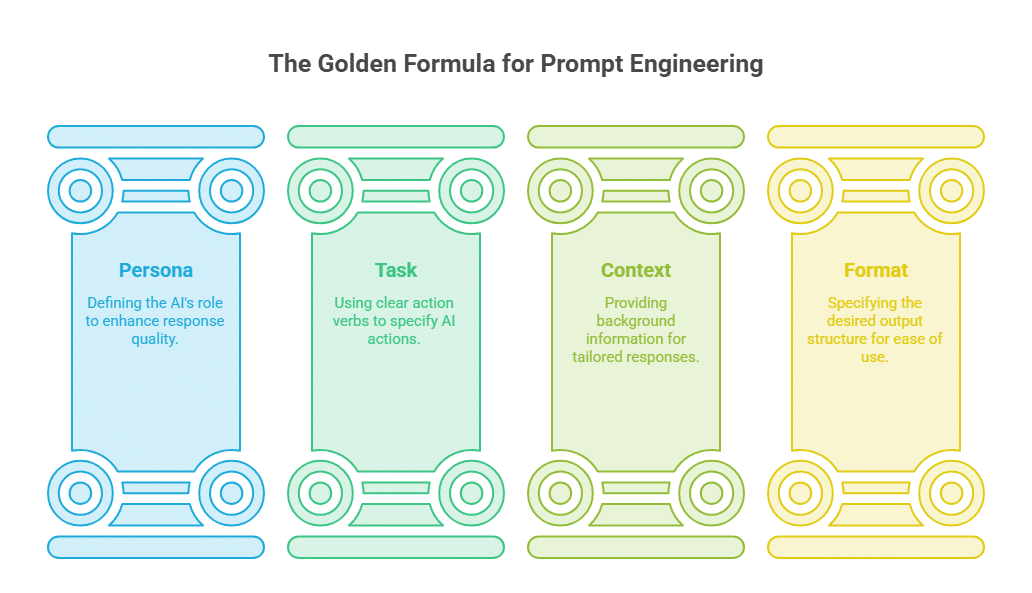
Writing a great prompt is not about guessing. It is about following a proven structure. Professional prompt engineers use a simple checklist to make sure their AI understands exactly what to do. Whenever you write a prompt, try to include these four key elements:
1. The Persona (Who is the AI?)
If you do not tell the AI who to be, it will just act like a generic robot. Tell it to take on a specific role! This drastically improves the quality, depth, and tone of the response.
- Bad: Tell me about space.
- Good: Act as a passionate NASA scientist explaining the solar system to a 10th-grade student.
2. The Task (What do you want?)
Use clear, strong action verbs to define exactly what the AI needs to do. Avoid vague requests that leave the AI guessing.
- Bad: Look at this data.
- Good: Summarize the key findings of this data and identify the biggest sales trend from the last quarter.
3. The Context (What is the background?)
AI does not know your personal life, your business, or your goals. You have to give it the background information! The more context you provide, the more tailored and useful the answer will be.
- Bad: Write an email to my boss.
- Good: Write a polite email to my boss asking for a two-day deadline extension on the marketing project because we are still waiting on crucial client feedback.
4. The Format (How should it look?)
Do you want a bulleted list? A table? A professional letter? Tell the AI exactly how to format the output so you do not have to reorganize the text yourself.
- Bad: Give me healthy eating tips.
- Good: Create a bulleted list of 5 healthy eating tips, keeping each tip under 20 words.
Beginner-Friendly Prompting Techniques
Now that you know the formula, let us look at some standard techniques that will instantly upgrade your AI experience.
1. Zero-Shot Prompting
This is the most common way people use AI. “Zero-shot” means you are giving the AI a task without showing it any examples of what you want. It is great for simple, straightforward questions where the answer is obvious.
- Example: “Translate the word ‘hello’ into French.”
2. Few-Shot Prompting
This is where the real magic happens! “Few-shot” means you give the AI a few examples of exactly what you want before asking it to do the task. This teaches the AI the exact pattern, format, and style you prefer.
- Example: “Classify the sentiment of the following customer reviews.Review: I absolutely love this product! -> Sentiment: Positive.Review: This broke after one day of use. -> Sentiment: Negative.Review: The shipping was fast but the box was damaged. -> Sentiment: ?”
By showing the AI the exact format in the examples, it will mimic your style perfectly!
Advanced Techniques Made Easy
Do you want to sound like a true AI expert? Try using these slightly advanced, but very easy, techniques to take your skills to the next level!
1. Chain of Thought (Thinking Step-by-Step)
AI models can sometimes get confused by complex math problems, logic puzzles, or massive tasks. You can fix this by simply asking the AI to explain its reasoning. Adding the phrase “think step-by-step” forces the AI to slow down and process the information logically. This dramatically reduces mistakes and hallucinations!
- Example: “I have 5 apples. I give 2 to my friend, then buy 3 more, and then split them evenly with my sister. How many apples do I have? Let us think step-by-step.”
2. Using Delimiters (Putting Things in Boxes)
When you give an AI a long piece of text to read, it can sometimes get confused about what is your instruction and what is the text it needs to analyze. You can use “delimiters” (like quote marks, dashes, or XML tags) to separate your rules from your data. This creates a clean boundary for the AI.
- Example: “Please summarize the text provided inside the triple dashes. Keep the summary under three sentences.[Insert your very long article text here]—“
FAQs About Prompt Engineering
Do I need coding experience to learn prompt engineering?
Not at all! Prompt engineering relies entirely on natural language. If you can write a clear email or give instructions to a coworker, you already have the foundational skills needed to be great at this.
Is prompt engineering only for text generation?
No! You can use prompt engineering for image generators, coding assistants, and complex data analysis tools. The core principles of being clear, specific, and providing context apply everywhere!
Will AI get so smart that prompt engineering becomes useless?
While AI models are getting much better at guessing what we want, they cannot read minds. You will always need to provide context, business goals, and specific formats. The skill of clearly communicating your needs will never go out of style!


