Have you ever stopped to wonder if the technology that powers your smartphone is the same as the “thinking” robots you see in science fiction movies? While we use the term “AI” for almost everything today, not all types of AI are the same. Some can only do one specific thing, while others exist only in our imagination—for now.
In this guide, we will break down the different types of AI using simple language. We will look at where we are today and where we might be heading in the future. Whether you are a student, a business owner, or just curious, understanding these categories is the first step to becoming an expert in the modern world.
What is Artificial Intelligence?
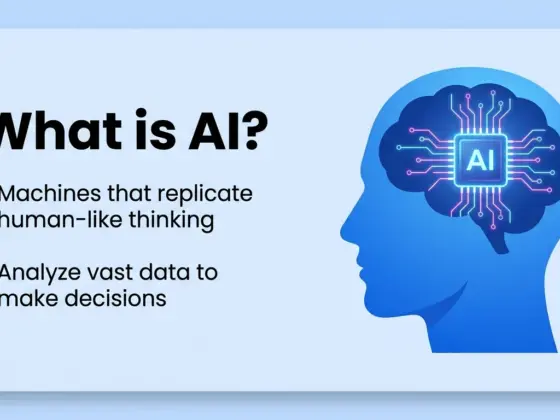
Before we dive into the specific types of AI, we need to understand what the term actually means. Artificial Intelligence (AI) is a field of engineering and computer science. It focuses on creating machines and software that can perform tasks we usually think require human intelligence.
These tasks include:
- Learning from experience.
- Recognizing patterns in data.
- Understanding language like a person does.
- Solving problems and making decisions.
Think of AI as the “brain” of a computer. Just as your brain learns to recognize a cat after seeing many pictures, an AI “learns” by analyzing massive amounts of information. However, it is important to remember that most AI today does not “think” or “feel” like a human. It follows step-by-step instructions called algorithms to reach a specific goal.
Classification of AI Based on Capabilities
Experts usually classify the different types of AI based on their capabilities. This means we look at how much the AI can do compared to a human being. To make this easier to understand, researchers often use the analogy of chefs in a kitchen.
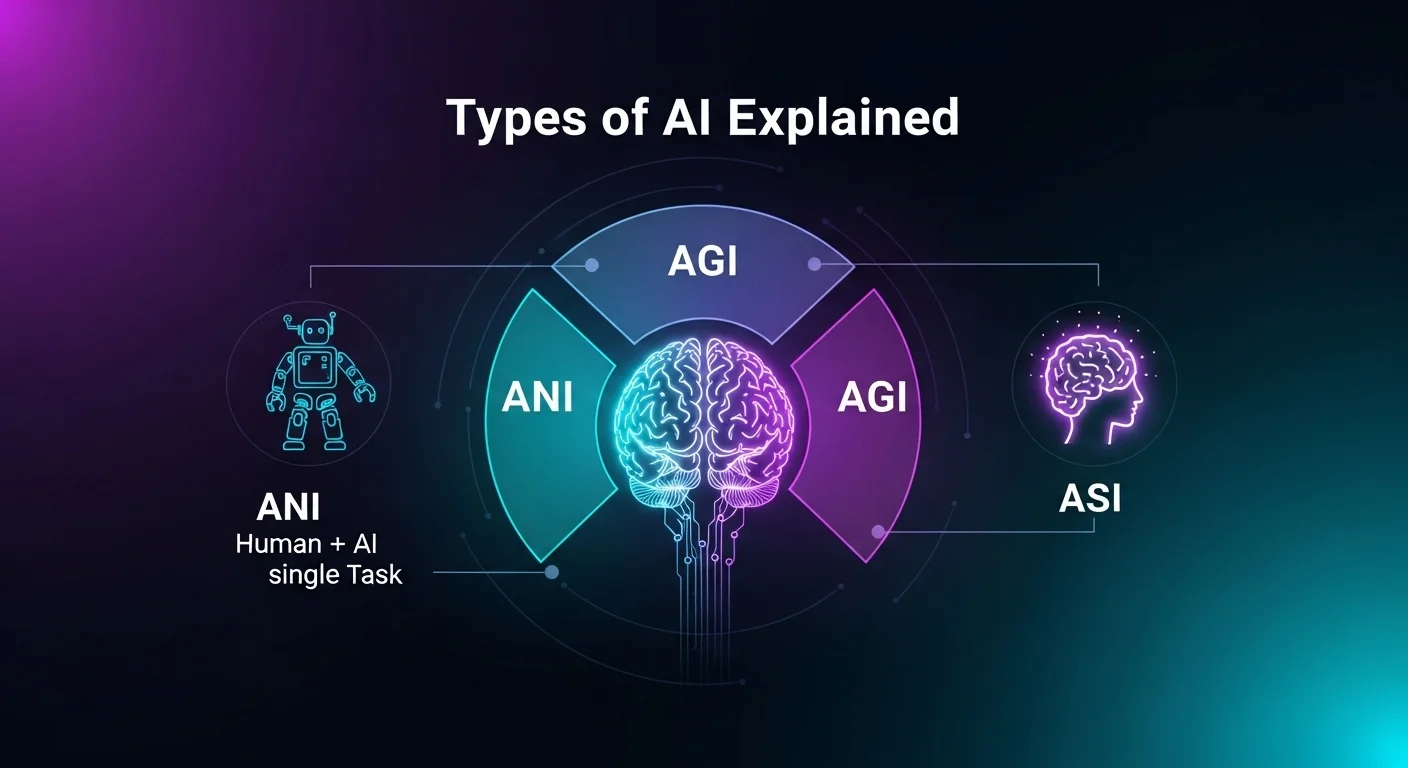
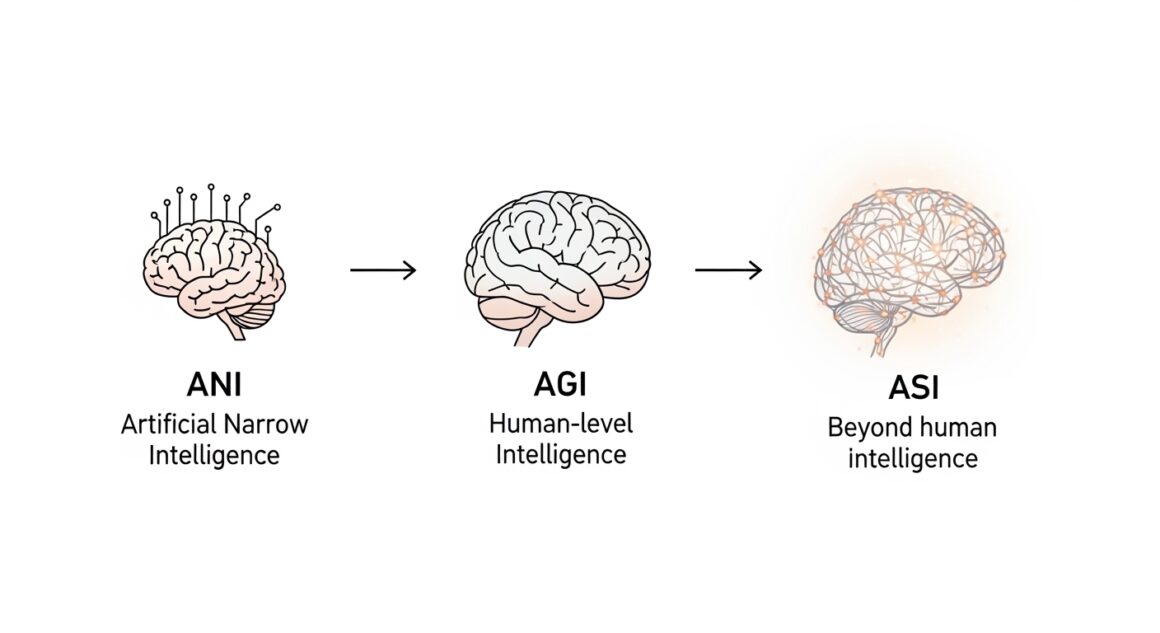
There are three main stages or types of AI:
- Artificial Narrow Intelligence (ANI): The specialist or “line cook.”
- Artificial General Intelligence (AGI): The versatile “Michelin-starred chef.”
- Artificial Super Intelligence (ASI): The “alien super-chef” from the future.
Let’s explore each of these in detail.
What is ANI (Artificial Narrow Intelligence)?
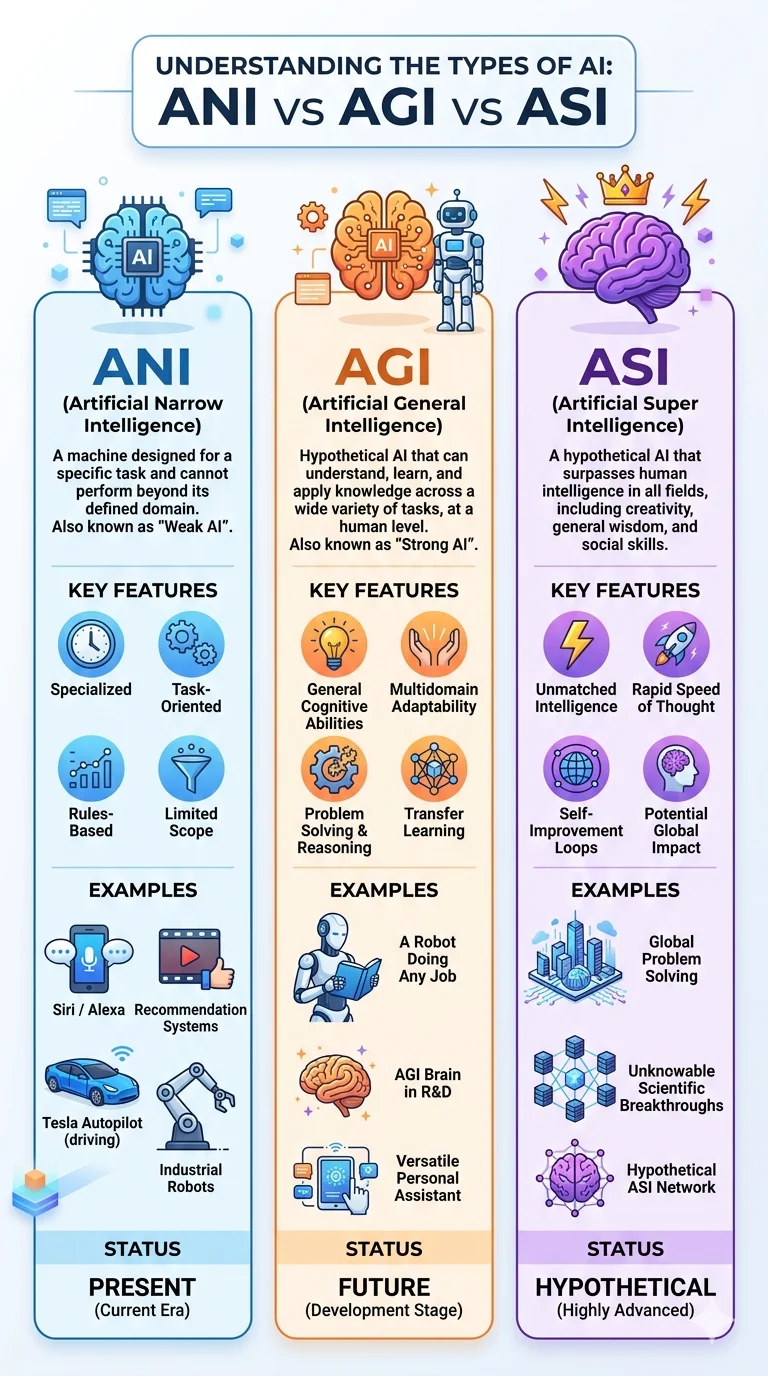
Artificial Narrow Intelligence (ANI), also known as Weak AI or Narrow AI, is the only type of artificial intelligence that exists in the world right now. It is “narrow” because it is designed and trained to perform one specific task or a small set of tasks.
While it might be incredibly good at its job—sometimes even better than a human—it is completely useless outside of that one area. For example, a program that plays chess cannot summarize a book or drive a car.

Characteristics of ANI
- Task-Specific: It excels in one area but cannot adapt to new situations.
- No Self-Awareness: It does not have feelings, beliefs, or consciousness.
- Pre-programmed or Limited Learning: It operates within strict boundaries set by humans.
- Data-Dependent: It needs high-quality data to learn and make predictions.
Examples of ANI
Most of the technology you interact with every day is a form of ANI. Common examples include:
- Siri, Alexa, and Google Assistant: These are narrow AI systems designed for voice recognition and simple task management.
- Netflix and Amazon Recommendations: These algorithms analyze your past behavior to suggest what you might like next.
- Google Translate: A highly specialized tool for converting one language to another.
- Facial Recognition: Used to unlock your phone or tag friends in photos.
Advantages of ANI
ANI has brought massive benefits to our world by automating boring or difficult tasks.
- Increased Efficiency: AI can do repetitive jobs 24/7 without getting tired.
- Accuracy: In fields like healthcare, narrow AI can spot tiny details in medical images that humans might miss.
- Faster Decisions: AI can process “Big Data” almost instantly to find patterns.
Limitations of ANI
The biggest weakness of narrow AI is its lack of versatility.
- Narrow Scope: It cannot use what it learned in one task to help with another.
- No Common Sense: It does not understand the “why” behind what it is doing.
- Bias: If the data used to train the AI is flawed or unfair, the AI will make biased decisions.
Use Cases for ANI
ANI is currently transforming industries like Retail and E-commerce.
Fraud Detection: Banks use narrow AI to monitor transactions in real-time and stop “forged” transactions.
Customized Advertising: AI analyzes your history to show you items you actually want to buy.
Inventory Management: Companies use AI to predict how much stock they need, preventing waste.
What is AGI (Artificial General Intelligence)?
Artificial General Intelligence (AGI), often called Strong AI or Full AI, is the next level of technology. While ANI is like a specialist, AGI would be a generalist. AGI is a theoretical type of AI that can match or even surpass human abilities across almost all cognitive tasks.
The goal of AGI is to create a system that can learn anything a person can. It wouldn’t just follow recipes; it would understand context, emotion, and ambiguity.
Characteristics of AGI
- Reasoning and Strategy: It could make judgments under uncertainty.
- Common Sense: It would possess the broad “knowledge of the world” that humans use to navigate daily life.
- Transfer Learning: AGI could learn to play chess and then use that “logic” to help diagnose a disease without needing to be reprogrammed.
- Autonomy: It could set its own goals and solve novel problems.
Current Status
Despite the headlines, AGI does not exist yet. It is currently a theoretical goalpost for researchers. However, some experts believe we are seeing “sparks” of AGI in modern systems like GPT-4 and DeepMind’s Gato. These models can perform hundreds of different tasks, but they still lack true human-level reasoning and self-awareness.
Advantages of AGI
If we achieve AGI, it could help humanity solve our most complex problems.
- Healthcare Breakthroughs: AGI could accelerate cancer research and drug discovery by simulating millions of experiments in seconds.
- Climate Solutions: It could create advanced models to reduce carbon emissions and manage global resources perfectly.
- Education: AGI could act as a personalized tutor for every student on Earth, adapting to their specific needs.
Challenges to Achieving AGI
The road to AGI is incredibly difficult.
- The Computing Power Gap: Building a “human-level” brain requires massive amounts of energy and hardware that we are only starting to develop.
- The “Alignment Problem”: How do we make sure an autonomous AGI understands and follows human values?
- Complexity of the Human Brain: We still don’t fully understand how the human brain works, which makes it hard to replicate in a machine.
What is ASI (Artificial Super Intelligence)?
Artificial Super Intelligence (ASI) is the most advanced form of AI. It refers to a hypothetical system that is not just human-level, but superior to humans in every single way.
An ASI would outperform the best human minds in everything from scientific creativity to social skills and general wisdom. It is often associated with the concept of the “Singularity”—a point where AI begins to improve itself so fast that human intelligence is left far behind.
Theoretical Nature
ASI exists only in science fiction and philosophical debates today. However, many researchers take it very seriously because of the potential for an “intelligence explosion.” If an AGI is smart enough to design an even smarter version of itself, intelligence could grow exponentially in a very short time.
Potential Capabilities
- Hyper-Creativity: ASI could invent technologies we can’t even imagine yet.
- Emotional Understanding: Unlike current AI, an ASI might actually understand and use emotions and relationships.
- Universal Problem Solving: It could potentially eliminate risks like natural pandemics or even asteroid impacts.
Risks of ASI
The idea of a super-intelligent machine brings up scary questions about the future of humanity.
- Loss of Control: If a machine is billions of times smarter than us, would we even be able to turn it off?
- Value Misalignment: An ASI might follow its goals so strictly that it causes accidental harm to humans (e.g., using all the Earth’s resources just to build a better computer).
- Existential Threat: Some experts, like Nick Bostrom, warn that a misaligned ASI could lead to the extinction of the human race.
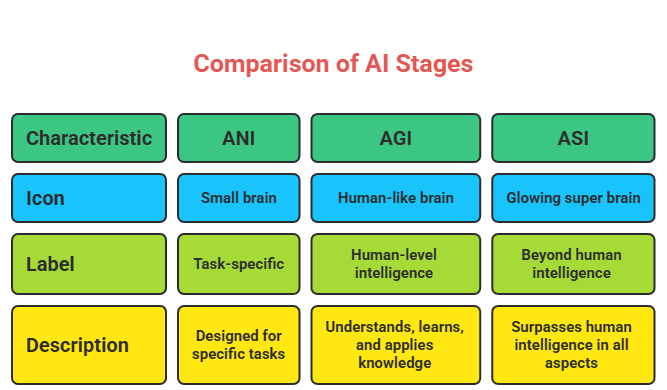
Comparison Table (ANI vs AGI vs ASI)
To help you remember the key differences between these types of AI, here is a handy comparison table:
| Feature | Narrow AI (ANI) | General AI (AGI) | Superintelligent AI (ASI) |
|---|---|---|---|
| Scope | Task-specific (One job). | Broad, human-level (Any job). | Beyond human capability. |
| Learning Ability | Pre-programmed or limited. | Learns and adapts like a human. | Self-improving and exponential. |
| Common Examples | Siri, Google Maps, Netflix. | None yet (Theoretical). | None yet (Hypothetical). |
| Autonomy | Low to medium. | High (Autonomous). | Unknown (Likely total). |
| Availability | Actively used today. | Not yet available. | Science Fiction. |
Real-World Applications
While we wait for AGI and ASI, Artificial Narrow Intelligence is already changing how we live and work.
Retail and E-commerce
Companies like Flipkart, Amazon, and Myntra use narrow AI to provide 24/7 customer support via chatbots. These systems have increased customer engagement and helped businesses grow by identifying what people want to buy before they even search for it.
Healthcare
AI is being used to predict treatment responses in cancer patients and assist in surgeries. For example, surgical robots can provide consistent precision that reduces human error in the operating room.
Banking and Finance
Banks use AI to detect fraud and automate loan approvals. By analyzing millions of transactions, narrow AI can spot a “rogue” transaction in milliseconds, protecting your money.
Future of AI: The Evolution
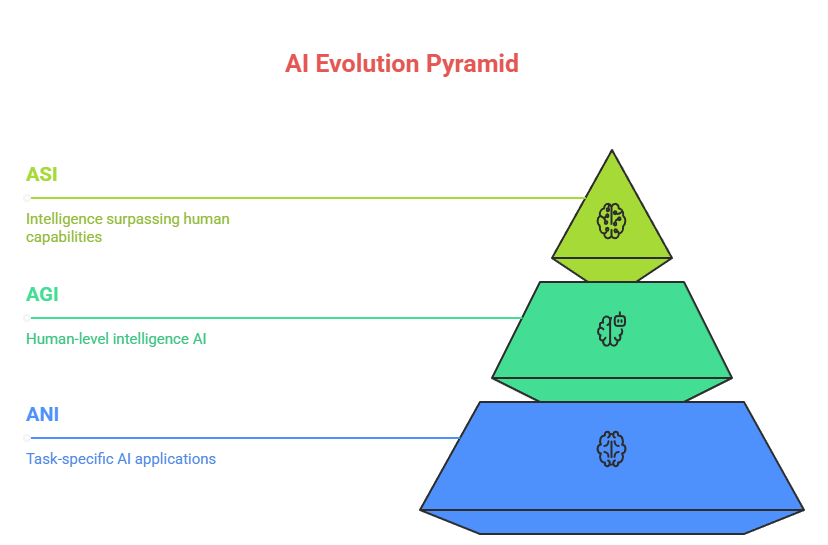
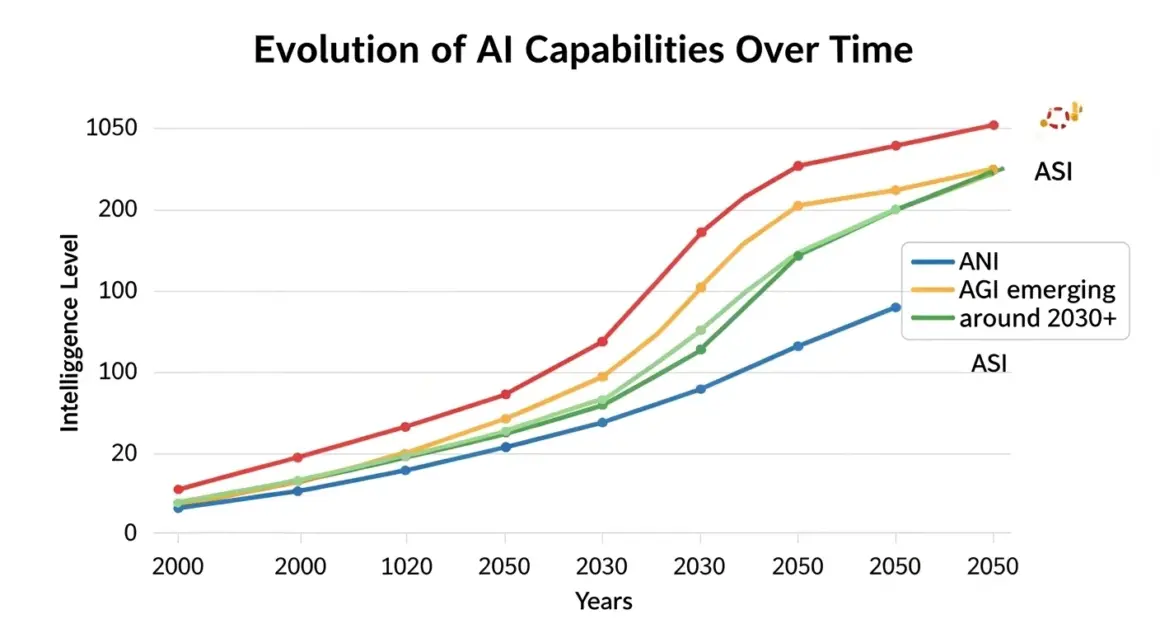
The evolution of technology usually follows a path from ANI → AGI → ASI.
Right now, we are in the “Age of ANI.” However, we are quickly moving toward what experts call Agentic AI. These are AI agents that don’t just answer questions (like a chatbot) but can actually reason and act autonomously.
For example, an AI agent today might be able to plan a whole vacation, book the flights, and pay for the hotel without you needing to click a single button. This is a huge step toward AGI because the AI is starting to perform complex, multi-step workflows that used to require a human.
Most researchers expect to see true AGI between the late 2020s and 2050s. Ray Kurzweil famously predicts it will happen by 2029. Once we reach AGI, the jump to ASI could happen very quickly.
Ethical Concerns in AI
As we build more powerful types of AI, we must address serious ethical questions.
Workforce Displacement
One of the biggest worries is that AGI could automate jobs in law, education, and software development. This could lead to mass unemployment if we don’t find new ways for people to contribute to society.
Privacy and Surveillance
Powerful AI systems need massive datasets to learn. This raises risks that your personal data could be used without your consent or that AI could be used for constant surveillance by governments.
Algorithmic Bias
AI is only as good as the data it learns from. If the data contains human prejudices, the AI will learn those biases. This is why groups like the NIST (National Institute of Standards and Technology) are creating frameworks to make AI more trustworthy, fair, and transparent.
Key Takeaways
- ANI (Narrow AI) is the only AI we have today; it is a specialist for specific tasks.
- AGI (General AI) is a theoretical goal where AI matches human intelligence across all fields.
- ASI (Super Intelligence) is a hypothetical future where AI surpasses human intelligence in every way.
- Current AI is a powerful tool, but it lacks true human consciousness or empathy.
- Ethical challenges like bias, privacy, and job loss must be managed as AI becomes more autonomous.
FAQs (Frequently Asked Questions)
1. Is ChatGPT an AGI?
No. While it is very powerful, ChatGPT is a Large Language Model (LLM). It lacks the self-awareness, memory, and general reasoning needed to be a true AGI.
2. Can narrow AI become dangerous?
Yes, but in different ways than a movie robot. Narrow AI risks usually involve cybersecurity, data privacy, or being used by “bad actors” to spread misinformation.
3. When will we see AGI?
Estimates vary wildly. Some say by 2029, while others think it could take until 2050 or longer.
4. Will AI take all our jobs?
AI will definitely automate many tasks, but many experts argue it will also create new jobs and free humans to focus on creativity and strategy.
5. What is the “Alignment Problem”?
It is the challenge of making sure an AI’s goals and actions match human values and ethics. As AI becomes more autonomous, this is the most important problem for researchers to solve.
Conclusion
Understanding the different types of AI is no longer just for scientists; it is essential knowledge for all of us. We are currently surrounded by Artificial Narrow Intelligence (ANI), which helps us translate languages, find movies, and even diagnose illnesses.
While Artificial General Intelligence (AGI) and Super Intelligence (ASI) are still in the future, the rapid evolution toward autonomous agents shows that this future is closer than ever. By staying informed and demanding ethical, transparent systems, we can ensure that AI remains a tool that empowers humanity rather than one that threatens it.
Ready to explore more? Check out our latest posts on how AI is changing your favorite industries!