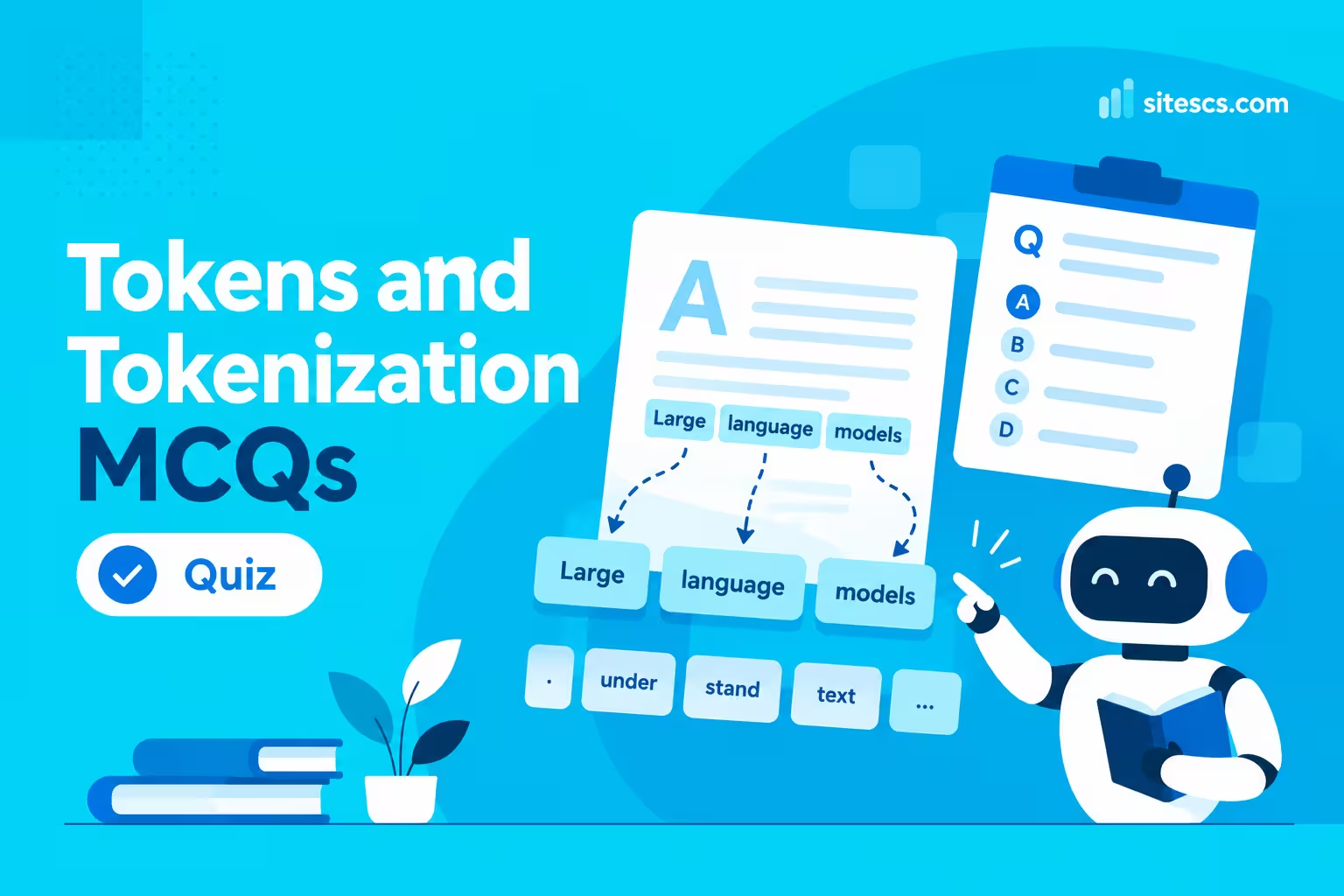
Tokens and tokenization are fundamental concepts in natural language processing (NLP) and Large Language Models (LLMs). Before a language model can process text, the input must be converted into smaller units that can be represented and analyzed mathematically.
These units are called tokens, and the process of dividing text into them is known as tokenization.
Understanding tokenization helps learners explore how language models process sentences, calculate context length, and generate responses.
What Is a Token in an LLM?
A token is a unit of information that a language model processes. Depending on the tokenizer, a token may represent a complete word, a part of a word, punctuation, whitespace-related characters, or another character sequence.
For example, the word “computer” might appear as one token in one tokenizer but be divided into multiple tokens by another.
Tokens are not necessarily equivalent to words. Different models can tokenize the same sentence differently because they use different vocabularies and encoding techniques.
What Is Tokenization?
Tokenization is the process of converting text into a sequence of tokens according to predefined encoding rules.
For example, a sentence such as “Artificial intelligence is useful” may be divided into several token units. The exact divisions depend on the tokenizer.
Each token is assigned a numerical identifier, commonly called a token ID. These identifiers are processed by the model’s embedding layers and subsequent neural network operations.
The tokenizer therefore provides a connection between readable language and machine-processable numerical information.
Types of Tokenization
Word-level tokenization separates text primarily into individual words. Although straightforward, it can require a large vocabulary and may struggle with unfamiliar words.
Character-level tokenization processes text using individual characters. It can represent unfamiliar words but often creates much longer sequences.
Subword tokenization combines some advantages of both approaches. Frequent words or character patterns may be represented efficiently, while uncommon words can be broken into smaller components.
Byte Pair Encoding (BPE), WordPiece, and Unigram are well-known tokenization approaches used in different NLP systems.
Why Are Tokens Important in Large Language Models?
Tokens influence how much information a model can process within its context window. They also affect response length, processing requirements, and API usage costs.
In many English-language applications, a rough estimate is that one token corresponds to approximately four characters or three-quarters of a word. However, this estimate varies by language, model, and text structure.
Code, mathematical expressions, unusual spellings, and multilingual content can have substantially different token counts.
Input Tokens and Output Tokens
Input tokens represent the information submitted to the model, including prompts and relevant conversation context. Output tokens are the units generated in the model’s response.
Some systems also distinguish cached input tokens and internal reasoning tokens for usage accounting.
Understanding these categories helps developers manage model limits and estimate computational expenses.
Practice Tokens and Tokenization MCQs
The Tokens and Tokenization MCQs quiz covers token definitions, token IDs, BPE, word-level tokenization, subword techniques, token counting, and context-window relationships.
These questions are useful for beginners studying NLP, prompt engineering, and LLM application development.
Take the quiz below to test your understanding of tokens and tokenization in artificial intelligence.
Tokens and Tokenization MCQs with Answers | LLM Quiz
Test your knowledge with Tokens and Tokenization MCQs. Understand token types, subword tokenization, token counts, and their role in LLMs.
