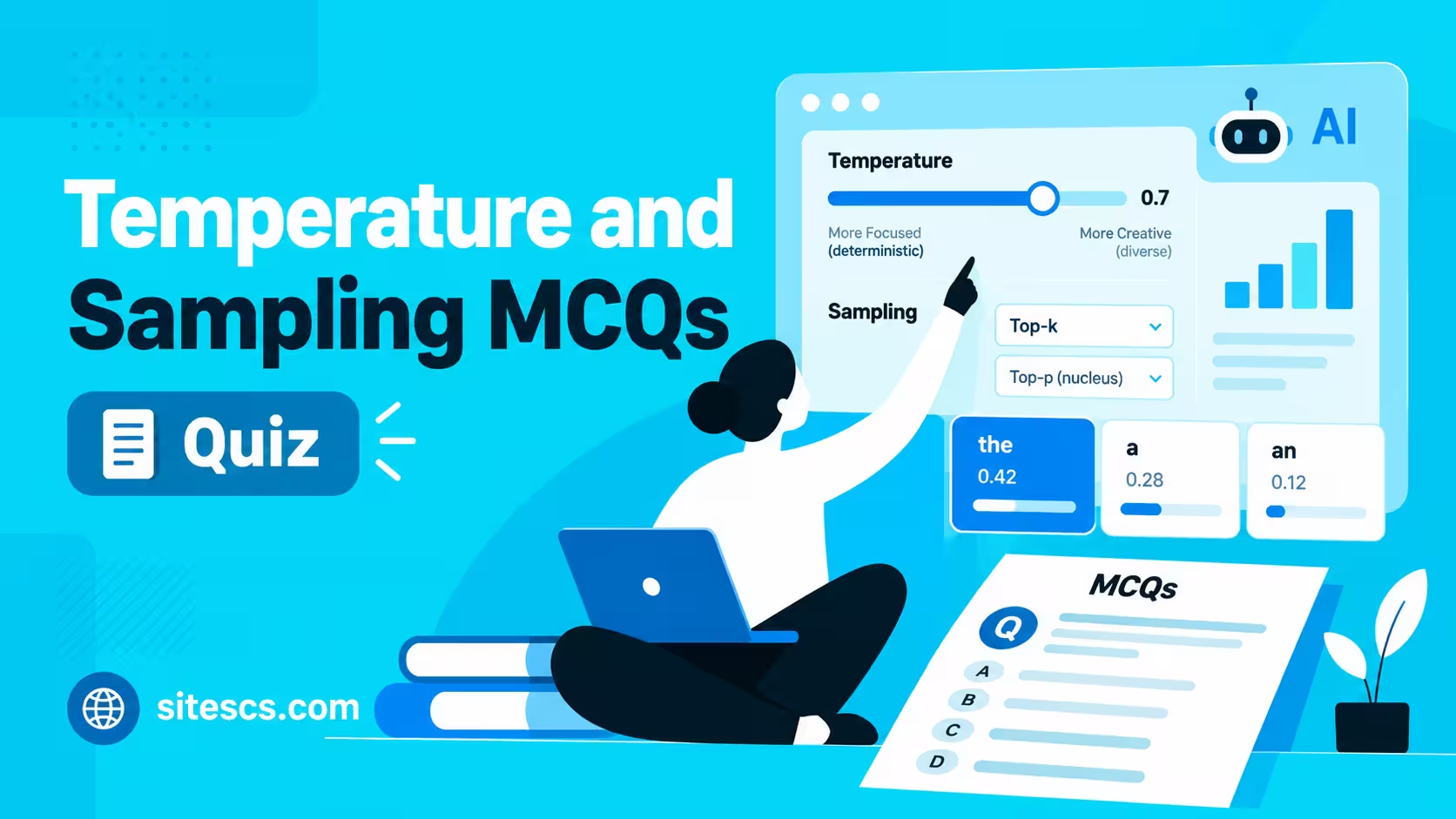
Temperature and sampling are important concepts in Large Language Models (LLMs) because they influence how a model selects tokens while generating responses.
When a language model processes a prompt, it calculates scores for possible next tokens. A decoding method then selects the token that will appear next in the generated sequence.
Temperature and sampling help determine whether the generated text is more predictable or more varied. Understanding these concepts is useful for prompt engineering, generative AI development, and language model evaluation.
What Is Temperature in an LLM?
Temperature is a parameter used in many language model decoding implementations to adjust the probability distribution of candidate tokens.
A lower temperature makes high-probability tokens relatively more dominant. A higher temperature produces a flatter distribution, allowing less likely tokens to be selected more frequently during sampling.
Temperature does not directly measure factual accuracy, intelligence, or creativity. Instead, it changes the degree of randomness available to the token-selection process.
The supported temperature range and its exact behavior depend on the model and generation system.
How Does Temperature Affect Generated Responses?
At a relatively low temperature, a model tends to produce more predictable and consistent wording when sampling is enabled.
For example, lower-temperature settings may be useful for structured information extraction, technical explanations, and tasks requiring controlled output.
At higher temperatures, the model can produce more varied expressions, unexpected combinations, and alternative phrasing.
This may be useful for brainstorming, creative writing, storytelling, and generating multiple ideas.
However, higher temperatures can also increase the likelihood of irrelevant or inconsistent output.
What Is Sampling in Large Language Models?
Sampling is the process of selecting a token from a probability distribution rather than always choosing the most likely candidate.
Suppose a model assigns probabilities of 60%, 25%, and 15% to three possible next tokens. A sampling algorithm can choose among these candidates according to their assigned probabilities.
The highest-probability token is more likely to appear, but other candidates may also be selected.
Repeated sampling can therefore produce different responses to the same prompt.
Temperature vs. Greedy Decoding
Greedy decoding selects the highest-scoring token at each generation step. Unlike random sampling, it does not intentionally choose among candidates based on randomness.
A very low temperature can make sampling behave similarly to greedy decoding, but the two concepts should not automatically be treated as identical.
Some implementations support a temperature value of zero as a special decoding setting. Others require a positive value or use different generation controls.
Even deterministic-looking settings do not guarantee identical results across all models, hardware configurations, or service implementations.
Relationship Between Temperature, Top-P, and Top-K
Temperature is often discussed alongside top-p and top-k sampling.
Temperature changes the relative probabilities of tokens. Top-k limits consideration to a fixed number of high-probability candidates, while top-p uses a cumulative probability threshold.
These techniques can be combined in supported generation systems, although overly restrictive settings may reduce output diversity.
Practice Temperature and Sampling MCQs
The Temperature and Sampling MCQs quiz tests knowledge of probability distributions, low and high temperature, greedy decoding, randomness, and sampling strategies.
Understanding these concepts helps learners explain why identical prompts can produce different answers.
Attempt the quiz below to evaluate your understanding of temperature and sampling in LLMs.
Temperature and Sampling MCQs with Answers | LLM Quiz
Practice Temperature and Sampling MCQs to understand LLM randomness, creativity, probability distributions, greedy decoding, and text generation.
