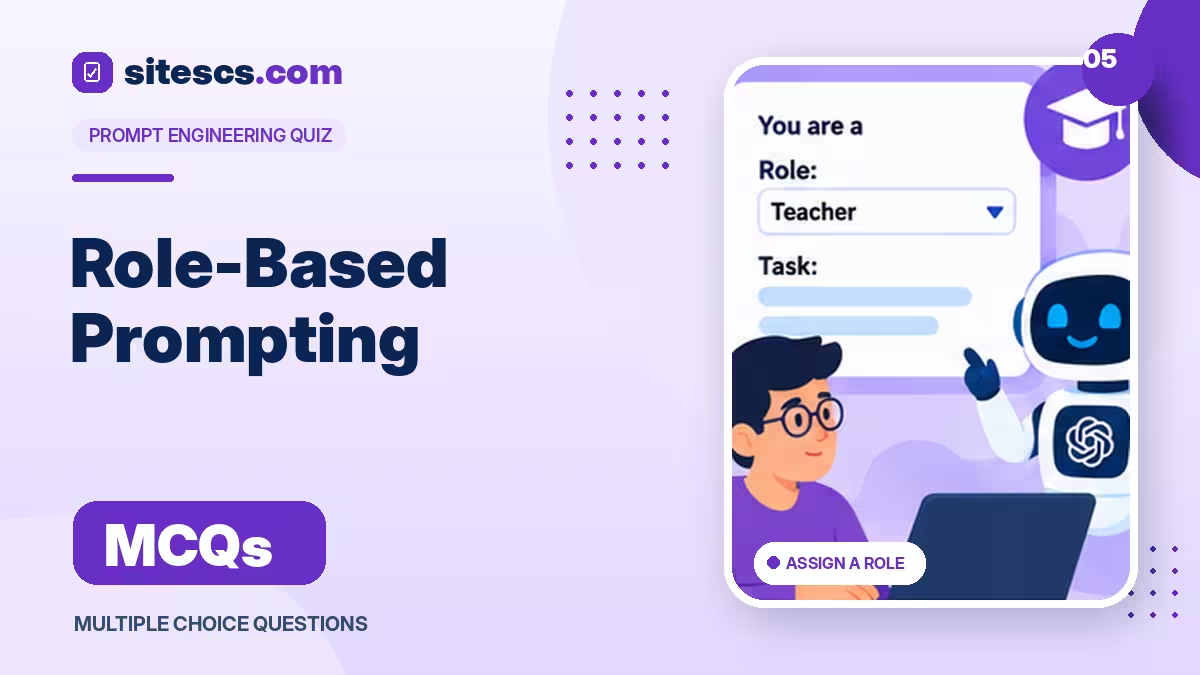
Role-based prompting is a prompt engineering technique in which an artificial intelligence model is instructed to respond from a particular professional role, functional position, or subject-specific perspective. The assigned role helps establish the type of assistance, communication style, and task priorities expected from the model.
This technique is commonly used with large language models for educational assistance, technical documentation, programming support, customer service, business analysis, and creative writing.
Role-based prompting is valuable for beginners because it demonstrates how contextual instructions can influence the way AI systems organize and present information.
What Is Role-Based Prompting?
Role-based prompting involves assigning an explicit role to an AI model before describing the task it should complete. The role acts as contextual guidance for the model’s response.
For example, consider this prompt:
“Act as a Python programming tutor. Explain the difference between lists and tuples to a beginner using simple examples.”
Here, the assigned role is Python programming tutor. This encourages the AI model to adopt an instructional approach and emphasize beginner-friendly explanations.
The role does not give the model real professional credentials or additional knowledge. Instead, it helps communicate the perspective and response characteristics requested by the user.
How Does Role-Based Prompting Work?
Role-based prompting works by adding role-specific context to a task instruction. The model interprets the assigned role alongside the requested action and generates a response based on both elements.
For instance, a cybersecurity instructor may be expected to explain security concepts with educational examples, while a technical editor may focus on clarity, consistency, and terminology.
The usefulness of role-based prompting depends on whether the assigned role meaningfully relates to the task. A generic instruction such as “Act as an expert” may provide less useful guidance than specifying the actual work and expected outcome.
Benefits of Role-Based Prompting
One important benefit is improved contextual relevance. A clearly defined role can help the model prioritize information appropriate for a particular professional or educational situation.
Role-based prompting may also improve consistency in tone, vocabulary, and presentation. For example, a customer support role can encourage polite, solution-focused communication, while a science teacher role can encourage explanatory language.
This technique can be combined with output formatting rules, detailed instructions, and few-shot examples for more controlled responses.
Role-Based Prompting vs Persona Prompting
Role-based prompting generally emphasizes a function, profession, or area of responsibility. Persona prompting often extends this idea by adding audience awareness, personality traits, communication preferences, or behavioral characteristics.
For example, “Act as a mathematics teacher” assigns a role, whereas “Act as a patient mathematics teacher who uses everyday examples for young learners” creates a more detailed persona.
These concepts overlap and are sometimes used interchangeably in prompt engineering.
Limitations of Role-Based Prompting
Assigning a professional role does not automatically make an AI model more accurate or reliable. Models may still generate incorrect explanations, outdated information, or unsupported statements.
For sensitive professional subjects, users should verify factual claims using reliable references and qualified experts when appropriate.
Role instructions should also remain consistent with the actual task and any applicable higher-priority instructions.
Practice Role-Based Prompting MCQs
Our Role-Based Prompting MCQs explore role assignment, practical prompt examples, contextual guidance, professional perspectives, benefits, limitations, and differences between role and persona prompting.
Complete the quiz below to evaluate your understanding of role-based AI interactions and strengthen your prompt engineering knowledge for interviews, certifications, and academic examinations.
Role-Based Prompting MCQs with Answers | AI Quiz
Practice Role-Based Prompting MCQs with definitions, examples, AI role assignment, benefits, limitations, and prompt engineering interview concepts.
