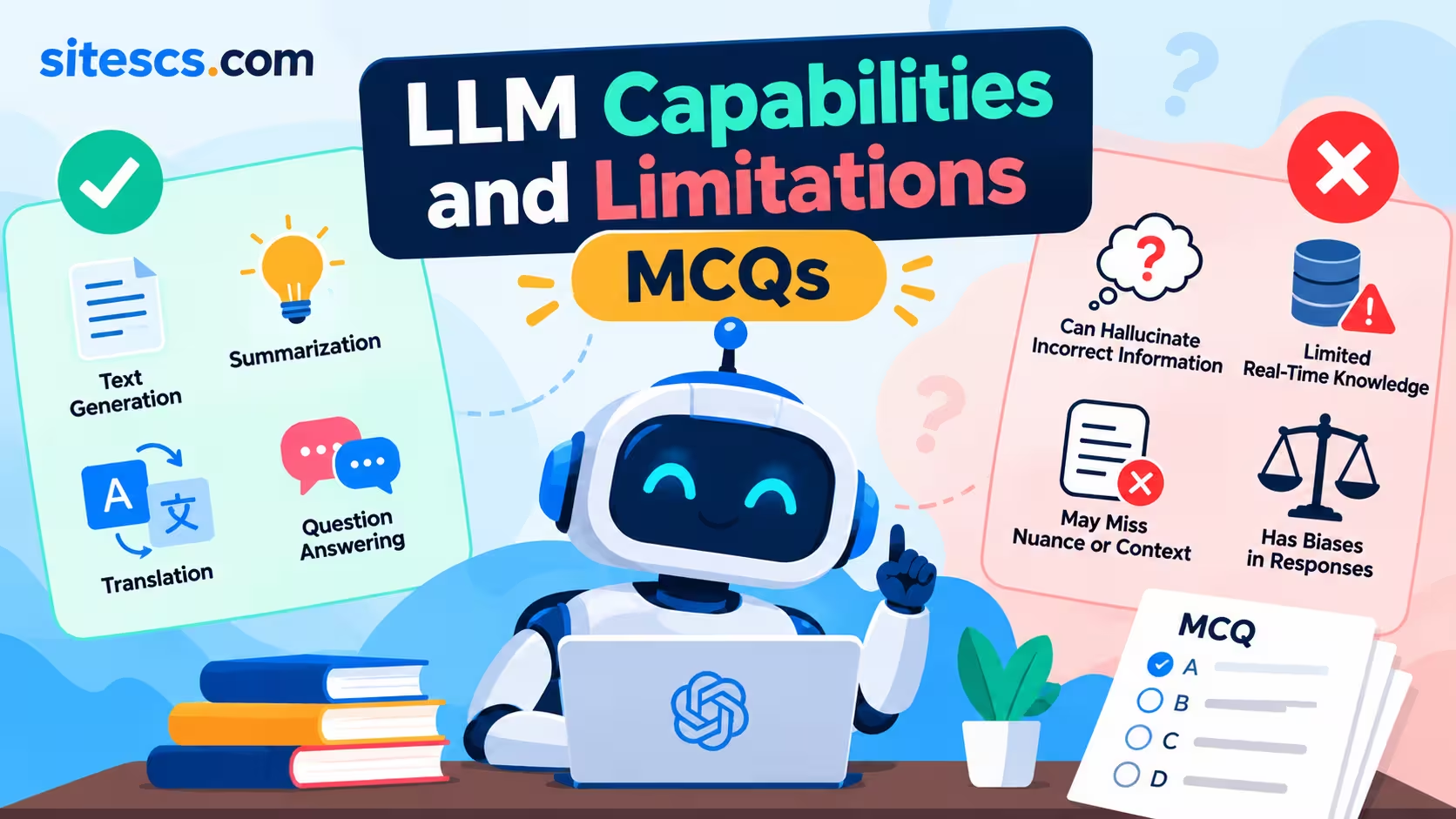
Large Language Models (LLMs) have significantly expanded the practical applications of artificial intelligence. They can generate natural language, assist with programming, summarize documents, answer questions, and support numerous knowledge-based tasks.
Despite these capabilities, LLMs also have important limitations relating to factual reliability, reasoning consistency, privacy, and computational requirements.
Understanding both their strengths and weaknesses is essential for responsible AI usage. It allows students, developers, and professionals to recognize when language models are useful and when additional verification or human supervision is required.
What Are the Main Capabilities of LLMs?
One of the most important capabilities of LLMs is natural language generation. These systems can produce readable responses based on prompts, instructions, and contextual information.
LLMs can perform tasks such as text summarization, translation, classification, document analysis, and question answering.
Many models can also explain programming concepts, generate code, identify potential software errors, and suggest improvements.
Their flexibility allows a single model to support several applications without requiring a completely separate AI model for each task.
Language Understanding and Content Generation
Language models can recognize patterns in grammar, meaning, structure, and context.
For example, an LLM may summarize a technical document in simple language or rewrite a paragraph for a professional audience.
The model can also adapt its output according to instructions about tone, length, language, and formatting.
These capabilities make LLMs useful for educational assistance, communication, documentation, and content development.
However, effective language generation should not be confused with guaranteed understanding or accuracy.
Reasoning and Problem-Solving Capabilities
Advanced language models can perform many reasoning-oriented tasks, including mathematical problem-solving, logical analysis, and multistep planning.
Their reliability varies according to the model, problem complexity, and available tools.
Some tasks benefit from additional computation or external tools, such as code execution and calculators.
Although LLMs can solve difficult problems, they may also make basic reasoning mistakes, overlook constraints, or produce convincing but incorrect explanations.
Common Limitations of Large Language Models
Hallucination is a major limitation of LLMs. Models may generate inaccurate claims or invent supporting evidence.
Bias is another concern because training data can contain social, cultural, or historical imbalances.
LLMs may also have incomplete knowledge about recent events unless they can access updated information through connected tools.
Other limitations include inconsistent responses, difficulty interpreting ambiguous requests, and potentially high computational costs.
Long input documents may create additional challenges, even when they fit within the model’s context window.
Privacy, Security, and Responsible AI Usage
Users should avoid submitting confidential information to AI services without understanding their data-handling policies.
Organizations must consider access controls, security protections, regulatory requirements, and output verification when deploying LLM applications.
AI-generated responses should be reviewed carefully before use in high-stakes environments such as healthcare, legal services, financial decisions, and cybersecurity.
Human expertise remains important for evaluating complex or consequential outputs.
How Can LLM Capabilities Be Improved?
LLM applications can become more useful through effective prompt engineering, retrieval-augmented generation, fine-tuning, tool integration, and systematic evaluation.
These techniques can improve task performance, provide additional context, or help verify particular outputs.
However, improvements must be measured rather than assumed, because their effectiveness depends on the application and model.
Practice LLM Capabilities and Limitations MCQs
The LLM Capabilities and Limitations MCQs quiz covers text generation, reasoning, coding, bias, hallucinations, privacy, and responsible AI development.
Take the quiz below to evaluate your understanding of what Large Language Models can and cannot reliably do.
LLM Capabilities and Limitations MCQs with Answers
Practice LLM Capabilities and Limitations MCQs covering AI strengths, reasoning, text generation, bias, hallucinations, and real-world applications.
