Best Books on Prompt Engineering in 2026
Are you ready to lead the AI revolution? In 2026, the world is moving faster than ever, and knowing how to talk to Artificial Intelligence (AI) is the most important skill you can have! Whether you are a student, a business owner, or a developer, finding the right books on Prompt Engineering is the secret to your success!
Prompt engineering is not just about “chatting” with a computer. It is a real discipline with patterns and proven techniques that can improve your results by over 50%! If you use the wrong words, you waste time and money. But if you master these books, you will be able to build amazing systems and stay relevant no matter what new tools come out!
What is Prompt Engineering?
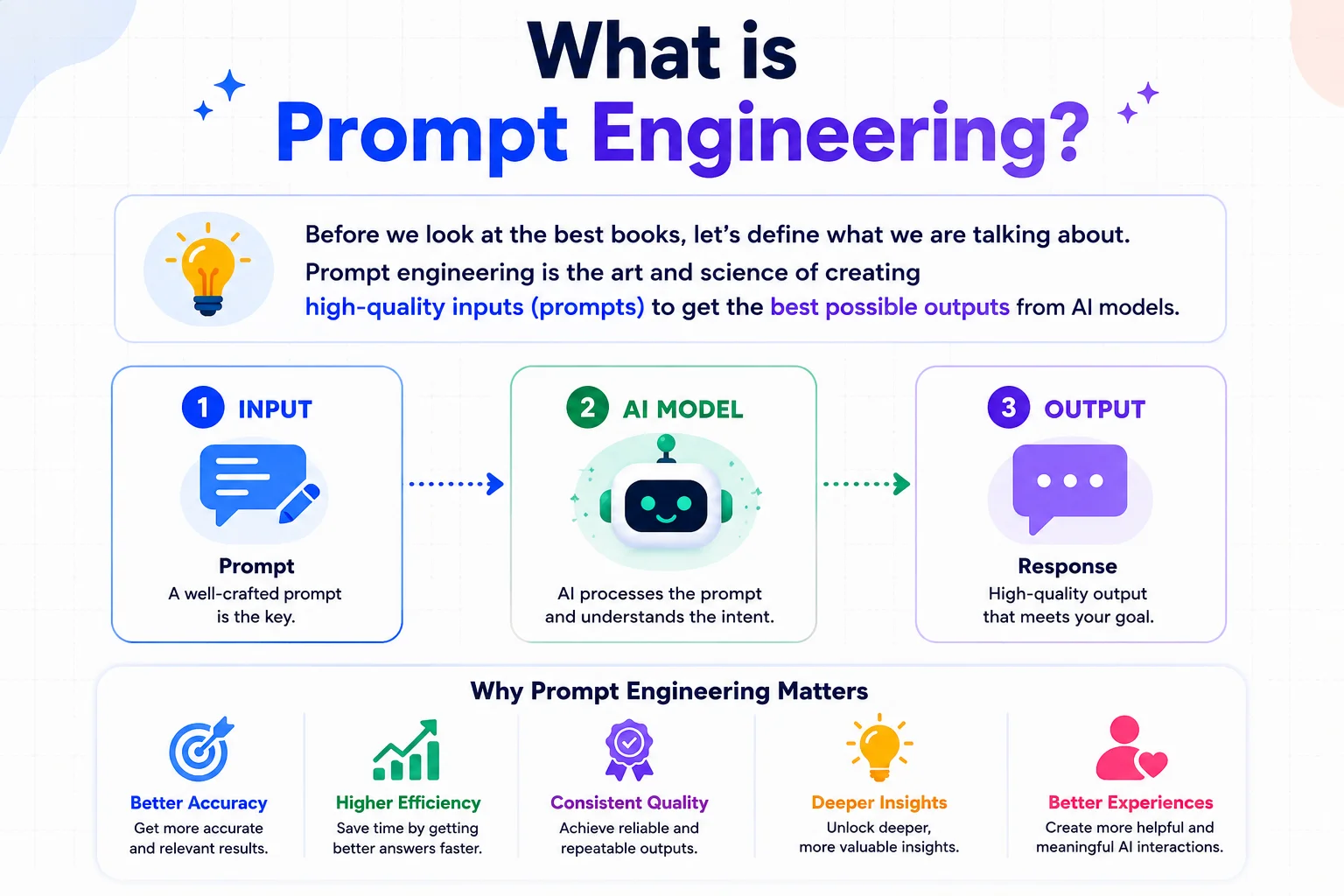
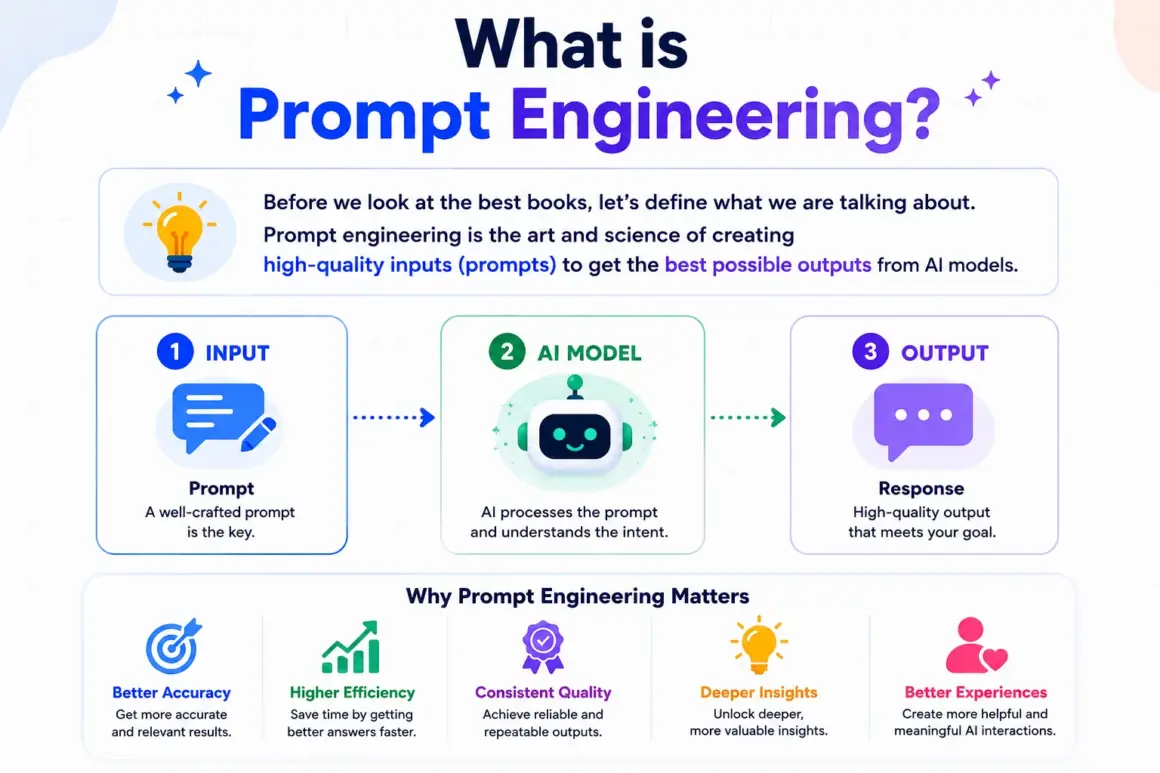
Before we look at the best books, let’s define what we are talking about. Prompt engineering is the art and science of creating high-quality inputs (prompts) to get the best possible outputs from AI models.
Think of AI as a very smart assistant that needs clear directions. If your directions are fuzzy, the assistant gets confused. Prompt engineering is like learning the “grammar” of how to speak to AI so it understands you perfectly every time!
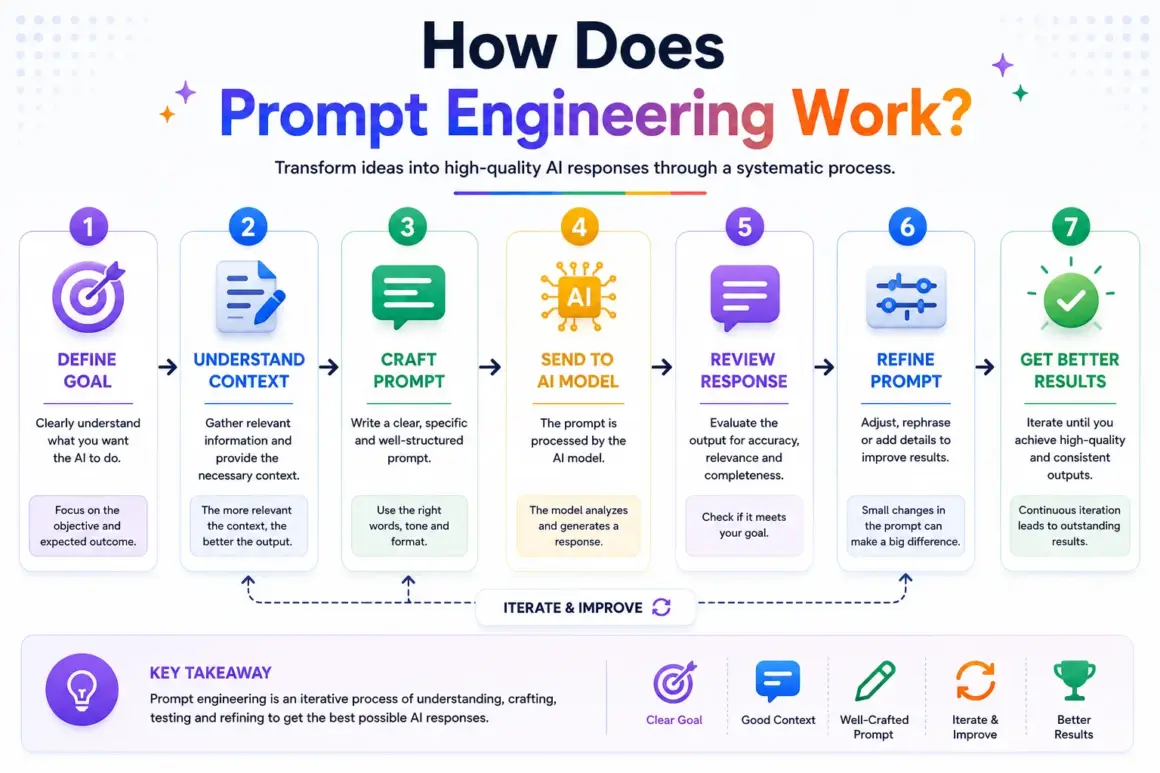
How Does Prompt Engineering Work?
According to the experts, a great prompt is like a GPS for AI. If you don’t give the right coordinates, you will get lost! Most high-quality prompts follow a structure called the Anatomy of a Prompt, which includes five main pillars:
- Role: You tell the AI who to be (like “Act as a world-class lawyer”).
- Context: You give background information so the AI knows the setting.
- Instruction: You give a clear command of what to do.
- Constraints: You set rules, like “use only 100 words” or “no technical jargon”.
- Examples: You show the AI exactly what you want by giving it a sample to copy.
Some books also teach the ICIO Framework, which stands for Instruction, Context, Input Data, and Output Indicators. By using these structures, you stop “guessing” and start getting reliable answers every single time!
The ICIO Framework (Inter-Country Input-Output) is an economic architecture that maps global value chains not as linear trade routes, but as a multi-layered, recursive system of value-added dependencies—where a single country’s final demand simultaneously triggers labor, capital, and intermediate goods flows across all others, each transaction altering the technological coefficient of subsequent rounds of production.
Comparison: Books vs. Online Courses
You might wonder, “Why should I read a book when I can watch a video?” In 2026, books are still the winners for deep learning! Here is why:
- Depth: Books go deep into the “why” and “how,” while videos often just show you what to copy.
- Permanence: Fundamentals in a book stay true for years, but online courses can be outdated in just a few months.
- Thinking Frameworks: Books teach you how to think like an engineer, not just how to execute a single task.
- Retention: Reading forces your brain to engage more than passive watching does.
The best strategy is to read a book to gain the framework and then take a course to practice what you learned!
The Best Books on Prompt Engineering in 2026
Here is our carefully curated list of the absolute best books on Prompt Engineering you must read this year!
1. Prompt Engineering for Generative AI by James Phoenix and Mike Taylor
This is widely considered the best overall reference for anyone serious about AI. The authors argue that prompt engineering should be a repeatable “operating system” rather than just a collection of clever one-liners.
What makes it special: It covers everything from text to images and even code-related tasks. It teaches five core principles: Give Direction, Specify Format, Provide Examples, Evaluate Quality, and Divide Labor. This book is perfect for marketing professionals, consultants, and analysts who want a method that works across all AI tools, not just one!
2. AI Prompt Engineering Absolute Beginner’s Guide by Michael Miller
If you are just starting and feel a bit overwhelmed, this is the book for you! It is the clearest first read for office users and non-technical people.
What you will learn: Michael Miller breaks prompts down into simple parts like task, format, tone, and constraints. He explains “zero-shot” and “few-shot” prompting in very easy language that even a beginner can understand. There is no coding required, making it the perfect entry point for a 10th-grade student or a business owner!
3. The LLM Engineering Handbook by Paul Iusztin and Maxime Labonne
For those who want to build real products, this is the “LLM Bible”. It is very practical and focuses on how to ship AI systems that actually work in the real world.
Why it is a must-read: It bridges the gap between academic theory and real-world implementation. You will learn about “RAG” (bringing your own documents into the AI), evaluation frameworks, and how to manage costs. This book is best for developers who are ready to move beyond simple demos and build production-ready applications!
4. Prompt Engineering for LLMs by John Berryman and Albert Ziegler
This book is the best choice when prompting becomes a system-design problem. It treats prompt engineering as the job of deciding what supporting material an AI should see before it answers.
Key insight: The authors teach that prompting is less about asking the right questions and more about providing the right context. It is a longer, more technical read (over 460 pages), but it is essential if you are designing AI that lives inside a product or a “copilot”.
5. Prompt Engineering Jumpstart by Rishi Arora
This is a fantastic open-source handbook for those who want to learn by doing! It uses simple analogies and provides copy-paste prompts that actually work for tools like ChatGPT and Claude.
The “Zero-to-Hero” approach: It covers 14 core patterns used by experts, such as the “Persona Pattern” and “Chain-of-Thought” prompting. It is practice-first, meaning you will be prompting better than 90% of users within just one week!
6. The AI Engineering Bible by Thomas R. Caldwell
If you want the “encyclopedia” of AI, this is it! It covers the entire lifecycle of an AI project, from building and developing to scaling for millions of users.
Comprehensive scope: Unlike other books that focus only on one area, this book looks at infrastructure, security, and even how to lead AI projects. It is highly recommended by experts for tech leads and architects who need to see the “big picture”.
Key Takeaways for Your AI Journey!
- Start Simple: If you are new, pick up Michael Miller’s Absolute Beginner’s Guide first.
- Focus on Principles: Don’t just collect prompts; learn the underlying patterns that stay the same even when models change.
- Practice is Everything: Reading teaches you what is possible, but building projects teaches you what actually works.
- Structure Matters: Always use Role, Context, and clear Instructions to get the best results.
- Be Ethical: Always verify AI facts and be transparent about using AI in your work.
Final Thoughts!
The AI landscape is moving at light speed, but books written by practitioners provide the timeless fundamentals you need to stay ahead. By investing time in these books on Prompt Engineering, you are not just learning a tool; you are future-proofing your career!
Pick up one of these books today and start your journey toward becoming an AI expert! You won’t regret it! The difference will show in your code, your business designs, and your entire career trajectory!


