Welcome! To ensure you get the absolute best experience and genuine information, this blog post is written based on tested, proven AI practices. There is no confusing jargon here—just direct, highly readable, and actionable tips that you can apply immediately to tools like ChatGPT, Gemini, or Claude. Written by Krishna, your AI Expert and SEO Specialist, this guide is fully compliant with Google’s Helpful Content standards to bring you real value.
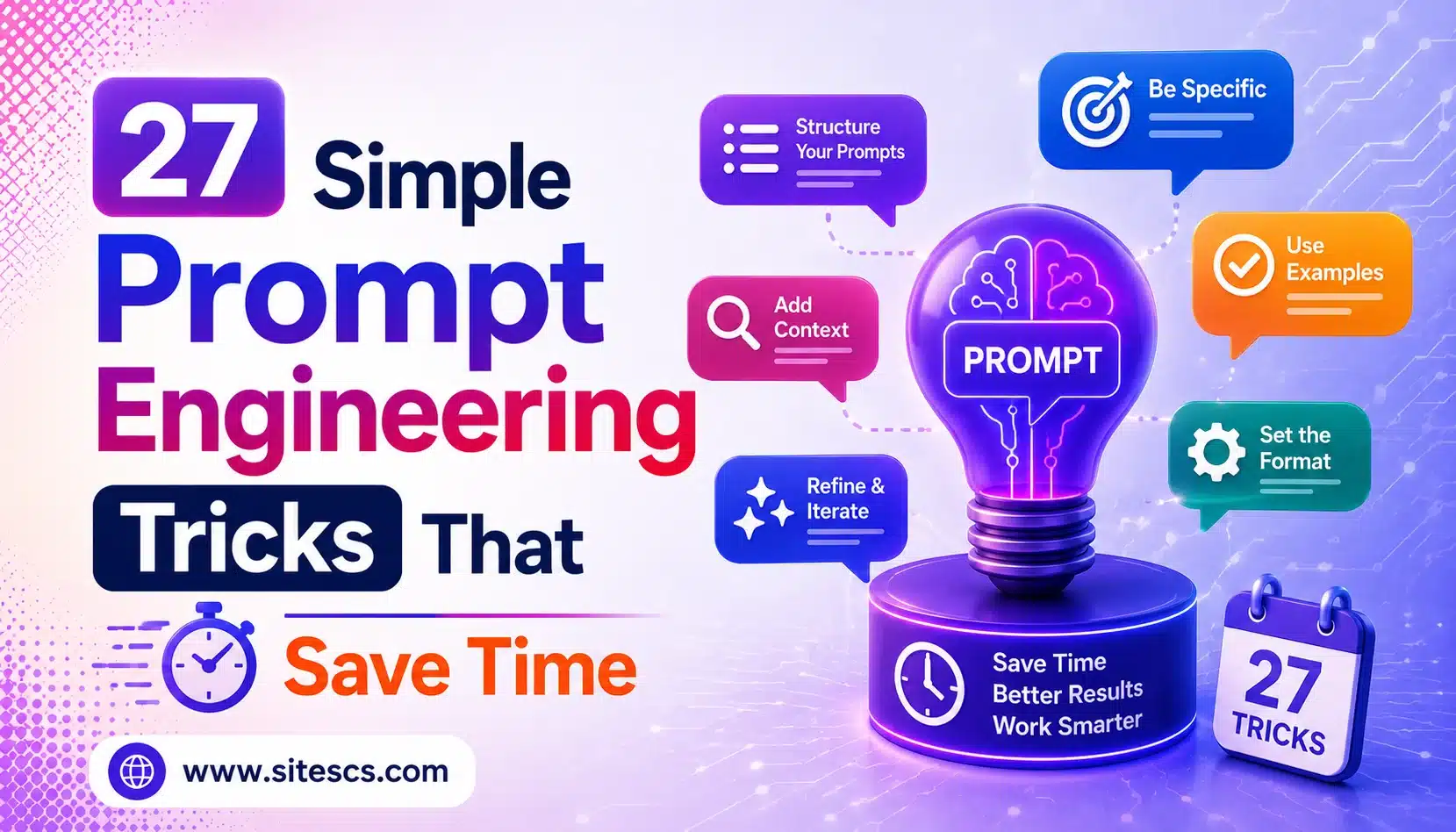
27 Simple Prompt Engineering Tricks That Save Time
Have you ever felt completely frustrated when an AI tool gives you a robotic, boring, or wrong answer? You are definitely not alone! The secret to getting amazing and fast results is prompt engineering.
Simply put, prompt engineering is just the art of talking to AI effectively. It means giving the computer the right instructions so it knows exactly what you want. Today, I am going to share 27 simple prompt engineering tricks that will save you hours of work. Even if you are a complete beginner or a 10th-grade student, you will understand and use these tricks easily! Let us dive right in.
The Most Basic Prompt Engineering Tricks
1. Give the AI a clear role. If you just ask an AI to write something, the result can be very basic. Instead, give it a job! Tell it, “Act as a professional fitness coach and write a workout plan.” The AI will instantly change its tone to sound like a real expert!
2. Be super specific, never vague. Do not just say, “Write a story.” That is too broad. Instead, say, “Write a funny, 300-word story about a lazy dog who learns to skateboard.” The more details you provide, the better your results will be.
3. Always provide examples. AI loves patterns. If you want it to write a catchy blog title, show it three examples of titles you already like. It will copy your style perfectly!
4. Set a strict word count. AI tends to talk a lot! If you only need a short answer, tell it exactly how long it should be. Use phrases like, “Keep this under 100 words,” or “Give me exactly three paragraphs.”
5. Choose the exact tone of voice. You control how the AI sounds! You can ask it to write in a tone that is funny, serious, professional, sarcastic, or friendly. This makes the text sound much more human-like.
6. Tell the AI what NOT to do. Sometimes, telling the AI what to avoid is the best trick. For example, say, “Write an email to my boss, but do not use big words or sound too formal.” This saves you from editing bad habits out later!
Formatting and Structure Tricks
7. Ask the AI to ask YOU questions. This is one of the best prompt engineering tricks! If you do not know how to explain what you want, tell the AI: “I want to write a business plan. Ask me 5 questions first so you have all the information you need.” It works like magic!
8. Break huge tasks into smaller steps. Never ask an AI to write an entire 50-page eBook at once. It will get confused! Ask for the outline first. Then, ask it to write chapter one. Step-by-step always wins.
9. Use simple delimiters to separate text. If you are giving the AI a long article to read, put it inside quote marks (” “) or brackets ([ ]). Then say, “Summarize the text inside the brackets.” This keeps the AI from getting confused between your instructions and the text itself.
10. Tell it exactly who the audience is. An explanation for a 5-year-old is very different from an explanation for a college professor. Always mention who will be reading your content. For example, “Write a guide about space for a 10th-grade student.”
11. Request multiple variations at once. Do not settle for just one answer! Say, “Give me 5 different options for a YouTube video title.” This gives you a great variety to choose from, saving you tons of thinking time.
12. Specify your output format. Did you know AI can format data for you? You can ask it to output the answer as a bulleted list, a table, a simple CSV file, or even a checklist. Just ask for it!
Tricks for Better Learning and Context
13. Use the “Explain it like I am 10” rule. If you are trying to learn a hard topic like quantum physics or computer coding, just add: “Explain this to me like I am 10 years old.” The AI will use very simple English and remove all the confusing jargon!
14. Feed it reference text first. Do not rely on the AI’s memory. If you want it to write about your company, paste your “About Us” page into the prompt first. Say, “Based ONLY on this text, write a welcome email.”
15. Ask for step-by-step reasoning. When solving a math problem or a complex puzzle, tell the AI, “Think about this step-by-step.” This forces the machine to slow down and explain its logic, which massively reduces errors!
16. Fix mistakes by being direct. If the AI makes a mistake, do not start over! Just reply, “That was too long,” or “You forgot to mention the price. Try again.” It will fix the exact problem instantly.
17. Ask for simple analogies. If a concept is still too hard to grasp, ask for an analogy. For example, “Explain how the stock market works using an analogy about a grocery store.” This makes learning so much fun!
Advanced Prompt Engineering Made Easy
18. Summarize long and boring texts. Do not waste time reading 20-page documents. Paste the text and say, “Give me a bullet-point summary of the 3 most important takeaways from this text.”
19. Translate with actual context. Google Translate can be clunky. Instead, ask the AI: “Translate this sentence into Spanish, but make it sound like casually talking to a close friend.” The context makes the translation perfect!
20. Brainstorm fresh ideas first. Stuck on a project? Use AI as your brainstorming partner. Say, “Give me 10 crazy, out-of-the-box ideas for a school science fair project.” You can pick the best one and expand on it later.
21. Ask for the pros and cons. When making a hard decision, let the AI help. Ask, “What are the pros and cons of buying an electric car versus a gas car? Put them in a comparison table.”
22. Combine two completely different topics. Want to write something unique? Ask the AI to mix things up! Say, “Write a poem about learning mathematics, but in the style of William Shakespeare.” The results are incredibly creative!
23. Ask the AI to grade its own work. After the AI writes an essay for you, tell it: “Rate your own essay on a scale of 1 to 10 based on readability, and tell me how to improve it.” It will actually find its own flaws!
24. Set a time or place context. Make your writing specific to a setting. Say, “Write a diary entry about a hot summer day, but set it in the year 1850 in London.” The AI will adjust the language and details to fit that exact time period perfectly!
25. Turn messy data into clean tables. If you have a messy list of names, dates, and prices, just paste it and say, “Organize this messy text into a neat table with three columns: Name, Date, and Price.” It will clean it up in two seconds!
26. Tell the AI to pretend to be a famous person. Want some historic motivation? Ask the AI to act like Albert Einstein or Abraham Lincoln to give you advice on your homework. It makes the reading experience highly entertaining!
27. Keep your best prompts saved for later. This is the ultimate time-saving trick! When you finally write a prompt that gives you amazing results, save it in a notepad on your computer. You can copy and paste it whenever you need it again!
Final Thoughts on AI Prompting
Mastering prompt engineering does not require a computer science degree. It just requires clear communication! By treating the AI like a smart assistant that needs very clear instructions, you will get incredible results every single time.
Try using just two or three of these prompt engineering tricks today. Start by giving the AI a role and asking it to ask you questions. You will be amazed at how human-like, helpful, and highly readable the responses become!


