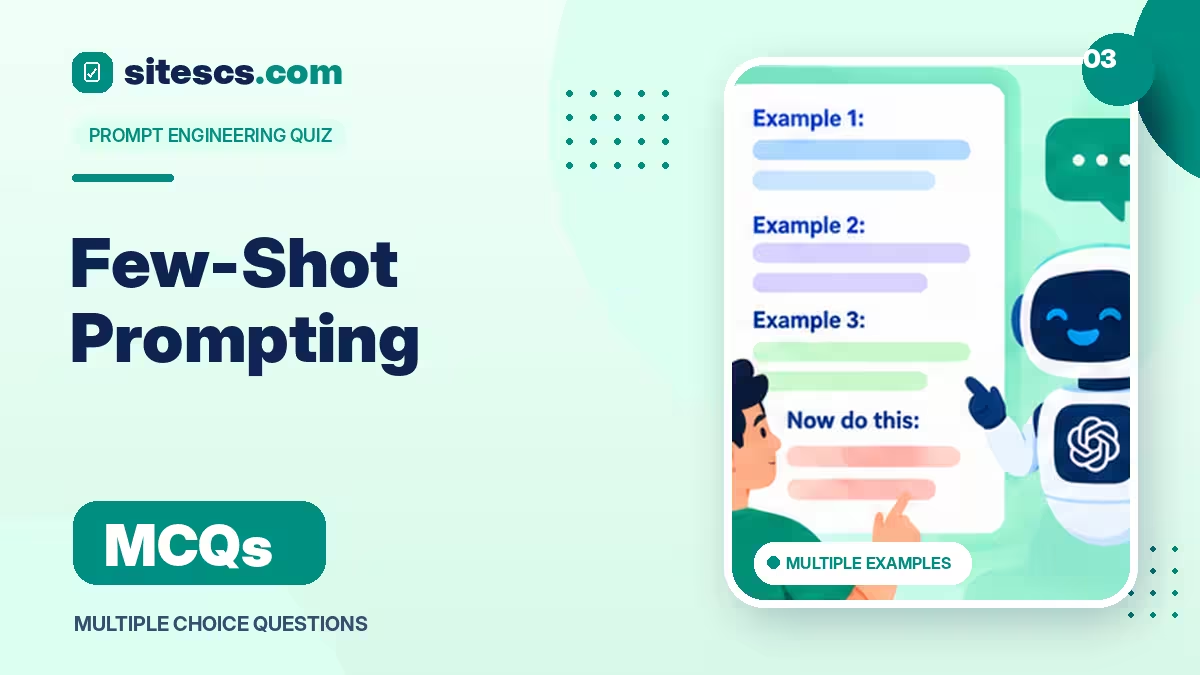
Few-shot prompting is a widely used prompt engineering technique that improves an AI model’s understanding of a task by providing multiple examples within the input prompt. Rather than relying entirely on a general instruction, this technique demonstrates the desired behavior through a small collection of sample inputs and outputs.
Few-shot prompting is particularly useful when working with large language models (LLMs) on text classification, sentiment analysis, translation, data extraction, content generation, and specialized formatting tasks.
For students learning artificial intelligence, understanding few-shot prompting is essential because it explains how examples can influence an AI model’s responses without modifying its underlying parameters.
What Is Few-Shot Prompting?
Few-shot prompting is a technique in which users provide two or more examples demonstrating how an AI model should complete a particular task. These examples help establish patterns that the model can apply to a new input.
For example, consider a sentiment classification prompt:
Example 1: “This movie is amazing.” → Positive
Example 2: “The service was terrible.” → Negative
Example 3: “The package arrived yesterday.” → Neutral
New Input: “I absolutely loved the experience.”
Using the demonstrated classification pattern, the AI model can identify the new sentence as expressing positive sentiment.
The number of examples is not fixed. Users typically provide a small collection selected according to task complexity and available context space.
How Does Few-Shot Prompting Work?
Few-shot prompting works through in-context learning, where the AI model identifies relevant relationships from demonstrations included in the prompt. The examples communicate task expectations, response structure, terminology, and acceptable output patterns.
When a new input is presented, the model uses the prompt’s instructions and demonstrations to generate an appropriate response.
Importantly, few-shot prompting does not automatically fine-tune or retrain an AI model. The supplied examples influence the current interaction rather than permanently changing the model’s learned weights.
Advantages of Few-Shot Prompting
One significant advantage is improved task guidance. Multiple examples can clarify complicated classification rules, demonstrate specialized output formats, and reduce uncertainty in ambiguous instructions.
Few-shot prompting is also valuable for tasks requiring consistent terminology or a particular writing style. By showing representative examples, users can communicate expectations that might be difficult to express through instructions alone.
The technique is flexible and can be combined with role-based prompting, instruction-based prompting, and output format specification to build more effective AI workflows.
Limitations and Best Practices
Few-shot prompting consumes more input tokens than zero-shot or one-shot prompting. Excessively long examples can reduce the context space available for the actual task.
Poorly chosen examples may introduce bias or teach unintended patterns. For example, if every positive review in the prompt is short and every negative review is long, the model might incorrectly associate sentence length with sentiment.
Effective examples should therefore be accurate, diverse, relevant, and consistent with the task instructions. Testing the prompt using previously unseen inputs can help identify weaknesses.
Few-Shot vs One-Shot Prompting
One-shot prompting includes exactly one demonstration, while few-shot prompting includes multiple demonstrations. Few-shot prompting can represent more cases and exceptions, but it requires additional prompt space and preparation.
Neither method guarantees correctness, making output evaluation important.
Practice Few-Shot Prompting MCQs
Our Few-Shot Prompting MCQs cover in-context learning, example selection, differences between prompting techniques, benefits, limitations, and practical applications.
Attempt the quiz below to assess your understanding of how multiple examples guide AI responses and strengthen your preparation for prompt engineering interviews, academic examinations, and AI certification assessments.
Few-Shot Prompting MCQs with Answers | AI Quiz
Practice Few-Shot Prompting MCQs covering definitions, examples, in-context learning, advantages, limitations, and prompt engineering techniques.
