Top 50 Prompt Engineering Interview Questions
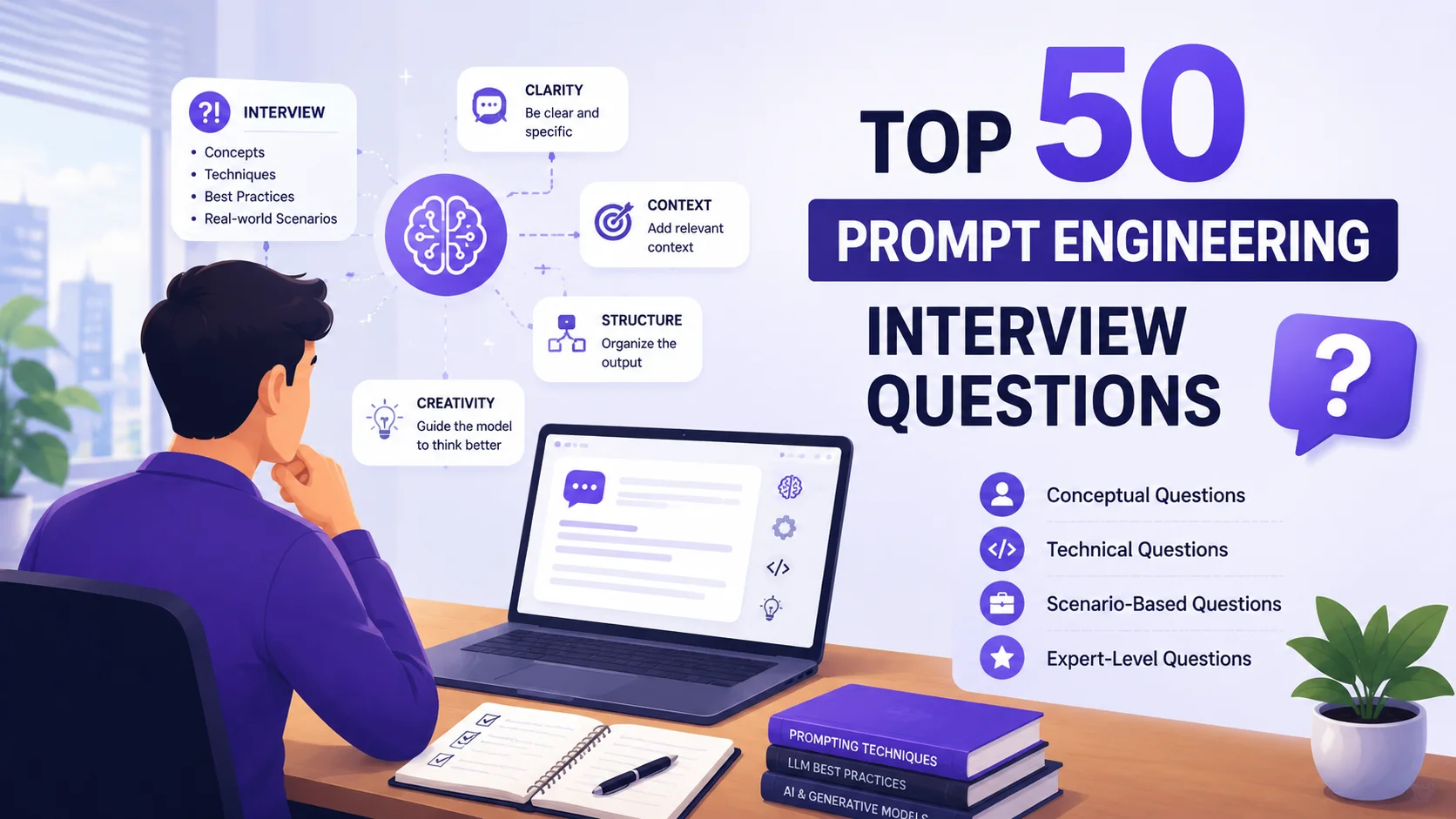
Artificial Intelligence is changing the way businesses work. From chatbots and virtual assistants to content creation and coding tools, AI systems are becoming smarter every day. At the center of this revolution is Prompt Engineering.
As companies increasingly adopt AI models such as Large Language Models (LLMs), the demand for skilled prompt engineers is growing rapidly. Whether you are preparing for your first AI job interview or looking to advance your career, understanding common prompt engineering interview questions can significantly improve your chances of success.
In this guide, you will find the top 50 prompt engineering interview questions and answers, explained in simple language that anyone can understand.
What Is Prompt Engineering?
Prompt Engineering is the process of designing, refining, and optimizing instructions given to AI models so they produce accurate, relevant, and useful responses.
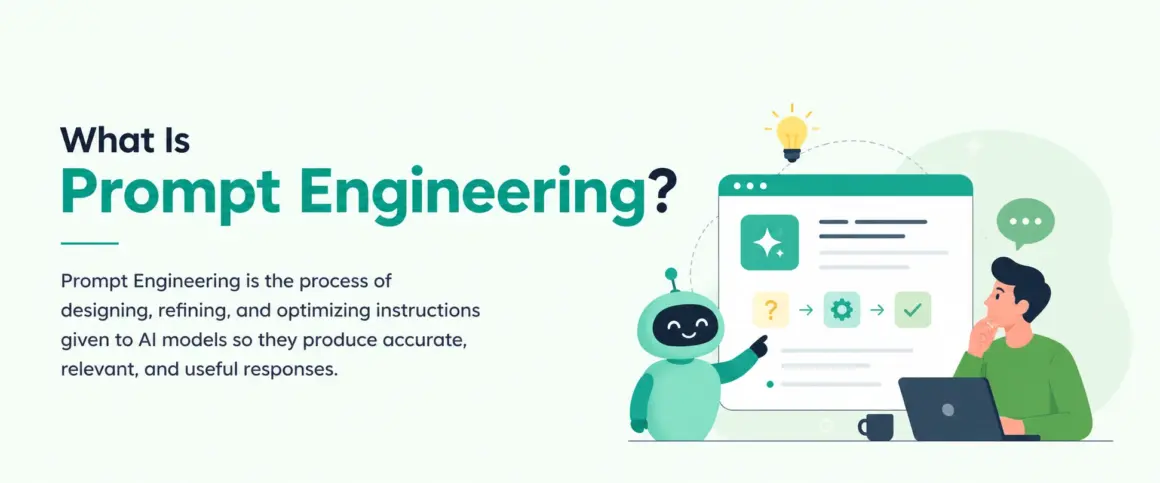
A prompt engineer understands how AI interprets instructions and creates prompts that guide the model toward the desired outcome.
Prompt Engineering means:
Writing clear and effective instructions that help AI generate better results.
Why Are Companies Hiring Prompt Engineers?
Organizations need experts who can:
- Improve AI response quality
- Reduce incorrect outputs
- Increase productivity
- Create AI-powered workflows
- Optimize chatbot performance
- Develop reliable AI applications
As AI adoption grows, prompt engineering skills are becoming highly valuable across industries.
How Prompt Engineering Works
The process usually involves:
- Understanding the task
- Creating a clear prompt
- Testing AI responses
- Refining instructions
- Measuring output quality
- Optimizing for consistency
The better the prompt, the better the AI output.
Prompt Engineering vs Traditional Programming
| Prompt Engineering | Traditional Programming |
|---|---|
| Uses natural language instructions | Uses programming code |
| Guides AI behavior | Defines exact logic |
| Flexible and adaptive | Strict and deterministic |
| Fast experimentation | Requires code changes |
| Focuses on communication | Focuses on algorithms |
Prompt Engineering Interview Questions
1) What is Prompt Engineering, and why has it become such an important skill in the AI industry?
Prompt Engineering is the process of designing clear and effective instructions that guide an AI model toward producing the desired output. It has become important because modern AI systems depend heavily on the quality of prompts. A well-written prompt can significantly improve accuracy, relevance, and consistency, making AI applications more useful in real-world business scenarios.
2) How would you explain Prompt Engineering to someone who has no technical background?
I would explain Prompt Engineering as the art of giving instructions to AI in a way that it clearly understands what we want. Just as humans perform better when instructions are specific and detailed, AI models also generate better responses when they receive clear guidance. The goal is simply to communicate with AI more effectively.
3) What is a prompt, and what are the key components of an effective prompt?
A prompt is any instruction, question, or piece of information given to an AI model. An effective prompt usually includes context, a clear objective, relevant constraints, and the desired output format. When these elements are combined properly, the AI can understand expectations and provide more accurate responses.
4) What is the difference between Prompt Engineering and traditional programming?
Traditional programming involves writing explicit rules and logic that computers follow exactly. Prompt Engineering, on the other hand, focuses on guiding AI behavior through natural language instructions. Instead of coding every rule, prompt engineers influence the model’s output by carefully designing and refining prompts.
5) Why do Large Language Models respond differently to different prompts even when the question appears similar?
Large Language Models interpret language based on patterns learned during training. Small changes in wording, context, tone, or instructions can significantly influence how the model understands the task. This is why prompt engineers spend time testing different prompt structures to achieve more reliable and consistent results.
6) What are the most important qualities of a good prompt engineer?
A successful prompt engineer should possess strong communication skills, logical thinking, creativity, problem-solving ability, and attention to detail. They must understand how AI models behave, identify weaknesses in outputs, and continuously refine prompts to improve performance across different use cases.
7) Can you explain Zero-Shot Prompting with a practical example?
Zero-Shot Prompting occurs when an AI model is asked to perform a task without being given any examples. For instance, asking an AI to “Write a professional email requesting a meeting with a client” relies entirely on the model’s existing knowledge. This method is simple and efficient for many common tasks.
8) What is Few-Shot Prompting, and when would you use it?
Few-Shot Prompting involves providing several examples before requesting a response. This technique is useful when a task requires a specific style, format, or pattern. By showing examples, the model better understands expectations and can generate outputs that closely match the desired structure.
9) What is Chain-of-Thought Prompting, and how does it improve AI responses?
Chain-of-Thought Prompting encourages the AI to break down a problem into smaller reasoning steps before arriving at a final answer. This approach often improves performance in logical reasoning, mathematics, analysis, and complex decision-making tasks because the model processes information more systematically.
10) How do you improve a prompt when the AI generates inaccurate or irrelevant answers?
I start by identifying where the misunderstanding occurs and then refine the prompt by adding context, clarifying instructions, specifying the desired format, and reducing ambiguity. Iterative testing is important because even small adjustments can dramatically improve response quality and relevance.
11) What role does context play in Prompt Engineering?
Context provides background information that helps the AI understand the situation more accurately. Without sufficient context, the model may make assumptions that lead to generic or incorrect responses. Including relevant details allows the AI to generate outputs that are more personalized, accurate, and aligned with the user’s goals.
12) What are AI hallucinations, and how can prompt engineers reduce them?
AI hallucinations occur when a model generates information that sounds convincing but is factually incorrect or completely fabricated. Prompt engineers can reduce hallucinations by providing clear context, requesting evidence-based responses, limiting assumptions, using external knowledge sources when available, and encouraging the model to acknowledge uncertainty when information is missing.
13) What is Role Prompting, and why is it commonly used in Prompt Engineering?
Role Prompting is a technique where the AI is assigned a specific role, profession, or identity before performing a task. For example, asking the model to act as a marketing consultant, software engineer, or financial analyst helps guide the tone, expertise level, and structure of the response. This often produces more focused and relevant outputs because the AI has a clearer perspective from which to answer.
14) Can you explain what a System Prompt is and how it differs from a User Prompt?
A System Prompt provides high-level instructions that define the overall behavior and rules the AI should follow throughout a conversation. A User Prompt is the specific request made by the user. The system prompt acts as a foundation that influences all responses, while user prompts focus on individual tasks or questions. Understanding this distinction is important when building reliable AI applications.
15) What is Prompt Chaining, and where is it used in real-world AI systems?
Prompt Chaining is the process of breaking a complex task into multiple smaller prompts, where the output of one prompt becomes the input for the next. This technique improves accuracy and organization because the AI focuses on one step at a time. Businesses often use prompt chaining in content creation, research automation, customer support workflows, and data analysis systems.
16) What is Temperature in AI models, and how does it affect generated responses?
Temperature is a parameter that controls how creative or predictable an AI model’s responses are. A lower temperature produces more consistent and focused answers, while a higher temperature encourages creativity and variation. For tasks requiring factual accuracy, lower values are generally preferred, whereas creative writing and brainstorming may benefit from higher values.
17) What are Tokens, and why are they important when working with Large Language Models?
Tokens are small units of text that AI models process during input and output generation. A token can represent a word, part of a word, punctuation mark, or character sequence. Token limits affect how much information a model can handle in a single interaction, making token management an important consideration when designing prompts for large documents or complex tasks.
18) What is a Context Window, and why should prompt engineers understand it?
A Context Window refers to the maximum amount of information an AI model can remember and process at one time. If a conversation exceeds the available context window, older information may be ignored or forgotten. Prompt engineers must understand these limitations to ensure important instructions remain available throughout long interactions.
19) What are Prompt Templates, and how do organizations use them?
Prompt Templates are reusable prompt structures designed for recurring tasks. Instead of creating new prompts from scratch every time, organizations develop templates for activities such as content generation, customer support responses, summarization, and report creation. Templates improve consistency, reduce errors, and save significant time in production environments.
20) How would you evaluate whether a prompt is successful or not?
A prompt should be evaluated based on how well it achieves its intended objective. Key evaluation criteria include accuracy, relevance, completeness, consistency, clarity, and user satisfaction. In professional environments, prompt engineers often conduct multiple tests and compare outputs against predefined benchmarks to measure performance improvements.
21) What is Retrieval-Augmented Generation (RAG), and why is it important?
Retrieval-Augmented Generation, commonly known as RAG, combines external knowledge sources with a language model before generating responses. Instead of relying only on training data, the AI retrieves relevant information from databases, documents, or search systems. This approach improves factual accuracy, reduces hallucinations, and enables access to up-to-date information.
22) How does RAG help reduce AI hallucinations?
RAG reduces hallucinations by grounding responses in real information retrieved from trusted sources. Rather than guessing answers based solely on learned patterns, the model references relevant documents before generating a response. This significantly improves reliability, especially in industries such as healthcare, finance, legal services, and enterprise knowledge management.
23) What is Prompt Injection, and why is it considered a security risk?
Prompt Injection is a technique where malicious instructions attempt to override the intended behavior of an AI system. Attackers may craft inputs that trick the model into revealing sensitive information or ignoring established rules. Understanding prompt injection is important because secure prompt design is becoming a critical requirement in enterprise AI deployments.
24) How can organizations protect AI systems from Prompt Injection attacks?
Organizations can reduce prompt injection risks through strong system prompts, input validation, access controls, output filtering, and continuous security testing. Developers should also separate sensitive instructions from user-provided content whenever possible. A layered security approach helps ensure AI systems remain reliable and resistant to manipulation attempts.
25) What is Multimodal Prompting, and how is it different from traditional text prompting?
Multimodal Prompting involves using multiple types of inputs such as text, images, audio, video, or documents together within a single prompt. Unlike traditional prompting, which relies only on text instructions, multimodal systems can analyze visual and contextual information simultaneously. This capability enables more advanced applications such as image analysis, document understanding, medical image interpretation, and visual question answering.
26) Can you provide an example of an effective multimodal prompt?
A practical example would be uploading a product image and asking the AI to identify the product, describe its features, suggest improvements, and create marketing content for an online store. By combining visual input with detailed instructions, the model can generate more relevant and context-aware responses than text-only prompting.
27) What is Structured Output Prompting, and why is it useful?
Structured Output Prompting instructs the AI to return information in a predefined format such as JSON, XML, tables, bullet lists, or specific templates. This approach is particularly useful when AI responses need to be integrated into software systems, databases, dashboards, or automation workflows because the output remains consistent and machine-readable.
28) How would you create a prompt that generates consistent outputs every time?
To improve consistency, I would provide clear instructions, define the desired format, include examples when necessary, eliminate ambiguous language, and establish specific constraints. Consistency also improves when prompts are tested repeatedly and refined based on observed results. Detailed prompts generally produce more predictable outputs than vague instructions.
29) What is Prompt Versioning, and why is it important in professional environments?
Prompt Versioning is the process of tracking changes made to prompts over time. Similar to software version control, it allows teams to compare prompt performance, identify improvements, document modifications, and revert to previous versions if necessary. This practice becomes essential when managing large-scale AI applications used by multiple teams.
30) How do you approach prompt optimization in a production environment?
Prompt optimization begins with defining measurable goals and evaluating current performance. I would analyze outputs, identify weaknesses, adjust prompt wording, add relevant context, test multiple variations, and compare results against predefined metrics. Continuous experimentation and performance monitoring help ensure long-term improvement and reliability.
31) What should you do if an AI model repeatedly misunderstands your instructions?
If the model consistently produces incorrect responses, I would simplify the prompt, break complex tasks into smaller steps, provide additional context, specify expected output formats, and include examples. Sometimes restructuring instructions completely is more effective than making minor adjustments. Systematic testing helps identify the exact source of confusion.
32) How would you debug a poorly performing prompt?
I would first examine whether the objective is clearly defined and whether sufficient context is provided. Next, I would isolate individual components of the prompt, test alternative phrasings, compare outputs, and identify patterns in failures. Debugging prompts requires a methodical approach similar to troubleshooting software problems.
33) What are the most common mistakes beginners make in Prompt Engineering?
Many beginners use vague instructions, provide insufficient context, combine multiple objectives into one prompt, fail to define output formats, and assume the model automatically understands their intent. Another common mistake is accepting the first response without testing alternative prompt variations that may produce significantly better results.
34) How would you explain the difference between Prompt Engineering and Fine-Tuning?
Prompt Engineering improves model performance through carefully designed instructions without changing the model itself. Fine-tuning involves retraining or adapting the model using specialized datasets. Prompt Engineering is generally faster, cheaper, and easier to implement, while fine-tuning may provide deeper customization for highly specialized applications.
35) When should a company choose Prompt Engineering instead of Fine-Tuning?
Organizations often choose Prompt Engineering when they need quick deployment, lower costs, flexibility, and frequent updates. Since prompts can be modified instantly, businesses can adapt to changing requirements without retraining the model. Fine-tuning becomes more suitable when highly specialized domain expertise or consistent behavior is required across large-scale deployments.
36) What role does Prompt Engineering play in AI-powered business applications?
Prompt Engineering serves as the bridge between business objectives and AI capabilities. It helps organizations automate customer support, generate content, analyze documents, summarize information, assist software development, and improve decision-making processes. Effective prompt design directly impacts the quality, efficiency, and reliability of AI-powered solutions.
37) What are AI Agents, and how does Prompt Engineering contribute to their effectiveness?
AI Agents are systems capable of performing tasks autonomously by making decisions, using tools, retrieving information, and interacting with users. Prompt Engineering plays a crucial role because the instructions given to the agent determine how it plans tasks, prioritizes actions, evaluates results, and communicates responses. Well-designed prompts help agents operate more reliably and efficiently while reducing mistakes.
38) How would you design prompts for an AI customer support agent?
When designing prompts for customer support, I would clearly define the agent’s role, tone, responsibilities, escalation procedures, and response guidelines. The prompt should instruct the AI to remain professional, provide accurate information, ask clarifying questions when needed, and transfer complex issues to human representatives. Detailed instructions improve consistency and customer satisfaction.
39) What ethical considerations should prompt engineers keep in mind when developing AI systems?
Prompt engineers must ensure that AI systems generate fair, accurate, unbiased, and responsible responses. They should avoid encouraging harmful behavior, misinformation, discrimination, or privacy violations. Ethical prompt design also involves transparency, accountability, and adherence to organizational policies and regulatory requirements, particularly in sensitive industries.
40) How can prompt engineers reduce bias in AI-generated outputs?
Reducing bias begins with using neutral language, providing balanced context, and testing prompts across diverse scenarios. Prompt engineers should regularly review outputs for unintended stereotypes or unfair assumptions and adjust instructions accordingly. Continuous monitoring and evaluation are essential because bias can emerge in different ways depending on the context of the request.
41) Interview Scenario: An AI chatbot gives different answers to the same question. How would you address this issue?
I would first examine whether the prompt contains ambiguity or insufficient guidance. Next, I would review model settings such as temperature, identify inconsistencies in context, and test multiple prompt variations. By refining instructions and standardizing response formats, consistency can often be significantly improved while maintaining answer quality.
42) Interview Scenario: A content-generation model produces repetitive articles. How would you solve the problem?
I would update the prompts to encourage diversity in structure, tone, examples, and perspectives. Additional context, creative constraints, and explicit instructions to avoid repetition can help generate more varied content. Testing different prompt designs and adjusting model parameters may further improve originality and engagement.
43) Interview Scenario: A business client wants AI-generated reports in a strict company format. What approach would you take?
I would create a structured prompt template that clearly specifies headings, sections, formatting rules, tone requirements, and mandatory information. Providing examples of successful reports would further improve consistency. Structured prompting ensures outputs remain aligned with organizational standards and reduces manual editing effort.
44) How would you measure the success of a Prompt Engineering project?
Success should be measured against clearly defined business objectives and performance metrics. Common indicators include response accuracy, user satisfaction, task completion rates, consistency, efficiency gains, error reduction, and return on investment. Effective prompt engineering delivers measurable improvements that support organizational goals.
45) What tools or platforms are commonly used by prompt engineers during development and testing?
Prompt engineers often use AI playgrounds, testing environments, prompt management platforms, analytics dashboards, version control systems, and evaluation frameworks. These tools help compare prompt variations, track performance metrics, document improvements, and maintain consistency across projects. Familiarity with testing methodologies is often more important than expertise with a specific tool.
46) How would you explain the importance of experimentation in Prompt Engineering?
Prompt Engineering is highly iterative because small wording changes can dramatically affect AI outputs. Experimentation allows engineers to compare approaches, discover optimal prompt structures, identify weaknesses, and improve performance over time. A successful prompt engineer treats prompt design as a continuous process of testing and refinement rather than a one-time task.
47) What is the biggest challenge facing prompt engineers today?
One major challenge is ensuring consistent and reliable outputs across diverse scenarios. AI models can behave differently depending on context, input phrasing, and task complexity. Prompt engineers must balance accuracy, efficiency, creativity, safety, and scalability while adapting to rapidly evolving AI technologies and business requirements.
48) How would you stay updated with the latest developments in Prompt Engineering and Generative AI?
I would regularly follow AI research papers, technical blogs, industry publications, developer communities, conferences, webinars, and official documentation from leading AI providers. Hands-on experimentation is equally important because practical experience often reveals insights that cannot be learned from theory alone.
49) Why do you believe Prompt Engineering will remain valuable even as AI models become more advanced?
As AI capabilities improve, businesses will still need professionals who can translate human goals into effective instructions. Advanced models may reduce the complexity of prompt design, but organizations will continue requiring experts who understand context, workflows, optimization, governance, and business objectives. Effective communication with AI will remain a critical skill.
50) Why should we hire you for a Prompt Engineering role?
A strong answer would emphasize analytical thinking, communication skills, problem-solving ability, and practical experience with AI systems. You could explain that you understand how to design, test, optimize, and evaluate prompts to achieve business goals while maintaining quality, consistency, and ethical standards. Employers value candidates who can bridge the gap between technical capabilities and real-world business needs.
Key Takeaways from These Prompt Engineering Interview Questions
Prompt Engineering is much more than simply asking questions to an AI model. It involves understanding how Large Language Models interpret instructions, designing prompts strategically, evaluating performance, reducing errors, improving consistency, and aligning AI outputs with business objectives. Employers increasingly seek professionals who can combine technical understanding with strong communication and problem-solving skills.


