Ultimate Prompt Engineering Cheat Sheet (Free PDF)
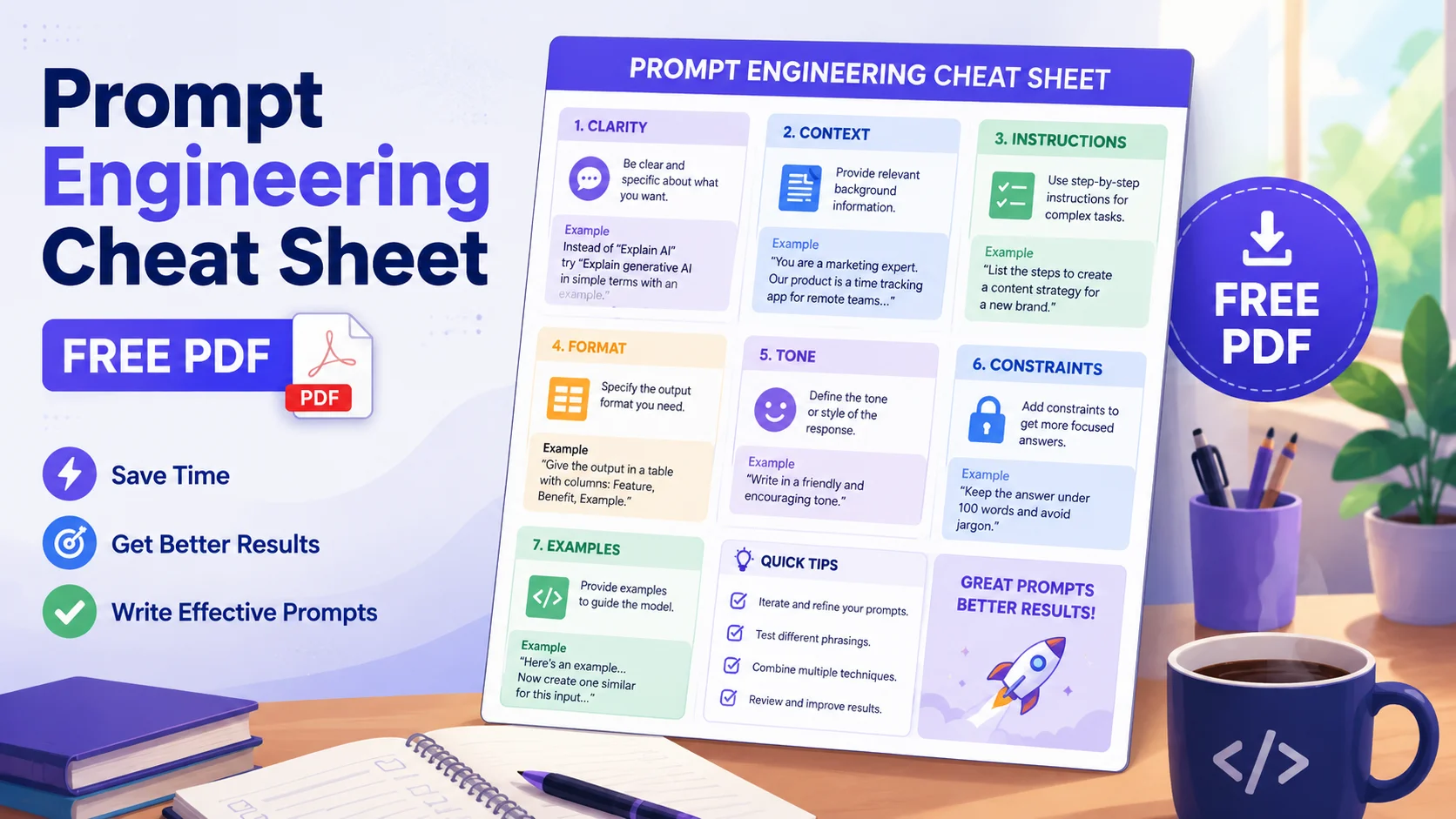
Artificial Intelligence can produce impressive results—but only when it receives clear instructions. The difference between an average AI response and an exceptional one often comes down to a single factor: prompt engineering.
Whether you’re using ChatGPT, Claude, Gemini, Perplexity, or another large language model (LLM), knowing how to structure prompts can dramatically improve output quality, accuracy, creativity, and consistency.
This guide serves as a comprehensive Prompt Engineering Cheat Sheet that you can use as a quick reference for creating effective prompts. It includes essential frameworks, practical templates, common mistakes, advanced techniques, and a downloadable PDF section that can be converted into a printable resource.
What Is Prompt Engineering?
Prompt engineering is the process of designing instructions that guide AI systems toward producing desired outputs.
Think of a prompt as a conversation blueprint. The more clearly you communicate:
- What you want
- How you want it
- Who the audience is
- What constraints exist
the better the AI performs.
Simple Example
Weak Prompt
Write an article about AI.
Strong Prompt
Write a 1,500-word beginner-friendly article explaining artificial intelligence for small business owners. Use simple language, practical examples, and include a FAQ section.
The second prompt provides context, audience, format, and expectations, resulting in significantly better output.
Why Prompt Engineering Matters
Effective prompting can help you:
✅ Generate higher-quality content
✅ Improve factual accuracy
✅ Reduce hallucinations
✅ Save editing time
✅ Create consistent outputs
✅ Automate repetitive workflows
✅ Improve coding assistance
✅ Enhance research productivity
As AI becomes integrated into daily work, prompt engineering is rapidly becoming a valuable professional skill.
The Universal Prompt Formula
One of the easiest frameworks for beginners is:
Context + Task + Requirements + Output Format
Template
Context:
[Background information]

Task:
[What should AI do?]

Requirements:
[Rules, constraints, style]

Output Format:
[How response should be structured]
Example
Context:
I run a fitness blog.

Task:
Create a blog post outline about home workouts.

Requirements:
Target beginners, use SEO headings, include FAQs.

Output Format:
Markdown outline with H2 and H3 headings.
This framework works across nearly every AI platform.
The Ultimate Prompt Engineering Cheat Sheet
1. Assign a Role
AI performs better when given a clear role.
Template
Act as a [profession].Examples
Act as a senior software engineer.Act as an SEO consultant.Act as a financial analyst.Act as a university professor.Why It Works
Roles establish expertise, tone, perspective, and reasoning style.
2. Define the Goal Clearly
Avoid vague instructions.
Weak
Tell me about marketing.Better
Explain digital marketing strategies for local restaurants seeking more customers.Specific prompts generate focused responses.
3. Define the Audience
Audience context significantly improves relevance.
Examples
Explain blockchain to a 10-year-old.Explain blockchain to software developers.Explain blockchain to investors.The same topic requires completely different explanations.
4. Specify Output Format
Never assume AI knows your preferred structure.
Examples
Provide a table.Create bullet points.Generate JSON.Write in Markdown format.Create a step-by-step guide.5. Add Constraints
Constraints improve precision.
Examples
Use less than 200 words.Avoid technical jargon.Include three examples.Write at an eighth-grade reading level.Use active voice only.6. Request Examples
Examples make responses more practical.
Template
Explain the concept and provide three real-world examples.Example
Explain machine learning and provide three business use cases.7. Ask for Step-by-Step Thinking
Complex tasks benefit from structured reasoning.
Template
Break the solution into logical steps.Example
Create a step-by-step business launch plan for an online consulting service.8. Use Delimiters
Separate information clearly.
Example
Analyze the text below:

"""
Insert content here
"""
Delimiters reduce ambiguity and confusion.
The CRAFT Framework
A popular prompt engineering framework is CRAFT.
| Component | Meaning |
|---|---|
| C | Context |
| R | Role |
| A | Action |
| F | Format |
| T | Tone |
Example
Context:
I own a SaaS startup.

Role:
Act as a growth marketer.

Action:
Create a customer acquisition strategy.

Format:
Numbered list.

Tone:
Professional and data-driven.
This framework consistently produces strong outputs.
The RISE Framework
Another effective structure is RISE.
| Element | Meaning |
|---|---|
| R | Role |
| I | Input |
| S | Steps |
| E | Expectation |
Example
Role:
Act as an HR consultant.

Input:
Remote-first technology company.

Steps:
Evaluate hiring strategy and identify weaknesses.

Expectation:
Provide actionable recommendations.
Prompt Templates for Popular Use Cases
Content Writing Prompt
Act as an experienced content writer.

Write a 1,500-word article about [topic].

Audience:
[Target audience]

Requirements:
- SEO optimized
- Human-friendly tone
- Include examples
- Add FAQs

Output:
Markdown format
Blog Outline Prompt
Create a comprehensive blog outline about [topic].

Requirements:
- SEO headings
- H2 and H3 structure
- Include FAQs
- Cover beginner and advanced concepts
Social Media Prompt
Act as a social media strategist.

Create 10 LinkedIn posts about [topic].

Requirements:
- Hook in first sentence
- Professional tone
- Include CTA
- Maximum 200 words each
Coding Prompt
Act as a senior software engineer.

Write Python code that:

[task]

Requirements:
- Add comments
- Explain logic
- Handle errors
- Follow best practices
Research Prompt
Act as a research analyst.

Analyze the topic:

[topic]

Provide:
- Key insights
- Opportunities
- Risks
- Trends
- Summary
Marketing Prompt
Act as a marketing strategist.

Create a marketing campaign for:

Product:
[product]

Audience:
[target audience]

Deliverables:
- Positioning
- Messaging
- Channels
- Content ideas
- KPIs
Advanced Prompt Engineering Techniques
Few-Shot Prompting
Provide examples before asking AI to complete a task.
Example
Input: Apple
Output: Fruit

Input: Carrot
Output: Vegetable

Input: Rose
Output:
The model learns patterns from examples.
Chain Prompting
Break complex tasks into smaller tasks.
Instead of:
Create a business plan.Use:
Step 1: Identify target market.

Step 2: Analyze competitors.

Step 3: Create pricing strategy.

Step 4: Build marketing plan.
This improves quality significantly.
Self-Critique Prompting
Ask AI to review its own output.
Example
Write the article.

Then evaluate:
- Clarity
- Accuracy
- Readability
- Missing information

Suggest improvements.
Iterative Refinement
Treat prompting as an ongoing conversation.
Example sequence:
Create outline.Then:
Expand section three.Then:
Add examples.Then:
Improve readability.Progressive refinement often outperforms single prompts.
Common Prompt Engineering Mistakes
Being Too Vague
Bad:
Write something about technology.Good:
Write a beginner guide explaining cloud computing for small businesses.Missing Context
Bad:
Create a strategy.Good:
Create a six-month marketing strategy for a local dental clinic.Too Many Instructions at Once
Overloaded prompts can create confusion.
Break large tasks into stages.
No Output Format
Always specify structure.
Example:
Output as:
- Executive summary
- Recommendations
- Action plan
Ignoring Audience
The same content should differ for:
- Students
- Executives
- Developers
- Customers
- Investors
Always define who the content is for.
ChatGPT Prompt Engineering Cheat Sheet
Content Creation
Act as a professional content writer.

Create [content type] about [topic].

Audience:
[audience]

Tone:
[tone]

Length:
[word count]

Output:
[format]
Summarization
Summarize the following content.

Requirements:
- Key points only
- Bullet format
- Less than 200 words

Text:
[paste content]
Brainstorming
Generate 50 ideas for [topic].

Requirements:
- Unique
- Practical
- Categorized
Learning
Teach me [topic].

Requirements:
- Beginner friendly
- Real-world examples
- Step-by-step explanation
Problem Solving
Analyze the following problem:

[problem]

Provide:
1. Root causes
2. Possible solutions
3. Recommended approach
4. Risks
One-Page Prompt Engineering Cheat Sheet
Remember These Five Rules
- Give context
- Assign a role
- Define the task
- Specify format
- Add constraints
Formula
Role + Context + Task + Requirements + FormatExample
Act as an SEO consultant.

Help a local bakery increase organic traffic.

Create:
- Keyword strategy
- Content plan
- Link-building ideas

Output:
Table format.
Free Prompt Engineering PDF Content Checklist
Include these sections in your printable PDF:
☑ Universal Prompt Formula
☑ CRAFT Framework
☑ RISE Framework
☑ Content Writing Prompts
☑ Marketing Prompts
☑ Coding Prompts
☑ Research Prompts
☑ Few-Shot Prompting
☑ Chain Prompting
☑ Self-Critique Prompting
☑ Common Mistakes
☑ Best Practices
Frequently Asked Questions
What is prompt engineering?
Prompt engineering is the practice of designing effective instructions that guide AI systems toward producing more accurate, useful, and relevant responses.
Is prompt engineering still important with modern AI models?
Yes. Modern models are more capable than earlier generations, but prompt quality still strongly influences output quality, consistency, reasoning, and formatting.
What is the best prompt structure?
One of the most reliable frameworks is:
Role + Context + Task + Requirements + Output Format
This structure provides clarity and reduces ambiguity.
Can prompt engineering improve AI accuracy?
It can improve relevance and reduce misunderstandings by supplying better context and constraints. However, it does not guarantee factual correctness, so important information should still be verified.
Which AI tools benefit from prompt engineering?
Prompt engineering techniques work across most major AI platforms, including ChatGPT, Claude, Gemini, Perplexity, Copilot, and many specialized AI applications.
Is prompt engineering difficult to learn?
Not at all. Most people can improve AI outputs dramatically by learning a few core principles: clarity, specificity, context, structure, and iteration.
Conclusion
Prompt engineering is no longer a niche technical skill. It has become a practical capability for writers, marketers, developers, researchers, business professionals, educators, and entrepreneurs.
The most effective prompts are not necessarily the longest. They are the clearest. By combining context, roles, objectives, constraints, and formatting instructions, you can consistently unlock better results from AI systems.
Use this Prompt Engineering Cheat Sheet as a quick-reference guide, save it as a PDF, and keep it nearby whenever you’re working with AI. Small prompt improvements often lead to dramatically better outcomes—and over time, those improvements compound into faster workflows, higher-quality content, and more reliable AI-assisted work.


