Prompt Engineering With RTF Framework: Simple Guide
Artificial Intelligence is changing how people work, learn, create content, and automate tasks. But here’s the truth many beginners miss: AI is only as good as the prompt you give it!
That’s where the RTF Framework becomes incredibly useful.
If you have ever received confusing, incomplete, or low-quality AI responses, the problem was probably not the AI itself. Most of the time, the issue comes from unclear prompting. The RTF framework helps solve this problem by giving structure to your prompts.
Table of Contents
- What Is the RTF Framework?
- Why the RTF Framework Matters in Prompt Engineering
- Understanding Each Part of the RTF Framework
- How the RTF Framework Works
- Simple RTF Framework Example
- Benefits of Using the RTF Framework
- Best Practices for Writing RTF Prompts
- Common Mistakes in the RTF Framework
- Key Takeaways
- Conclusion
- FAQs About RTF Framework
- References
In this guide, you’ll learn what the rtf framework is, how it works, why it matters in prompt engineering, practical examples, comparisons, and how beginners can use it to get professional-level AI outputs.
What Is the RTF Framework?
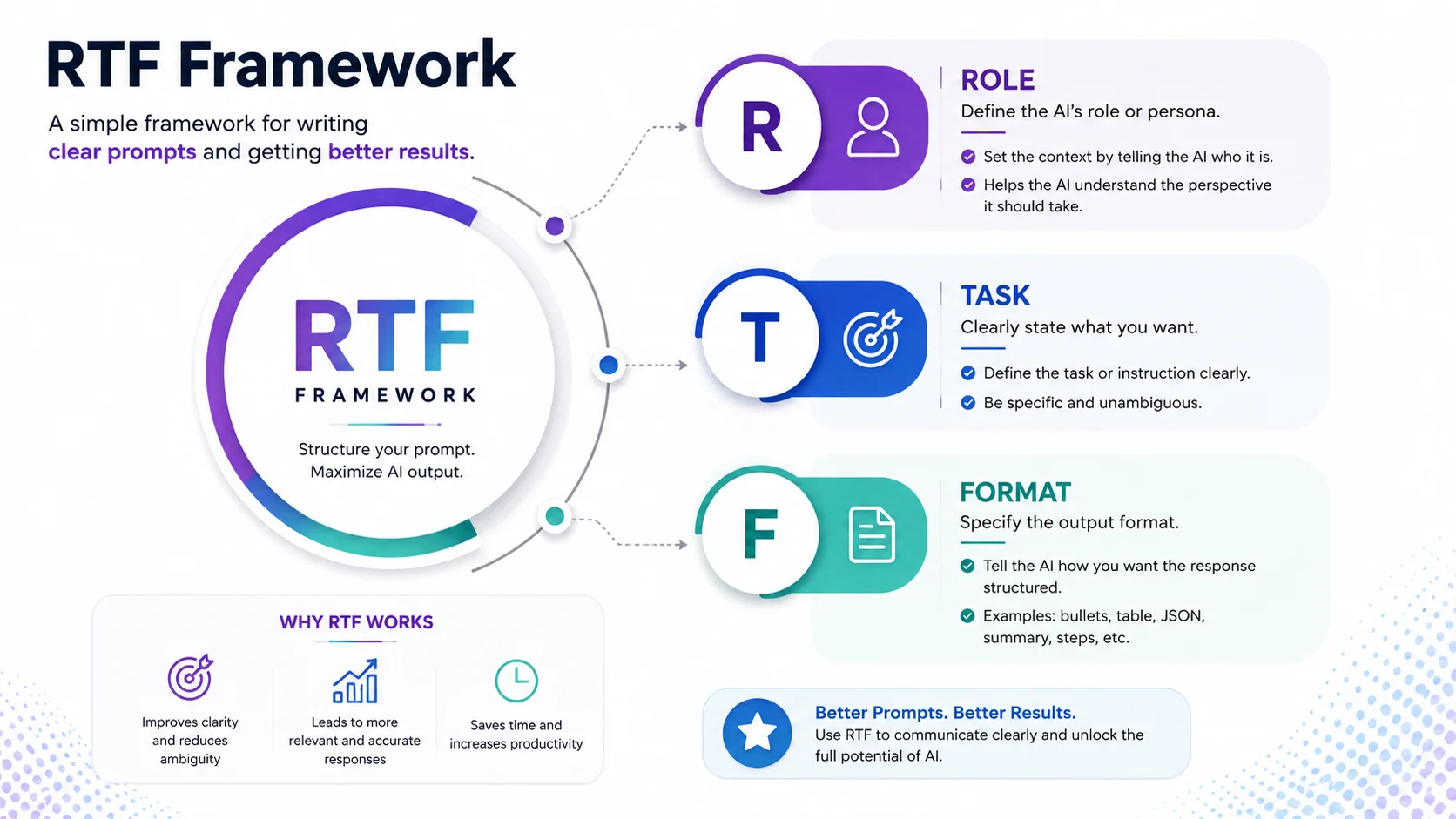
The RTF framework stands for:
- R = Role
- T = Task
- F = Format
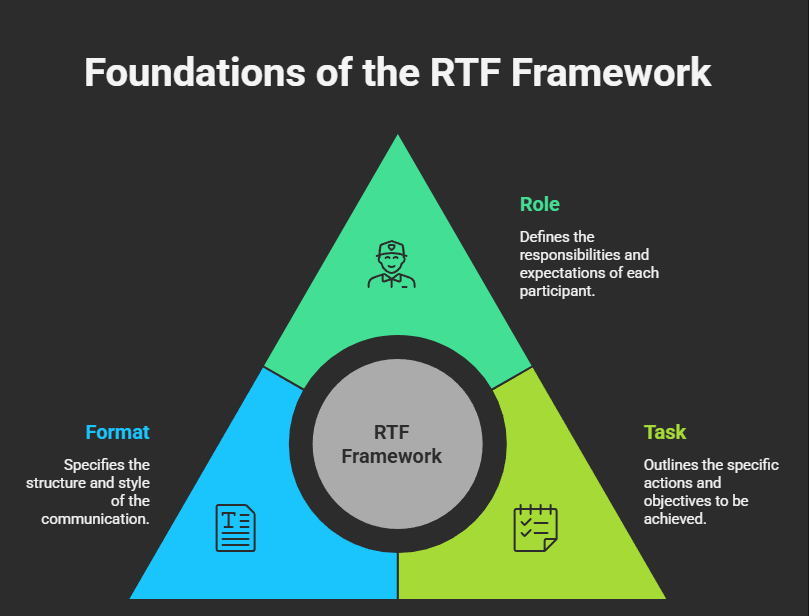
It is a simple prompt engineering structure used to communicate clearly with AI tools like OpenAI ChatGPT, Claude, Gemini, and other large language models.
The framework tells the AI:
- Who it should act as
- What it should do
- How the output should look
This structure dramatically improves response quality because the AI receives better instructions.
Why the RTF Framework Matters in Prompt Engineering
Many users type prompts like:
“Write something about marketing.”
This is too vague. The AI has no idea:
- What type of marketing?
- What audience?
- What style?
- What format?
Now compare it with an RTF prompt:
“Act as a digital marketing expert. Write a beginner-friendly blog post explaining Instagram marketing strategies. Use simple English with headings and bullet points.”
See the difference?
The second prompt gives:
- A role
- A clear task
- A proper format
As a result, the AI produces a much more useful response.
Understanding Each Part of the RTF Framework
1. Role (R)
The Role tells the AI what personality, expertise, or perspective it should adopt.
You can ask the AI to behave like:
- An SEO expert
- A teacher
- A lawyer
- A software engineer
- A content writer
- A business consultant
Example
“Act as a professional SEO specialist.”
This immediately changes the tone and expertise level of the response.
Why Role Is Important
Without a role, AI responses can feel generic. Assigning a role creates:
- Better context
- More accurate answers
- More targeted outputs
- Professional tone
2. Task (T)
The Task explains exactly what you want the AI to do.
This is the most important part of the prompt.
Good Task Examples
- Write a blog post
- Explain a concept
- Summarize an article
- Create a marketing strategy
- Generate social media captions
- Build a coding tutorial
Weak Task Example
“Tell me about AI.”
Better Task Example
“Explain artificial intelligence to beginners using simple examples.”
Specific tasks produce better responses because the AI understands your intention clearly.
3. Format (F)
The Format tells the AI how the final response should appear.
This is extremely important for content creators, bloggers, students, and marketers.
Common Formats
- Bullet points
- Step-by-step guide
- Table
- Blog post
- FAQ section
- Email format
- Short summary
- LinkedIn post
Example
“Use H2 headings, bullet points, and a conclusion section.”
Now the AI understands how to organize the content.
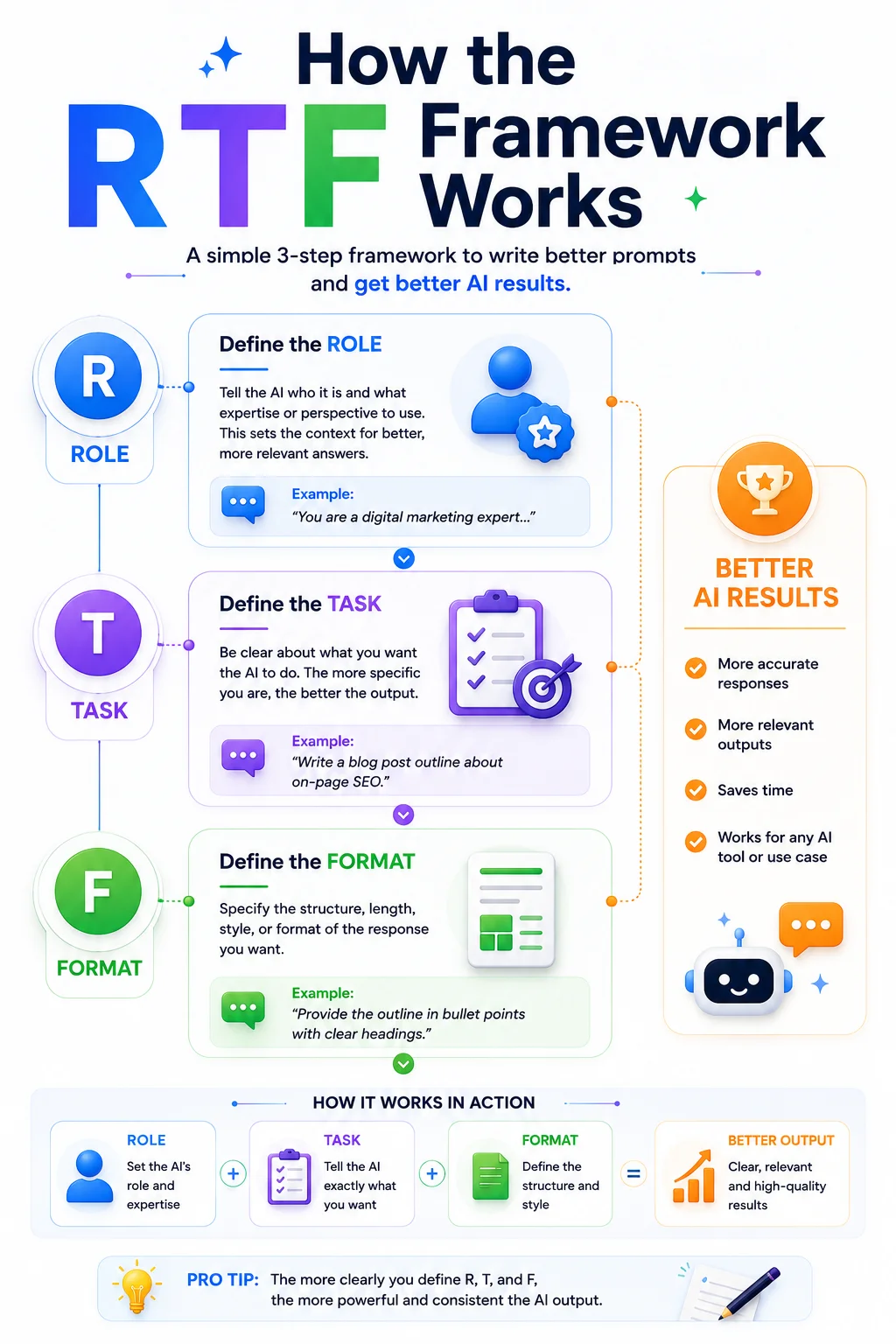
How the RTF Framework Works
The RTF framework works by improving communication between humans and AI.
Think of AI like a highly intelligent assistant. If your instructions are unclear, the output becomes unpredictable. But when instructions are structured, AI performs much better.
Here’s the basic formula:
Role + Task + Format = Better AI Output
This structure reduces confusion and increases accuracy.
Simple RTF Framework Example
Basic Prompt
“Write about fitness.”
The result may be random and generic.
RTF Prompt
“Act as a certified fitness trainer. Write a beginner-friendly guide about home workouts for weight loss. Use short paragraphs, H2 headings, and bullet points.”
This prompt is:
- Clear
- Structured
- Goal-oriented
The output will usually be much more professional.
RTF Framework vs Normal Prompting
| Feature | Normal Prompt | RTF Framework |
|---|---|---|
| Clarity | Low | High |
| Structure | Random | Organized |
| Output Quality | Inconsistent | More accurate |
| SEO Optimization | Weak | Better |
| AI Understanding | Limited | Strong |
| Professional Results | Rare | Common |
The RTF framework gives AI a roadmap. That’s why many prompt engineers prefer it.
Benefits of Using the RTF Framework
1. Better AI Responses
Structured prompts help AI understand exactly what you need.
2. Saves Time
You spend less time correcting bad outputs.
3. Improves Accuracy
Clear instructions reduce misunderstandings.
4. Great for Beginners
Even new users can generate high-quality AI content easily.
5. Useful for Many Industries
The framework works for:
- Blogging
- SEO
- Coding
- Education
- Marketing
- Business
- Research
Best Practices for Writing RTF Prompts
1. Be Specific
Avoid vague prompts.
Weak
“Write an article.”
Better
“Act as a tech blogger and write a 1000-word article about AI automation for beginners.”
2. Mention Audience Type
Tell AI who the content is for.
Examples:
- Beginners
- Students
- Business owners
- Developers
- Marketers
3. Define Tone
You can request:
- Professional tone
- Conversational style
- Friendly language
- Technical explanation
4. Specify Output Structure
Mention formatting requirements clearly.
- Examples:
- Include examples
- Use bullet points
- Add FAQs
- Use H2 headings
Common Mistakes in the RTF Framework
1. Giving Incomplete Instructions
AI cannot read your mind. Missing details often lead to poor results.
2. Using Overly Broad Tasks
Broad prompts create broad answers.
3. Ignoring Format
Without formatting instructions, responses may look messy or difficult to read.
Advanced RTF Prompt Example
Here’s a professional-level example:
“Act as an experienced SEO content strategist. Write a 1200-word blog post about AI tools for small businesses. Use beginner-friendly language, H2 headings, FAQs, key takeaways, and an engaging conclusion.”
This prompt contains:
- Role
- Task
- Format
- Audience direction
- SEO structure
That’s why it performs well.
Key Takeaways
- The rtf framework stands for Role, Task, and Format.
- It improves prompt clarity and AI response quality.
- Structured prompts outperform random prompts.
- The framework works for beginners and professionals alike.
- Using RTF helps create more accurate, readable, and useful AI outputs.
Conclusion
Prompt engineering is becoming one of the most valuable AI skills today. And among all prompting methods, the RTF framework is one of the easiest and most effective systems for beginners.
Instead of typing random instructions, RTF helps you communicate with AI in a structured way. The result is better content, faster workflows, and more professional outputs.
FAQs About RTF Framework
1. What does RTF stand for in prompt engineering?
RTF stands for:
- Role
- Task
- Format
It is a framework used to create structured AI prompts.
2. Why is the RTF framework important?
It helps AI understand instructions clearly, improving output quality and accuracy.
3. Is the RTF framework beginner-friendly?
Yes! It is one of the simplest prompt engineering methods for beginners.
4. Can the RTF framework improve SEO content?
Absolutely. It helps generate better structured and more readable SEO-friendly content.
References
- OpenAI Prompt Engineering Guide
- OpenAI Best Practices for Prompting
- Anthropic Prompt Engineering Documentation
- Google Prompt Design Guide for Generative AI
- Microsoft Azure AI Prompt Engineering Concepts
- NVIDIA Introduction to Prompt Engineering
- IBM Guide to Prompt Engineering
- Google Search Essentials


