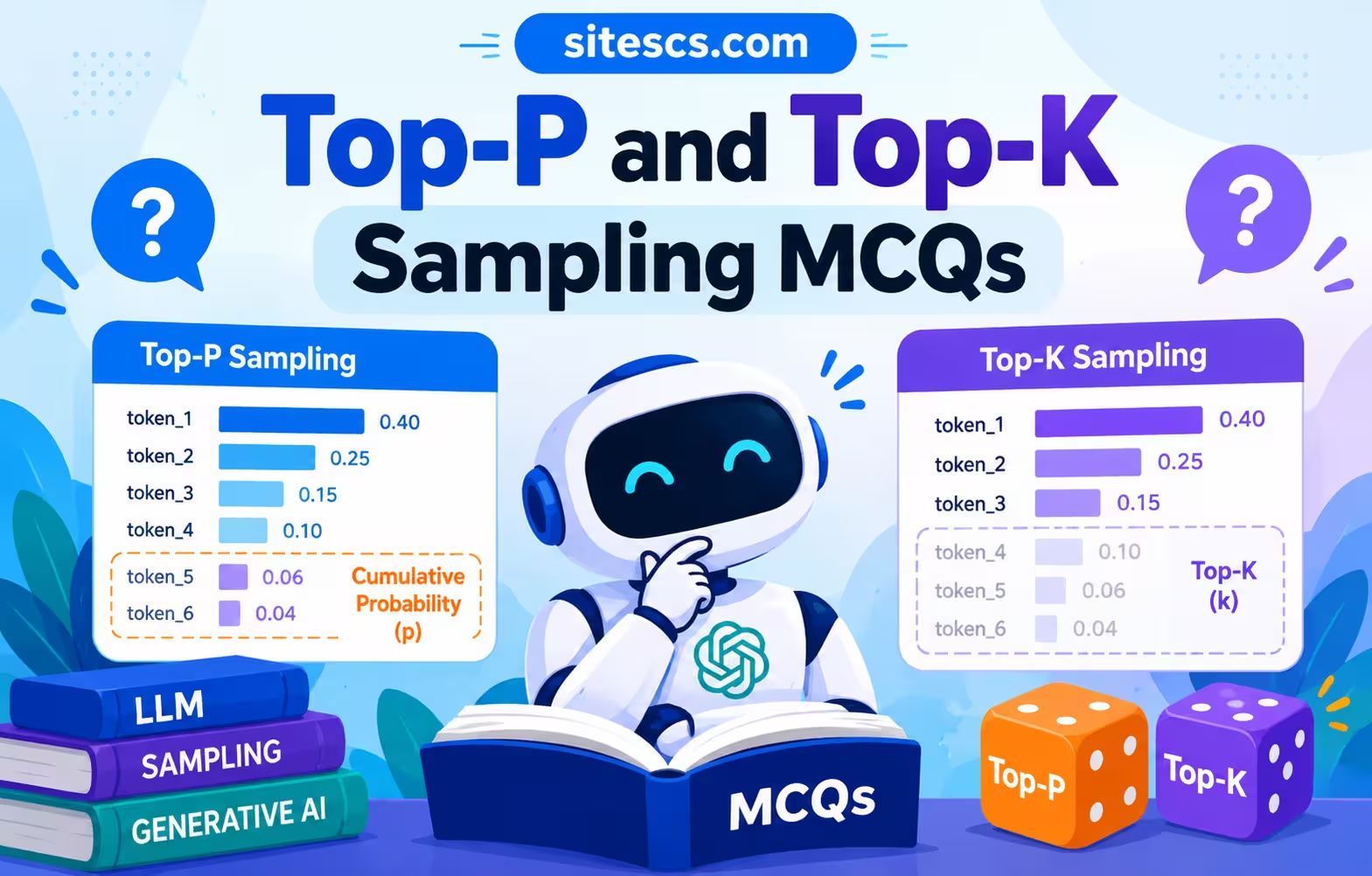
Top-p and top-k sampling are decoding techniques used in Large Language Models (LLMs) to control which tokens are considered during text generation.
When an LLM generates a response, it calculates a probability distribution over possible next tokens. Instead of selecting from every available token, some decoding methods restrict the candidate set to improve the balance between diversity and coherence.
Top-p and top-k are two commonly studied approaches. Understanding their differences is valuable for generative AI learners, developers, and students preparing for LLM technical assessments.
What Is Top-K Sampling?
Top-k sampling is a decoding technique that restricts the candidate tokens to the k highest-probability options.
For example, if top-k is set to 5, only the five highest-ranked tokens remain eligible for selection at the current generation step.
The model then samples from those candidates using their adjusted probabilities.
The value of k represents the number of eligible tokens, not a percentage or probability threshold.
Smaller top-k values create a narrower candidate pool, while larger values allow more possible token choices.
What Is Top-P Sampling?
Top-p sampling, also known as nucleus sampling, selects the smallest group of highest-probability tokens whose combined probability reaches or exceeds a specified threshold.
For example, when top-p is set to 0.90, the algorithm includes the highest-ranked tokens until their cumulative probability is at least 90%.
Unlike top-k, top-p does not necessarily use the same number of candidates at every generation step.
When a few tokens dominate the probability distribution, the nucleus may be small. When probabilities are more evenly distributed, it may contain more tokens.
Top-P vs. Top-K Sampling: Key Differences
The main difference between top-p and top-k is how they determine the eligible candidate pool.
Top-k uses a fixed number of candidates, while top-p uses a cumulative probability threshold.
Suppose five possible tokens have probabilities of 45%, 30%, 15%, 6%, and 4%.
With top-k set to 2, only the first two tokens remain eligible.
With top-p set to 0.90, the first three tokens are included because their combined probability reaches 90%.
This example demonstrates how the two approaches produce different candidate sets.
How Do Top-P and Top-K Affect LLM Responses?
Both sampling strategies influence the range of language model outputs.
A restrictive candidate pool often encourages more conventional token choices. A wider pool permits greater variation but may also introduce less relevant possibilities.
The final result depends on several factors, including the original token probabilities, temperature, model training, and prompt context.
Neither top-p nor top-k guarantees factual correctness or prevents hallucinations.
Can Top-P and Top-K Be Used Together?
Some text generation frameworks support applying both restrictions during decoding.
When combined, the methods narrow the token candidate set according to their configured rules. However, support and processing order can vary among implementations.
Developers should understand the generation framework before selecting sampling parameters. Testing different configurations is more reliable than assuming one setting works best for every task.
Practice Top-P and Top-K Sampling MCQs
The Top-P and Top-K Sampling MCQs quiz covers nucleus sampling, cumulative probability, candidate filtering, token rankings, and the relationship between sampling and temperature.
These concepts are frequently relevant to generative AI development and LLM interviews.
Take the quiz below to test your understanding of top-p and top-k decoding strategies.
Top-P and Top-K Sampling MCQs with Answers | LLM Quiz
Practice Top-P and Top-K Sampling MCQs. Learn nucleus sampling, token selection, probability thresholds, and decoding strategies in LLMs.
