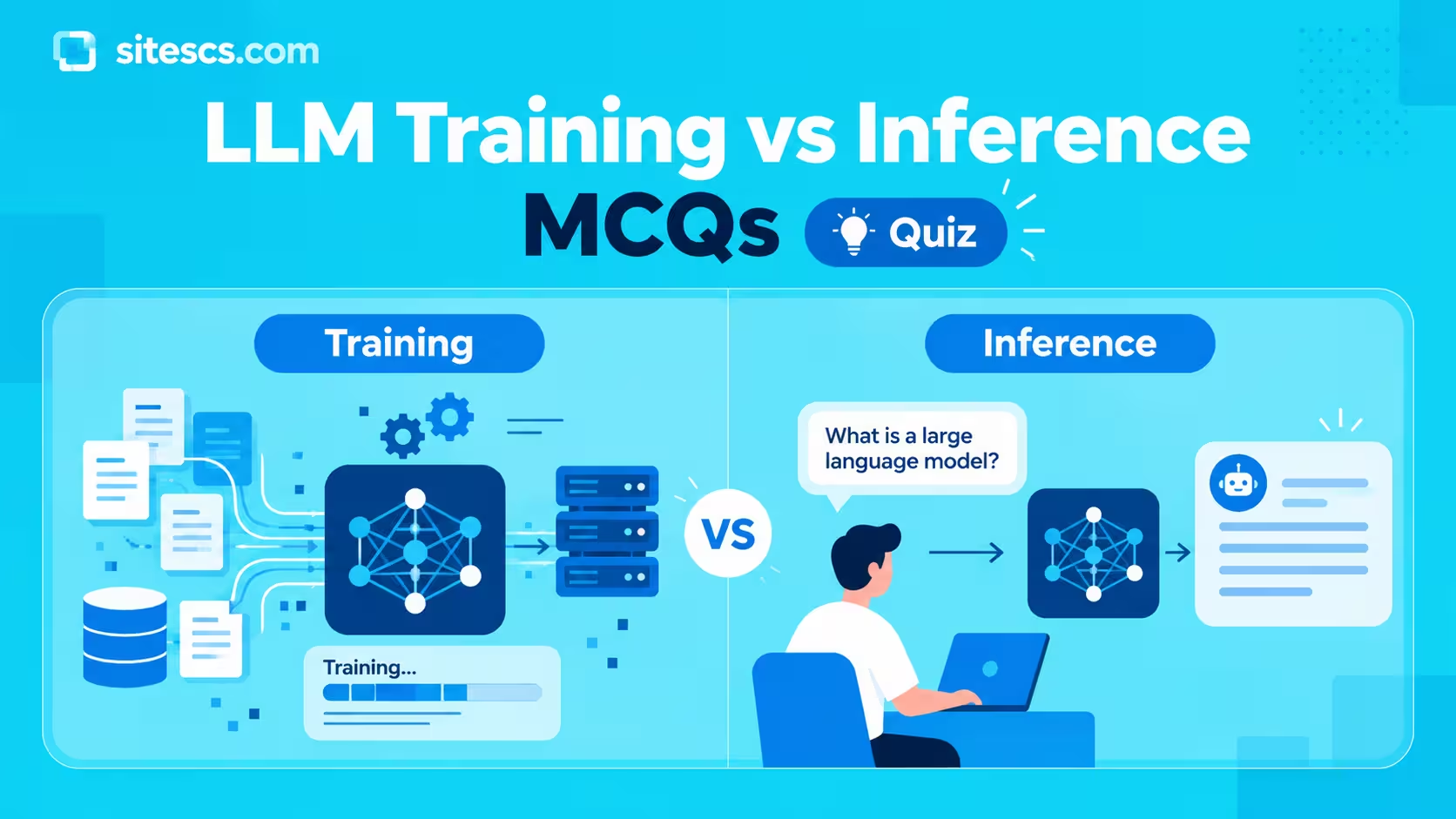
Training and inference are two fundamental processes in the lifecycle of a Large Language Model (LLM). Although they are closely related, they serve different purposes in artificial intelligence.
Training is the process through which an AI model learns patterns from data by adjusting its parameters. Inference is the process of using an already trained model to generate predictions or responses.
Understanding this difference helps students learn how generative AI systems are developed, deployed, and used in real-world applications.
What Is LLM Training?
LLM training involves exposing a neural network to large datasets so that it can learn statistical relationships among words, tokens, and other information.
During pretraining, autoregressive language models commonly learn by predicting the next token in a sequence. Their predictions are compared with expected targets, and a mathematical loss function measures prediction error.
Optimization algorithms adjust model parameters to reduce that error over repeated training steps.
Training typically requires powerful computing resources, including graphics processing units (GPUs) or specialized AI accelerators.
What Is LLM Inference?
Inference occurs when a trained language model processes a new input and produces an output using its learned parameters.
For example, when a user asks an AI assistant to summarize an article, the model performs inference to generate the summary.
During ordinary inference, the model uses its existing weights without updating them through the training process.
Inference may involve repeated forward computations because an autoregressive model generates tokens sequentially.
Key Differences Between Training and Inference
The main difference lies in their objectives. Training changes model parameters to improve learned behavior, whereas inference uses those parameters to perform tasks.
Training relies on datasets, learning objectives, optimization algorithms, and parameter updates. Inference generally requires an input prompt, a trained model, and a method for generating or selecting outputs.
Training a large model can require substantial computation and time. A single inference request is generally much less expensive, although serving large numbers of requests can still demand significant resources.
Understanding Pretraining and Fine-Tuning
Pretraining is the initial learning stage in which a model develops broad capabilities from large datasets.
Fine-tuning is an additional training process that adapts a pretrained model to particular tasks, formats, or behaviors.
For example, an organization may fine-tune a model using approved customer-support examples to improve its responses in that domain.
Both pretraining and fine-tuning involve learning. They are therefore different from ordinary inference.
Does an LLM Learn During Every Conversation?
A common misconception is that a language model automatically updates its parameters whenever a user interacts with it.
In normal inference, this does not happen. The model can use information from the current conversation without permanently changing its learned weights.
Some applications save conversation history, retrieve documents, or use user feedback in separate systems. Such functionality should not be confused with automatic parameter training.
Why Understanding Training vs Inference Matters
This distinction is important when evaluating AI performance, operational costs, model customization, and deployment strategies.
Developers must decide whether an application needs prompt engineering, retrieval, fine-tuning, or a different model.
Recognizing these differences also helps learners understand why modifying a prompt is not the same as retraining an AI system.
Practice LLM Training vs Inference MCQs
The LLM Training vs Inference MCQs quiz covers pretraining, fine-tuning, forward passes, backpropagation, optimization, parameter updates, and model deployment.
Take the quiz below to test your understanding of how language models learn and generate predictions.
LLM Training vs Inference MCQs with Answers | AI Quiz
Learn the differences between LLM training and inference through MCQs covering pretraining, fine-tuning, model parameters, and AI predictions.
