How AI Works (Simple Explanation for Beginners)
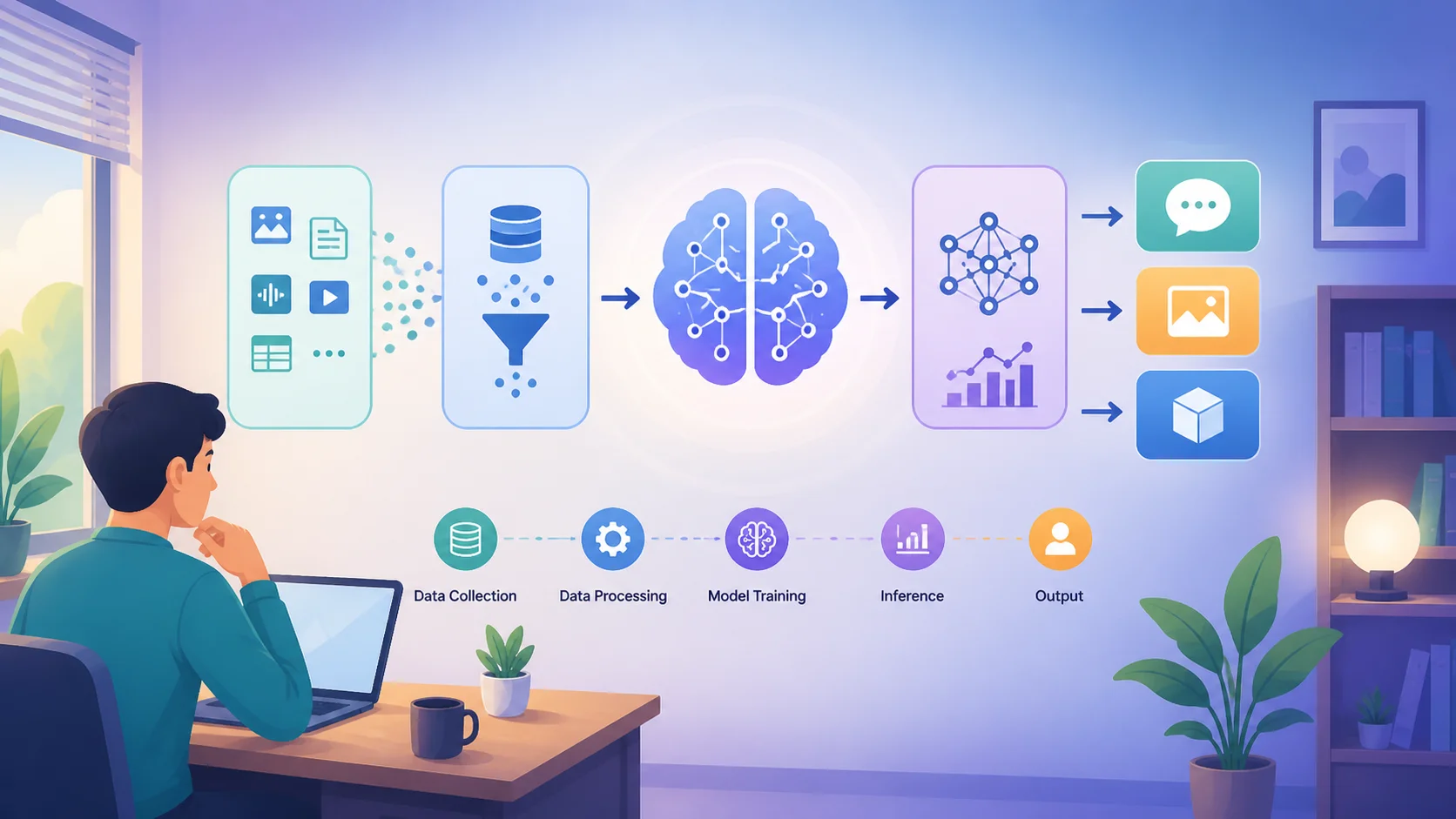
In this beginner-friendly guide, you will learn:
- What Artificial Intelligence really means
- Different types of AI
- Real-life examples of AI
- How AI works step by step
- Why AI is becoming so powerful today
Let’s start with the basics!
Table of Contents
- 1. Introduction: Why Everyone Is Talking About AI
- 2. What is Artificial Intelligence?
- 3. How AI Works
- The Simple AI Workflow
- A Very Easy Analogy: Teaching a Child
- 4. Key Components of AI Systems
- Types of Data Used in AI
- 5. Machine Learning: The Engine Behind AI
- 6. Deep Learning: How AI Mimics the Human Brain
- 7. How AI Models Learn (Step-by-Step)
- 8. Role of Data in AI (Why It Matters So Much)
- 9. AI vs Traditional Programming
- 10. Popular AI Technologies Explained Simply
- 11. Real-World Applications of AI
- 12. Common Myths About AI
- 13. Limitations of AI
- 14. The Future of AI
- 15. Beginner-Friendly Example: How ChatGPT Works (Simplified)
- 16. How to Start Learning AI (Beginner Roadmap)
1. Introduction: Why Everyone Is Talking About AI
Artificial Intelligence is everywhere today! From asking OpenAI’s ChatGPT questions to watching movie recommendations on Netflix, AI has become a big part of our daily lives. Even self-driving cars, smart voice assistants, and online shopping suggestions use AI to work smarter and faster!
But have you ever wondered how AI actually works?
In very simple words, Artificial Intelligence (AI) is technology that allows machines to think, learn, and make decisions like humans.
AI is changing the world rapidly. Businesses, schools, hospitals, banks, and even mobile apps now depend on AI systems. That is why understanding AI is becoming important for everyone — not just programmers or scientists!
2. What is Artificial Intelligence?
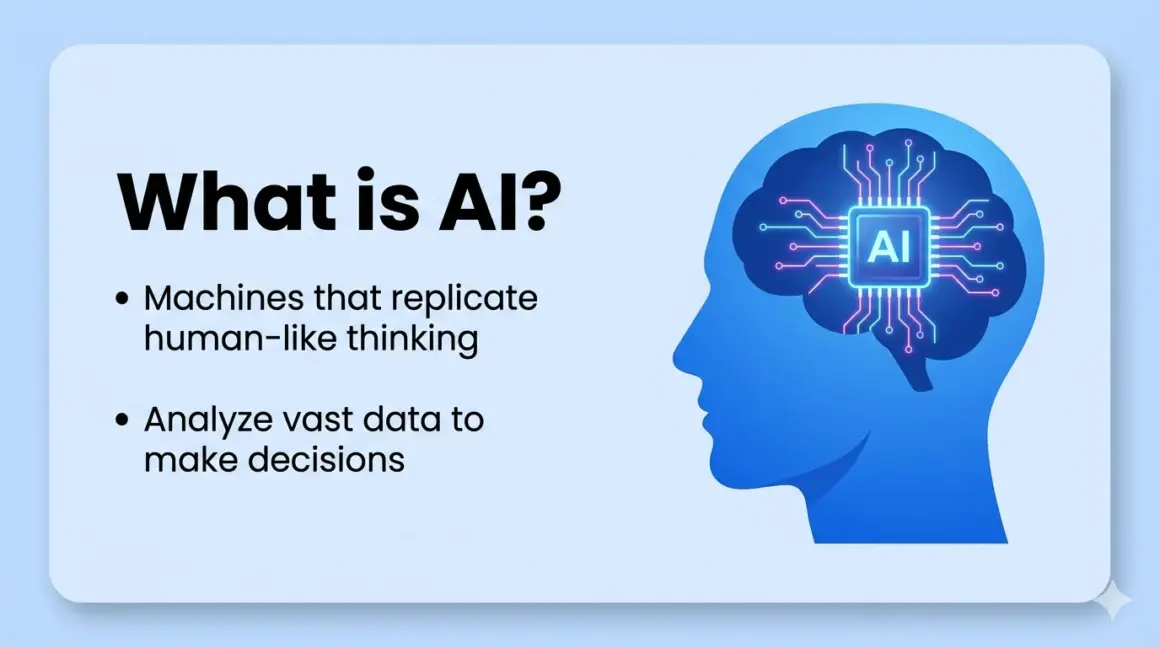
Artificial Intelligence, commonly called AI, is a branch of computer technology that helps machines perform tasks that normally require human intelligence.
In simple language, AI allows computers and machines to:
- Learn from information
- Solve problems
- Recognize patterns
- Understand language
- Make decisions
For example, when you ask Google Assistant a question and it answers back, AI is working behind the scenes. When Amazon recommends products you may like, that is also AI.
AI systems become smarter by analyzing large amounts of data and learning from experience — just like humans learn from practice!
Some important abilities of AI include:
AI systems can learn from data and improve over time without being manually programmed again and again.
AI can analyze information, compare patterns, and find logical solutions.
AI can make predictions or choose actions based on the information it receives.
That is why AI is considered one of the most powerful technologies in the modern world!
Types of AI
Not all AI systems are the same. Experts usually divide AI into three main categories.
1. Narrow AI (Weak AI)
Narrow AI is the most common type of AI used today.
It is designed to perform one specific task very well. It cannot think like a human or perform tasks outside its programming.
Examples include:
- Voice assistants like Siri and Alexa
- Recommendation systems on YouTube
- Facial recognition systems
- Spam email filters
Even though Narrow AI is limited, it is extremely useful and powerful in daily life!
2. General AI (Strong AI)
General AI is a future concept that does not fully exist yet.
This type of AI would be able to think, learn, and perform multiple tasks just like a human being. It could understand emotions, solve complex problems, and adapt to completely new situations.
Scientists and tech companies are still researching whether true General AI can be created in the future.
3. Superintelligence
Superintelligence is a theoretical idea where AI becomes smarter than humans in almost every field.
This type of AI only exists in discussions, research, and science-fiction movies right now. Some experts believe it could change the world dramatically in the future, while others warn about possible risks.
At present, Superintelligence is not real-world technology.
Examples of AI in Real Life
Many people think AI is futuristic technology, but the truth is — AI is already all around us!
Here are some common real-life examples of AI.
1. Voice Assistants
Voice assistants like Google Assistant, Siri, and Alexa use AI to understand spoken language and answer questions.
They can:
- Set alarms
- Play music
- Search the internet
- Control smart home devices
2. Recommendation Systems
Have you ever noticed how Netflix suggests movies you may enjoy? Or how Spotify recommends songs based on your taste?
That is AI analyzing your behavior and predicting what you might like next!
Recommendation systems are widely used in:
- Online shopping
- Video streaming
- Music apps
- Social media platforms
3. Fraud Detection
Banks and payment apps use AI to detect suspicious activities and prevent fraud.
For example, if someone suddenly tries to use your credit card in another country, AI systems can quickly identify unusual behavior and alert the bank instantly.
This helps improve online security and protects users from financial crimes.
4. Autonomous Vehicles
Self-driving cars are one of the most advanced examples of AI technology.
Companies like Tesla use AI systems to:
- Detect roads
- Recognize traffic signs
- Avoid obstacles
- Make driving decisions
These vehicles use cameras, sensors, and machine learning algorithms to understand their surroundings in real time.
Even though fully autonomous cars are still developing, AI-powered driving technology is improving rapidly!
3. How AI Works
Now comes the most important question…
Many beginners think AI works like a human brain with emotions and real thinking. But in reality, AI mainly works by finding patterns in huge amounts of data and making predictions based on those patterns.
AI does not “understand” things exactly like humans do. Instead, it learns from examples and improves its results over time.
For example:
- If an AI system sees thousands of cat photos, it starts learning what makes a cat look different from a dog.
- After enough training, the AI can predict whether a new image contains a cat or a dog.
That is the core idea behind most modern AI systems!
The Simple AI Workflow
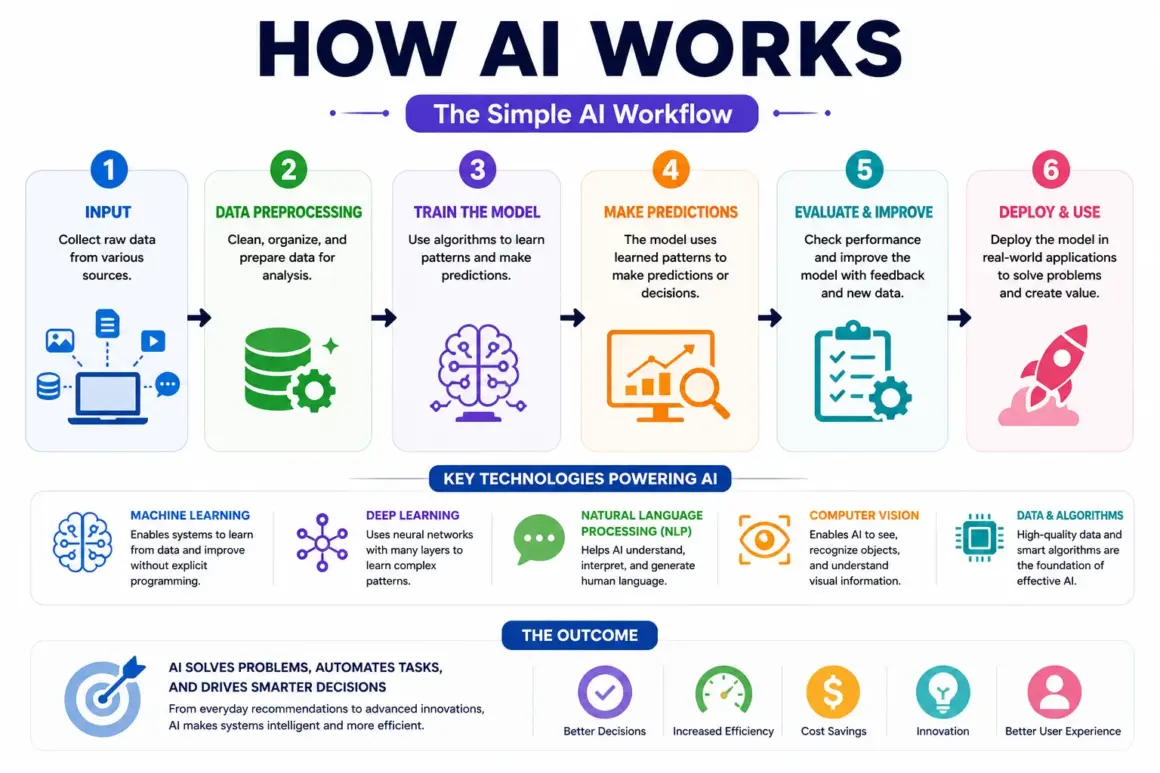
Most AI systems follow a basic step-by-step process.
| Step | What Happens | Simple Example |
|---|---|---|
| 1. Data Collection | AI gathers information | Thousands of cat and dog photos |
| 2. Data Processing | Data is cleaned and organized | Removing blurry images |
| 3. Model Training | AI learns patterns from data | Learning ear shape, fur, eyes |
| 4. Prediction / Output | AI gives an answer | “This is a cat!” |
You can think of AI like a student preparing for an exam:
- The data is the study material
- The algorithm is the learning method
- The AI model is the trained student
- The prediction is the final answer
Simple, right?!
A Very Easy Analogy: Teaching a Child
Imagine you want to teach a child the difference between cats and dogs.
You show:
- 100 pictures of cats
- 100 pictures of dogs
At first, the child may make mistakes. But after seeing many examples, the child starts recognizing patterns:
- Cats usually have smaller faces
- Dogs may have longer noses
- Fur patterns look different
AI learns in a very similar way!
The more examples AI sees, the better it becomes at identifying patterns and making predictions.
This process is called training.
4. Key Components of AI Systems
AI may sound magical, but almost every AI system is built using three major components:
- Data
- Algorithms
- Models
These three parts work together to make AI intelligent.
Data: The Foundation of AI
Data is the most important part of any AI system.
Without data, AI cannot learn anything!
Data can include:
- Images
- Videos
- Text
- Audio
- Numbers
- User behavior
- Sensor information
For example:
- YouTube uses watch history data to recommend videos.
- Google uses search data to improve search results.
- Amazon uses shopping behavior to suggest products.
Why Data Quality Matters
AI is only as good as the data it learns from.
Good data helps AI make accurate decisions.
Bad or incorrect data can create poor predictions.
That is why experts often say:
“Garbage in, garbage out!”
If the training data is messy, incomplete, or biased, the AI system may also become inaccurate or biased.
Types of Data Used in AI
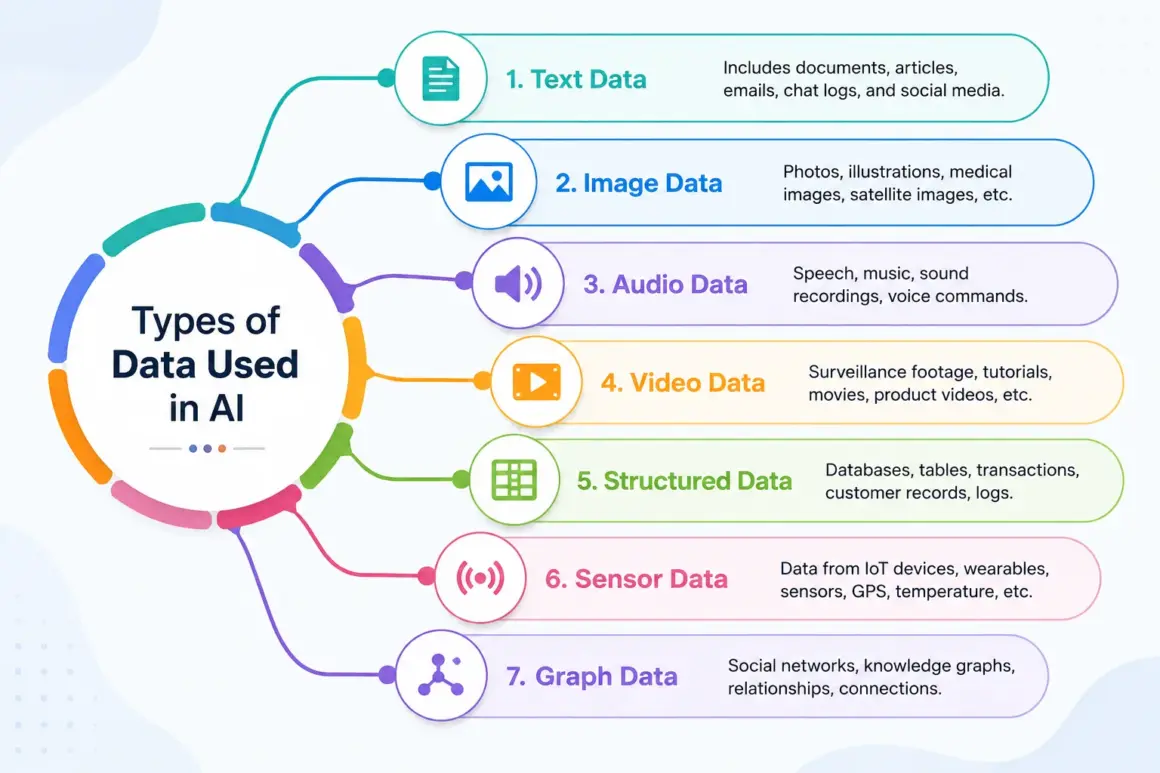
| Data Type | Meaning | Example |
|---|---|---|
| Structured Data | Organized and easy to read | Spreadsheets, databases |
| Unstructured Data | Messy or complex information | Images, videos, social media posts |
Today, most AI systems work heavily with unstructured data because the internet contains huge amounts of images, text, and videos.
Algorithms: The Brain Behind AI
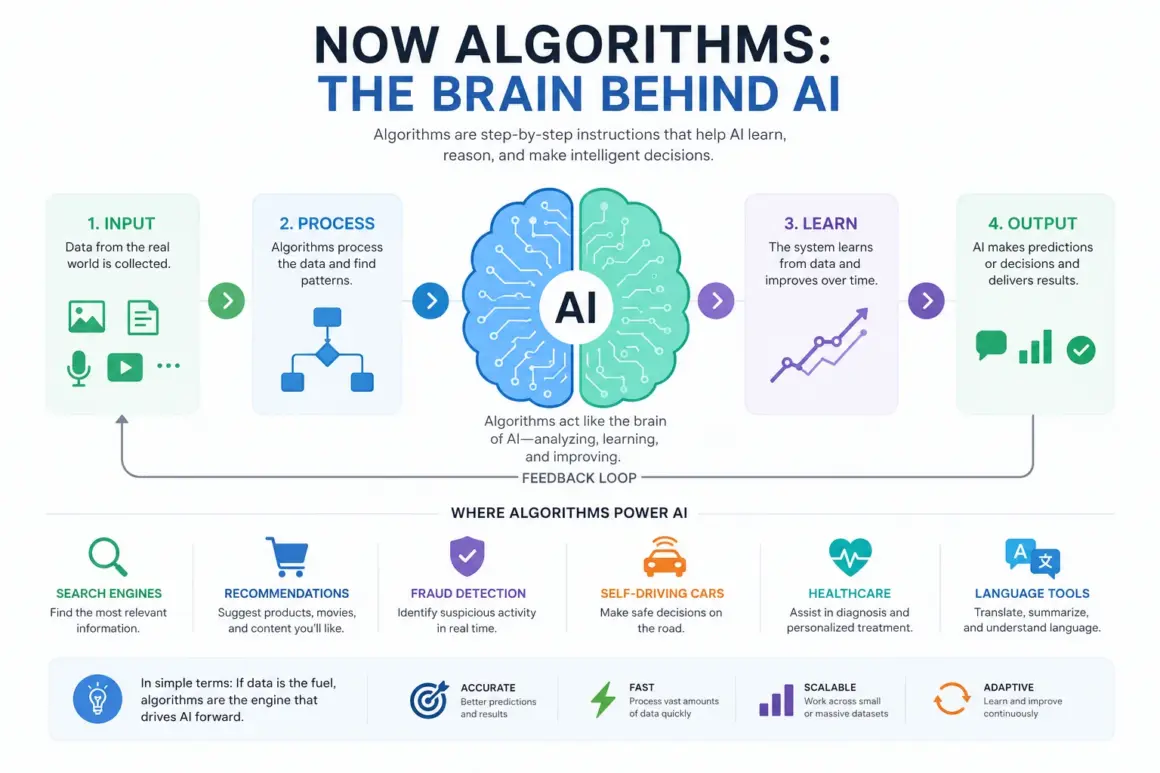
Algorithms are the rules and instructions that tell AI how to learn from data.
You can think of an algorithm like a recipe.
A cooking recipe tells a chef:
- What ingredients to use
- What steps to follow
- How to prepare the dish
Similarly, an AI algorithm tells the computer:
- How to analyze data
- What patterns to look for
- How to make decisions
Different AI tasks use different algorithms.
For example:
- One algorithm may recognize faces
- Another may translate languages
- Another may recommend movies
Traditional Programming vs AI
This is where AI becomes really interesting!
In traditional software:
- Humans write exact rules
- Computers simply follow instructions
Example:
IF temperature > 40°C
THEN turn on fan
The computer cannot learn beyond those rules.
AI Programming
In AI:
- Humans provide data
- AI learns rules automatically
Instead of manually writing every instruction, the AI system discovers patterns by itself.
That is why AI is much more flexible than traditional software.
Models: The Decision Makers
After AI learns from data using algorithms, it creates something called a model.
A model is the trained version of the AI system.
This model is responsible for making predictions and decisions.
For example:
- A spam detection model predicts whether an email is spam
- A recommendation model predicts what movie you may like
- A language model like ChatGPT predicts the next words in a sentence
AI models work by calculating probabilities and patterns.
For example, imagine an AI trained to detect cats.
When a new image appears, the model checks:
- Ear shape
- Eye placement
- Fur texture
- Facial structure
Then it calculates something like:
- 95% chance = cat
- 5% chance = dog
Finally, it predicts:
“This image is a cat.”
That is basically how many modern AI systems work behind the scenes!
5. Machine Learning: The Engine Behind AI
When people talk about modern AI, they are usually talking about Machine Learning.
Machine Learning (ML) is one of the biggest reasons why AI has become so powerful in recent years!
In simple words, Machine Learning is a method that allows computers to learn from data instead of being manually programmed for every task.
Rather than giving exact instructions, developers provide:
- Large amounts of data
- Learning algorithms
- Training examples
Then the AI system discovers patterns on its own.
You can think of Machine Learning as the “learning engine” behind AI.
The Main Idea of Machine Learning
Instead of writing thousands of rules like:
IF email contains "win money"
THEN mark as spam
Machine Learning systems analyze millions of emails and automatically learn what spam usually looks like.
That is why ML systems become smarter over time!
Main Types of Machine Learning
There are three major types of Machine Learning.
| Type | How It Works | Simple Example |
|---|---|---|
| Supervised Learning | Learns from labeled data | Spam detection |
| Unsupervised Learning | Finds hidden patterns | Customer grouping |
| Reinforcement Learning | Learns through rewards and mistakes | Game-playing AI |
Supervised Learning
In supervised learning, the AI is trained using labeled examples.
For example:
- Email marked as “spam”
- Email marked as “not spam”
The AI studies these examples and learns the difference between them.
This is one of the most common Machine Learning methods today.
Used in:
- Fraud detection
- Image recognition
- Medical diagnosis
- Weather prediction
Unsupervised Learning
In unsupervised learning, the AI receives data without labels.
The system tries to discover hidden patterns by itself.
For example:
- Grouping customers by shopping habits
- Detecting unusual behavior
- Finding trends in large datasets
This type of learning is useful when humans do not already know the answers.
Reinforcement Learning
Reinforcement learning works through rewards and penalties.
The AI learns by trial and error — similar to how humans learn from experience.
For example:
- A robot learns how to walk
- A game AI learns winning strategies
- Self-driving systems improve driving decisions
When the AI makes a good decision, it gets a “reward.” Over time, it learns which actions produce better results.
Simple Example: Email Spam Detection
Let’s simplify everything with a real-world example.
Suppose an AI system studies:
- 1 million spam emails
- 1 million normal emails
The AI starts noticing patterns:
- Certain words appear frequently in spam
- Suspicious links are common
- Fake offers use similar language
After training, the AI can predict whether a new email is spam — even if it has never seen that exact email before!
That is Machine Learning in action!
6. Deep Learning: How AI Mimics the Human Brain
Deep Learning is one of the most advanced parts of AI.
It powers:
- Modern chatbots
- Image generators
- Voice assistants
- Self-driving cars
- Language models like ChatGPT
Deep Learning is inspired by the structure of the human brain.
But remember — AI does not actually think like humans. It only imitates certain learning patterns.
What is Deep Learning?
Deep Learning is a special type of Machine Learning that uses something called neural networks.
These neural networks are designed to process huge amounts of data and recognize complex patterns.
For example, Deep Learning helps AI:
- Recognize faces in photos
- Understand speech
- Translate languages
- Generate realistic text
- Detect objects in videos
Neural Networks Explained Simply
A neural network is made of connected layers that process information step by step.
Basic flow:
Input → Hidden Layers → OutputFor example:
- Input = image of an animal
- Hidden layers = analyze shapes, colors, features
- Output = “cat” or “dog”
The hidden layers are where most of the “learning” happens.
How Neural Networks Learn
Neural networks use something called weights.
Weights help the AI decide which information is more important.
Example:
- Pointed ears may strongly suggest “cat”
- Long nose may strongly suggest “dog”
The AI adjusts these weights during training to improve accuracy.
Another concept is activation functions.
These functions help the AI decide:
- Which patterns matter
- Which information should move forward in the network
You do not need advanced math to understand the basics. Just remember:
Neural networks learn by continuously adjusting themselves to reduce mistakes.
Real-World Applications of Deep Learning
Deep Learning is used almost everywhere today.
Image Recognition
AI can identify:
- Faces
- Objects
- Animals
- Medical scans
Used by:
- Smartphones
- Security systems
- Social media apps
Speech Recognition
Voice assistants like Siri and Google Assistant use Deep Learning to understand spoken language.
They convert human speech into text and respond intelligently.
Language Models
Large language models like ChatGPT are trained on massive amounts of text.
These models learn:
- Grammar
- Sentence structure
- Context
- Writing patterns
That is why they can generate human-like responses!
7. How AI Models Learn (Step-by-Step)
Training an AI model is similar to teaching a student through practice and correction.
The learning process usually happens in several stages.
Step 1: Training Phase
First, developers feed huge amounts of data into the AI model.
Examples:
- Images
- Text
- Audio
- Videos
- Numbers
The AI studies this information and starts identifying patterns.
For example:
- A face recognition AI studies millions of faces
- A chatbot studies billions of sentences
The more useful data the AI receives, the better it can learn.
Step 2: Measuring Mistakes (Loss Function)
AI does not become perfect immediately.
At first, it makes many mistakes.
A loss function measures how wrong the AI’s predictions are.
Simple idea:
- Smaller loss = better predictions
- Bigger loss = more mistakes
The AI constantly tries to reduce this loss during training.
Step 3: Optimization and Improvement
After measuring mistakes, the AI adjusts itself to improve performance.
This process is called optimization.
The system:
- Changes internal weights
- Learns from errors
- Improves prediction accuracy
This learning cycle repeats many times.
Step 4: Iteration and Epochs
AI models learn through repeated training cycles called epochs.
One epoch means:
The AI has processed the entire training dataset once.
Usually, AI trains through:
- 10 epochs
- 100 epochs
- Sometimes thousands of epochs
With every cycle, the AI usually becomes more accurate.
Step 5: Testing and Validation
After training, developers test the AI using new data it has never seen before.
This checks whether the AI truly understands patterns — or simply memorized training data.
A major problem in AI is called overfitting.
Overfitting happens when:
- AI memorizes training examples
- But performs poorly on new real-world data
Good AI models must generalize well to new situations.
8. Role of Data in AI (Why It Matters So Much)
Data is the fuel of Artificial Intelligence.
Without data, modern AI simply cannot function.
In fact, many experts say:
“Better data is often more important than better algorithms.”
Garbage In, Garbage Out
AI learns directly from the data it receives.
If the data is:
- Incorrect
- Incomplete
- Biased
- Low quality
Then the AI’s predictions may also become inaccurate.
This is known as:
“Garbage in, garbage out.”
For example:
- Poor medical data may create dangerous healthcare predictions
- Biased hiring data may create unfair hiring systems
That is why high-quality data is extremely important in AI development.
Bias in AI Data
Bias happens when training data unfairly favors certain groups, behaviors, or outcomes.
AI itself is not “good” or “bad.”
It simply learns patterns from the data humans provide.
Biased data can lead to:
- Unfair decisions
- Discrimination
- Incorrect predictions
Today, many AI researchers focus heavily on ethical AI and fairness.
What is Data Labeling?
Many AI systems need labeled data during training.
Example:
- “This image contains a cat”
- “This email is spam”
- “This review is positive”
Humans often help label this data before AI training begins.
Accurate labeling helps AI learn faster and make better predictions.
9. AI vs Traditional Programming
AI systems work very differently from traditional software.
Here is a simple comparison:
| Traditional Programming | AI-Based Systems |
|---|---|
| Rule-based | Data-driven |
| Humans write explicit logic | AI learns patterns automatically |
| Static behavior | Improves over time |
| Limited flexibility | Can adapt to new data |
| Works only for defined tasks | Handles complex predictions |
Simple Example
A developer manually writes:
IF password is correct
THEN login successful
The computer simply follows fixed instructions.
AI Programming
In AI systems:
- Developers provide examples and data
- The AI learns patterns automatically
For example:
- AI learns what spam looks like
- AI learns human speech patterns
- AI learns driving behavior
That is why AI can solve problems that are too complex for traditional programming rules alone!
10. Popular AI Technologies Explained Simply
Artificial Intelligence is a huge field, and many powerful technologies work together behind the scenes. Some AI technologies help machines understand language, while others help them recognize images or control robots.
One of the most popular AI technologies today is Natural Language Processing (NLP). NLP helps computers understand, process, and respond to human language. It allows machines to read text, understand speech, and even hold conversations with humans. Technologies like ChatGPT, translation tools, and customer support chatbots use NLP heavily. When you type a message into an AI chatbot and receive a human-like response, NLP is making that possible!
Another important AI technology is Computer Vision. This technology helps machines “see” and understand images or videos. Computer Vision is used in:
- Face recognition systems
- Medical image analysis
- Security cameras
- Self-driving cars
- Smartphone camera features
For example, when your phone unlocks using your face, AI-powered Computer Vision is analyzing your facial features in real time.
AI is also widely used in Robotics. Robotics combines AI with physical machines. Robots powered by AI can move, make decisions, and perform tasks automatically. AI robots are used in factories, hospitals, warehouses, and even space research. Some robots can walk, pick up objects, and interact with humans using sensors and machine learning systems.
These technologies continue improving every year, making AI more useful in daily life!
11. Real-World Applications of AI
AI is no longer just a futuristic idea. It is already transforming many industries around the world.
In healthcare, AI helps doctors detect diseases faster and more accurately. AI systems can analyze medical scans, identify cancer patterns, and assist in diagnosis. Hospitals also use AI to predict patient risks and improve treatment plans.
In the finance industry, AI helps banks detect fraud and suspicious transactions. If unusual activity appears on your account, AI systems can quickly identify the problem and alert the bank. This improves security and helps prevent financial crimes.
In e-commerce, companies like Amazon and Flipkart use AI recommendation systems to suggest products users may like. AI studies customer behavior, search history, and shopping patterns to personalize the experience.
Education is also changing because of AI. Modern learning platforms use AI to create personalized learning experiences for students. Some systems can identify weak subjects and recommend better study materials based on student performance.
Transportation is another major area where AI is growing rapidly. Self-driving vehicle technology developed by companies like Tesla uses AI to recognize roads, traffic signs, pedestrians, and obstacles. AI also helps improve traffic management and route optimization.
AI applications are expanding every year, and many industries are only beginning their AI journey!
12. Common Myths About AI
Many people misunderstand AI because of movies, social media, and science-fiction stories. Let’s clear up some common myths.
One popular myth is:
“AI will replace all human jobs.”
The reality is more complicated. AI will automate some repetitive tasks, but it will also create many new jobs in technology, healthcare, education, and business. In most cases, AI is designed to assist humans — not completely replace them.
Another myth is:
“AI thinks exactly like humans.”
This is not true. AI does not have emotions, consciousness, or real understanding. It simply identifies patterns and predicts results based on training data.
Some people also believe:
“AI is always accurate.”
But AI can still make mistakes! AI systems depend heavily on data quality and training methods. Incorrect or biased data can produce incorrect results.
There is also a fear that:
“AI is dangerous by default.”
AI itself is just a tool. Like any technology, it can be used responsibly or irresponsibly. Ethical development and proper regulations are very important to ensure AI benefits society safely.
Understanding these myths helps people view AI more realistically instead of fearing it unnecessarily.
13. Limitations of AI
Even though AI is powerful, it still has many limitations.
One major limitation is that AI lacks true understanding. AI can process information and generate responses, but it does not truly “understand” meaning the way humans do. It recognizes patterns mathematically rather than thinking consciously.
AI is also highly dependent on data. Without enough high-quality data, AI systems perform poorly. If training data is incomplete or inaccurate, the results may also become unreliable.
Bias is another serious challenge in AI systems. Since AI learns from human-created data, it can sometimes inherit unfair biases present in that data. This may affect hiring systems, facial recognition tools, or recommendation algorithms.
Another limitation is computational cost. Advanced AI systems require massive computing power, expensive hardware, and huge energy consumption. Training large AI models can cost millions of dollars and require powerful data centers.
Because of these limitations, AI still needs significant human supervision and improvement.
14. The Future of AI
The future of AI looks extremely exciting!
One of the biggest trends today is Generative AI. Generative AI systems can create:
- Text
- Images
- Videos
- Music
- Code
Tools like ChatGPT and AI image generators are examples of this rapidly growing technology.
Researchers are also exploring the idea of Artificial General Intelligence (AGI) — AI that could perform many intellectual tasks similar to humans. True AGI does not exist yet, but it remains one of the long-term goals of AI research.
In the future, AI will likely work more closely with humans rather than replacing them completely. This concept is called Human-AI Collaboration. AI can handle repetitive tasks while humans focus on creativity, emotional intelligence, and decision-making.
There is also increasing focus on Ethical AI Development. Governments, companies, and researchers are discussing:
- AI safety
- Privacy protection
- Fairness
- Transparency
- Responsible AI usage
As AI becomes more powerful, ethical development will become even more important.
15. Beginner-Friendly Example: How ChatGPT Works (Simplified)
Many beginners wonder:
“How does ChatGPT actually work?”
In simple terms, ChatGPT is trained using enormous amounts of text data collected from books, articles, websites, and other written materials.
During training, the AI studies:
- Grammar
- Sentence patterns
- Context
- Relationships between words
The core idea is surprisingly simple:
ChatGPT predicts the next most likely word in a sentence.
For example:
"The sky is..."The AI predicts possible next words like:
- blue
- cloudy
- clear
It selects the most likely continuation based on patterns learned during training.
ChatGPT uses advanced Deep Learning systems called Transformers. Transformers help the AI understand relationships between words and context across entire sentences.
This is why ChatGPT can:
- Answer questions
- Write articles
- Explain concepts
- Generate code
- Hold conversations
Even though it sounds intelligent, it is fundamentally predicting patterns in language using massive neural networks.
16. How to Start Learning AI (Beginner Roadmap)
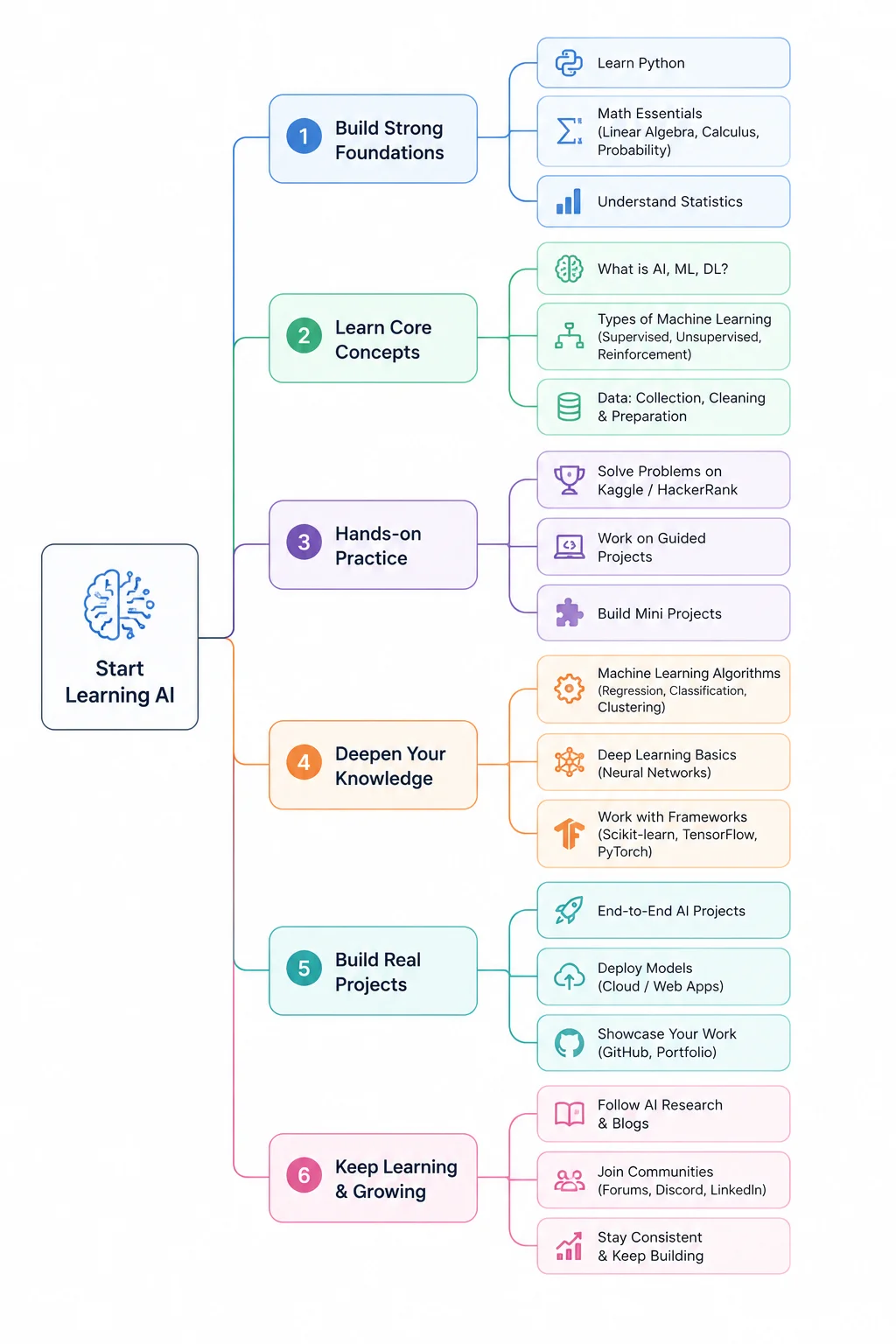
Learning AI may seem difficult at first, but beginners can absolutely start step by step!
You do not need to become a math genius immediately. However, basic math concepts like algebra, probability, and statistics can be very helpful later.
One of the most important skills for AI is programming. Most beginners start with Python because it is simple, beginner-friendly, and widely used in AI development.
Many free and paid online courses can help you learn:
- Machine Learning
- Deep Learning
- Python programming
- Data science
- Neural networks
The best way to improve is through hands-on practice. Beginners should try small projects like:
- Spam email classifiers
- Chatbots
- Image recognition tools
- Simple recommendation systems
Building projects helps you understand how AI works in real-world situations.
The AI industry is growing incredibly fast, and there has never been a better time to start learning!
Sources & References:
- World Economic Forum AI Reports
https://www.weforum.org/topics/artificial-intelligence/ - OpenAI
https://openai.com/ - Google AI Resources
https://ai.google/ - IBM AI Learning Hub
https://www.ibm.com/topics/artificial-intelligence - MIT
https://www.mit.edu/ - Stanford University Human-Centered AI
https://hai.stanford.edu/ - DeepLearning.AI
https://www.deeplearning.ai/ - Coursera AI Courses
https://www.coursera.org/browse/data-science/machine-learning - Microsoft AI Learning
https://www.microsoft.com/en-us/ai - Harvard University CS50 AI Course
https://cs50.harvard.edu/ai/ - NVIDIA Deep Learning Resources
https://www.nvidia.com/en-us/deep-learning-ai/ - Artificial Intelligence: A Modern Approach
https://aima.cs.berkeley.edu/ - Khan Academy
https://www.khanacademy.org/ - TensorFlow Documentation
https://www.tensorflow.org/ - Meta AI Research
https://ai.meta.com/


