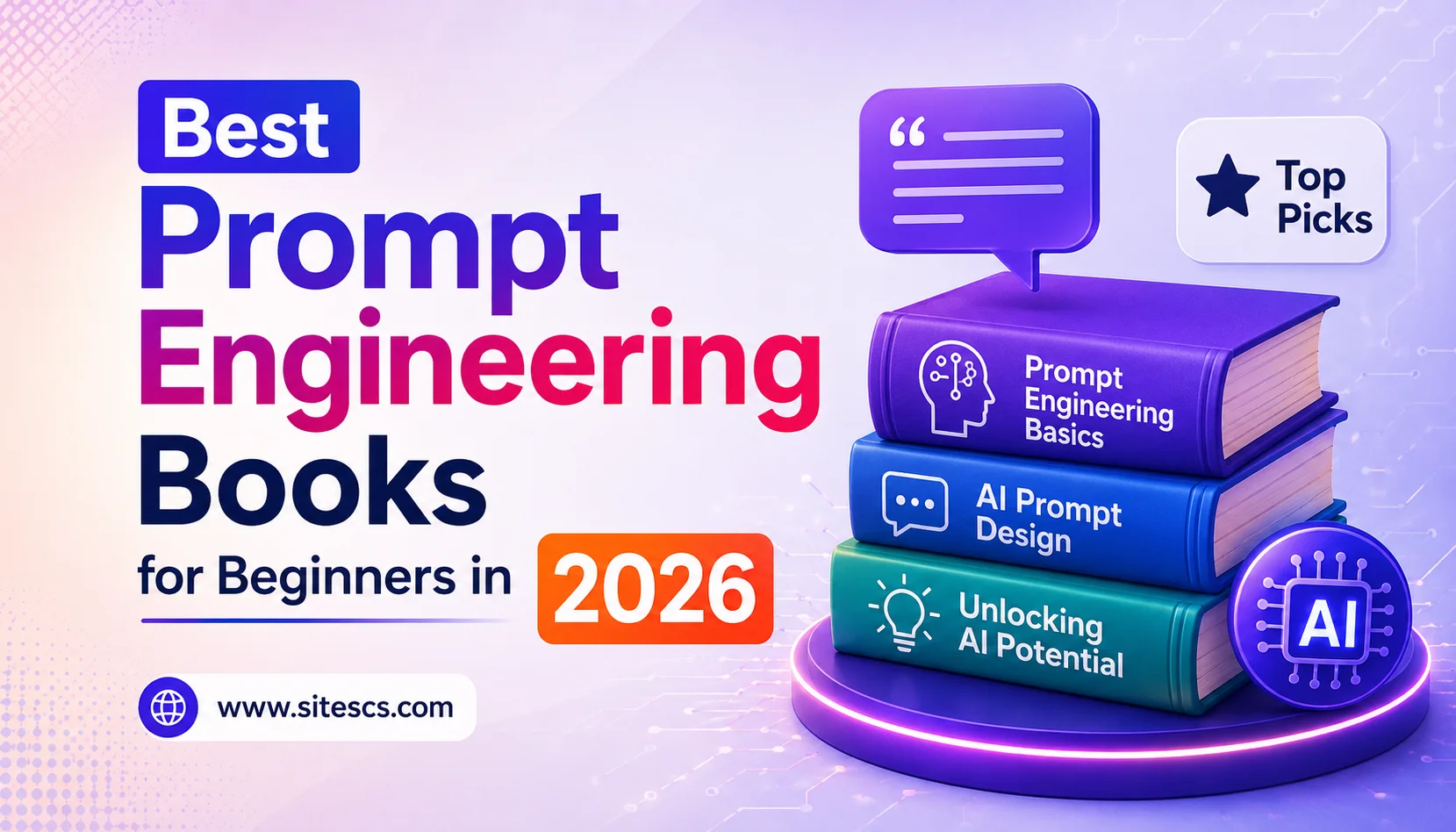
Best Prompt Engineering Books for Beginners in 2026
Artificial Intelligence is changing the way people work, learn, and create content. Tools like ChatGPT, Claude, Gemini, and other Large Language Models (LLMs) have made prompt engineering one of the most valuable skills in today’s AI-driven world.
Prompt engineering is the art of writing clear and effective instructions that help AI models generate better responses. Whether you are a student, content creator, developer, marketer, or AI enthusiast, learning prompt engineering can significantly improve your productivity and AI results.
While online tutorials and videos are useful, books provide a structured learning path and deeper understanding of AI prompting techniques. If you are just starting your journey, this guide covers the best prompt engineering books for beginners in 2026.
Why Learn Prompt Engineering?
Prompt engineering is no longer a niche skill. It has become an important part of working with AI tools.
Benefits of learning prompt engineering include:
- Getting more accurate AI responses
- Improving content generation quality
- Building AI-powered applications
- Automating repetitive tasks
- Enhancing productivity at work
- Understanding how LLMs think and respond
The right book can help you learn these skills faster and avoid common mistakes.
1. Prompt Engineering for LLMs
Why Beginners Should Read It
This book is often considered one of the best starting points for new learners. It explains how prompts influence AI behavior and demonstrates practical techniques for improving AI-generated outputs.
What You’ll Learn
- Prompt design fundamentals
- Few-shot prompting
- Chain-of-thought prompting
- Role-based prompting
- Structured output generation
- AI reasoning techniques
Best For
Beginners who want a solid foundation in prompt engineering without needing advanced technical knowledge.
2. Prompt Engineering for Generative AI
Why It Stands Out
Unlike many books that focus only on text generation, this book explores prompt engineering across multiple AI systems, including text, image, code, and multimodal models.
What You’ll Learn
- Text generation prompts
- AI image prompting
- Code generation techniques
- Workflow automation
- Prompt optimization strategies
Best For
Content creators, marketers, designers, and professionals who use different AI tools daily.
3. AI Engineering
Why Beginners Love It
Although this book covers broader AI engineering concepts, it provides valuable insights into how prompt engineering fits into real-world AI applications.
What You’ll Learn
- AI application architecture
- Model selection
- Prompt design in production
- AI deployment basics
- Building reliable AI systems
Best For
Readers who want to move beyond prompting and understand practical AI development.
4. Generative AI with LangChain
Why It’s Worth Reading
LangChain remains one of the most popular frameworks for building AI-powered applications. This book introduces prompt templates, retrieval systems, and AI workflows.
What You’ll Learn
- LangChain fundamentals
- Prompt templates
- Retrieval-Augmented Generation (RAG)
- AI chatbots
- Knowledge-based assistants
Best For
Developers interested in creating AI applications using modern frameworks.
5. Hands-On Large Language Models
Why It Matters
Understanding how LLMs work helps you become a better prompt engineer. This book combines theory and practical implementation.
What You’ll Learn
- Transformer architecture
- Embeddings
- Semantic search
- Fine-tuning concepts
- Language model behavior
Best For
Technical beginners who want to understand the science behind AI responses.
6. Build a Large Language Model
A Deeper Look Into AI
Written for learners who want to understand LLMs from the ground up, this book explains how GPT-style models are built.
What You’ll Learn
- Tokenization
- Attention mechanisms
- Model training basics
- Fine-tuning workflows
- Neural network concepts
Best For
Aspiring AI engineers and developers.
7. Building LLMs for Production
Why It’s Important
Creating a successful AI application requires more than writing good prompts. This book explains how prompt engineering fits into production environments.
What You’ll Learn
- Prompt evaluation
- AI monitoring
- Scaling AI systems
- Production deployment
- Reliability testing
Best For
Professionals preparing for enterprise AI projects.
8. Designing Machine Learning Systems
More Than Prompt Engineering
Prompt engineering works best when supported by strong AI infrastructure. This book focuses on building reliable machine learning systems.
What You’ll Learn
- Data pipelines
- System architecture
- Model deployment
- Monitoring and maintenance
- Production workflows
Best For
Learners interested in the bigger AI ecosystem.
9. Building Agentic AI Systems
The Future of AI
AI agents are becoming increasingly popular in 2026. These systems can plan, reason, and use tools to complete tasks autonomously.
What You’ll Learn
- AI agent design
- Tool integration
- Multi-step reasoning
- Autonomous workflows
- Agent frameworks
Best For
Readers interested in next-generation AI applications.
10. The AI Engineering Bible
Complete Beginner Reference
This comprehensive guide covers many AI topics, including machine learning, LLMs, prompt engineering, deployment, and infrastructure.
What You’ll Learn
- AI fundamentals
- Prompt engineering basics
- Generative AI concepts
- Deployment strategies
- AI product development
Best For
Beginners seeking a single resource that covers the entire AI landscape.
How to Choose the Right Prompt Engineering Book
Before purchasing a book, consider your learning goals.
Choose Prompt Engineering for LLMs If:
- You are completely new to AI.
- You want practical prompting techniques.
- You need a beginner-friendly approach.
Choose Prompt Engineering for Generative AI If:
- You use AI for content creation.
- You work with image-generation tools.
- You want broader AI prompting skills.
Choose Hands-On Large Language Models If:
- You enjoy technical learning.
- You want to understand AI models deeply.
- You plan to become an AI developer.
Choose Building Agentic AI Systems If:
- You are interested in AI agents.
- You want to build autonomous AI workflows.
- You want to stay ahead of future AI trends.
Why Books Are Better Than Random Online Tutorials
Many AI tutorials become outdated quickly because AI technology evolves rapidly.
Books provide:
- Structured learning paths
- Expert guidance
- Detailed explanations
- Practical examples
- Long-term foundational knowledge
A good book teaches principles that remain useful even as AI tools change.
Final Thoughts
Prompt engineering is one of the most valuable AI skills in 2026. Whether you want to create better content, automate tasks, build AI applications, or improve your career opportunities, learning how to communicate effectively with AI is essential.
The books listed above provide an excellent starting point for beginners. Start with a beginner-friendly prompt engineering book, practice daily with AI tools, and gradually expand your knowledge into LLMs, RAG systems, AI agents, and production AI applications.
The sooner you master prompt engineering, the better prepared you’ll be for the future of artificial intelligence.
Frequently Asked Questions (FAQs)
Which is the best prompt engineering book for complete beginners?
Prompt Engineering for LLMs is one of the best choices because it explains prompting techniques in a simple and practical way.
Do I need coding knowledge to learn prompt engineering?
No. Many prompt engineering concepts can be learned without programming experience. However, coding knowledge becomes helpful for advanced AI projects.
Are prompt engineering books still relevant in 2026?
Yes. As AI models become more advanced, effective prompting remains important for obtaining accurate, reliable, and useful results.
Which book helps with ChatGPT prompting?
Prompt Engineering for LLMs and Prompt Engineering for Generative AI both provide practical techniques that work well with ChatGPT and similar AI models.
What should I read after learning prompt engineering?
After mastering prompting basics, explore books on LLMs, RAG systems, AI agents, and AI engineering to deepen your understanding of modern AI applications.