Best Prompt Engineering Techniques for ChatGPT Users
Welcome. I am Krishna, an AI strategist and prompt engineering expert. If you use generative AI daily, you already know that the quality of your output depends entirely on the quality of your input. We have moved far beyond treating large language models (LLMs) like simple search engines or novelty chatbots. Today, mastering the best prompt engineering techniques for ChatGPT users separates those who merely play with artificial intelligence from those who command it to do meaningful work.
In this comprehensive guide, I will walk you through the practical, real-world strategies that professionals use to drive automated workflows, write complex code, scale productivity, and generate high-quality content. We will skip the theoretical hype and focus on actionable frameworks that actually work in modern enterprise environments.
Why AI and Prompt Engineering Matter Right Now
Artificial intelligence no longer sits on the fringe of business strategy. According to recent findings from McKinsey & Company’s 2026 AI Trust Maturity Survey, organizations are rapidly transitioning from basic generative AI experimentation to deploying sophisticated, “agentic” AI systems across their core operations. This shift means that AI now acts autonomously, making decisions, calling tools, and executing multi-step workflows.
Prompt engineering sits at the foundation of this revolution. It represents the crucial bridge between human intent and machine execution. When you learn advanced prompt engineering techniques, you stop hoping the AI will guess your intent and start programming it to deliver exact, repeatable outcomes. You move from a passive consumer of technology to an active architect of automation.
What Exactly Are AI Prompts? A Beginner-Friendly Explanation
Think of an AI prompt as a highly detailed blueprint you hand to a brilliant, lightning-fast, but incredibly literal intern. If you tell this intern, “Write a report on our sales,” they might give you a one-page bulleted summary, or they might generate a 50-page historical analysis of global commerce. They lack context.
A prompt is the specific instruction you feed into an LLM like ChatGPT. Good prompt engineering involves structuring that instruction with necessary context, strict constraints, formatting rules, and highly specific goals. You are not just asking a question; you are deliberately designing a cognitive task for a neural network to process.
The Evolution: Types and Levels of Prompts
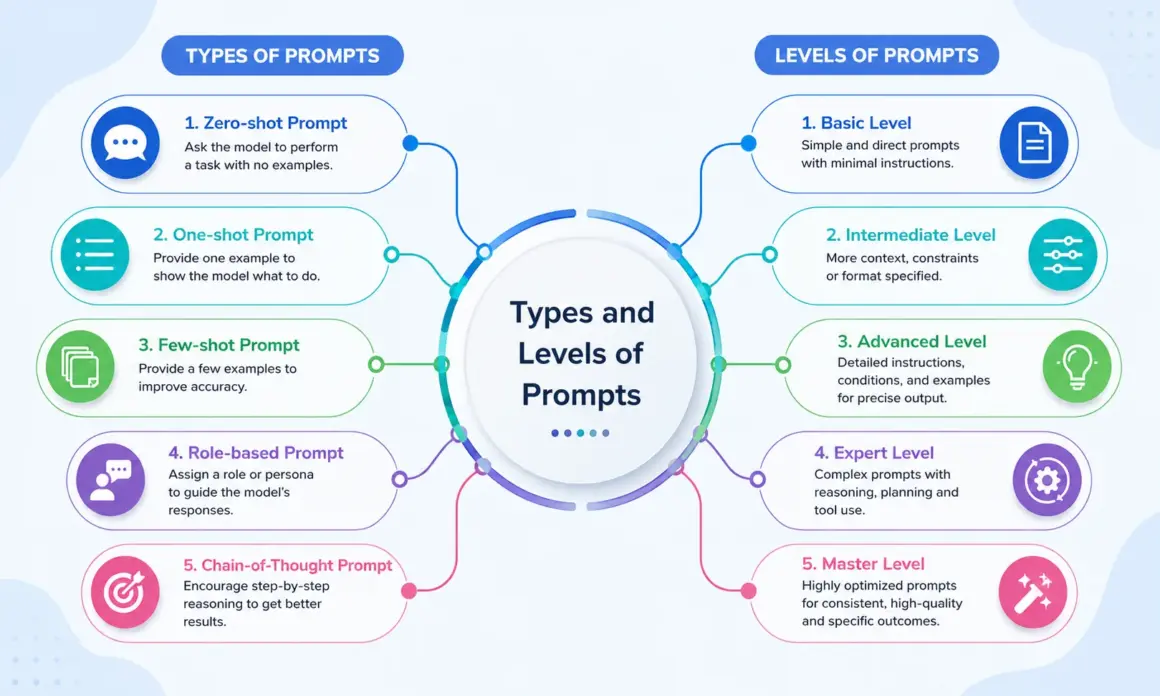
Not all prompts are created equal. As you develop your skills, you will move through different levels of complexity, transforming how the artificial intelligence responds.
Basic Prompts
Basic prompts involve “zero-shot” prompting. You give the AI a command without providing any examples or background data. Example: “Write a summary of the French Revolution.” This approach works for simple factual retrieval but almost always yields generic, surface-level results.
Advanced Prompts
Advanced techniques include “few-shot” prompting, where you provide the model with examples of the desired output before asking it to perform the actual task. By showing the AI the exact tone, structure, and length you want, you drastically reduce hallucinations and irrelevant answers. You set a definitive pattern for the model to follow.
Chain-of-Thought and Workflows
Chain-of-thought prompting forces the AI to break down complex problems into step-by-step reasoning. Instead of asking for a final answer immediately, you explicitly instruct the AI to “think step by step.” This method significantly improves accuracy in logic, math, and strategic planning. In 2026, we see this technique evolving into robust multi-agent workflows, where one perfectly crafted prompt triggers a cascade of automated, interconnected tasks.
System Prompts
Developers and advanced users utilize system prompts to define the AI’s core persona, ethical guardrails, and operational boundaries before the user even interacts with it. A system prompt operates behind the scenes and might dictate, “You are a senior data scientist. You only provide answers based on verified statistical models, you never use passive voice, and you always format code in Python.”
Step-by-Step Prompt Writing Guidance (Dos and Don’ts)
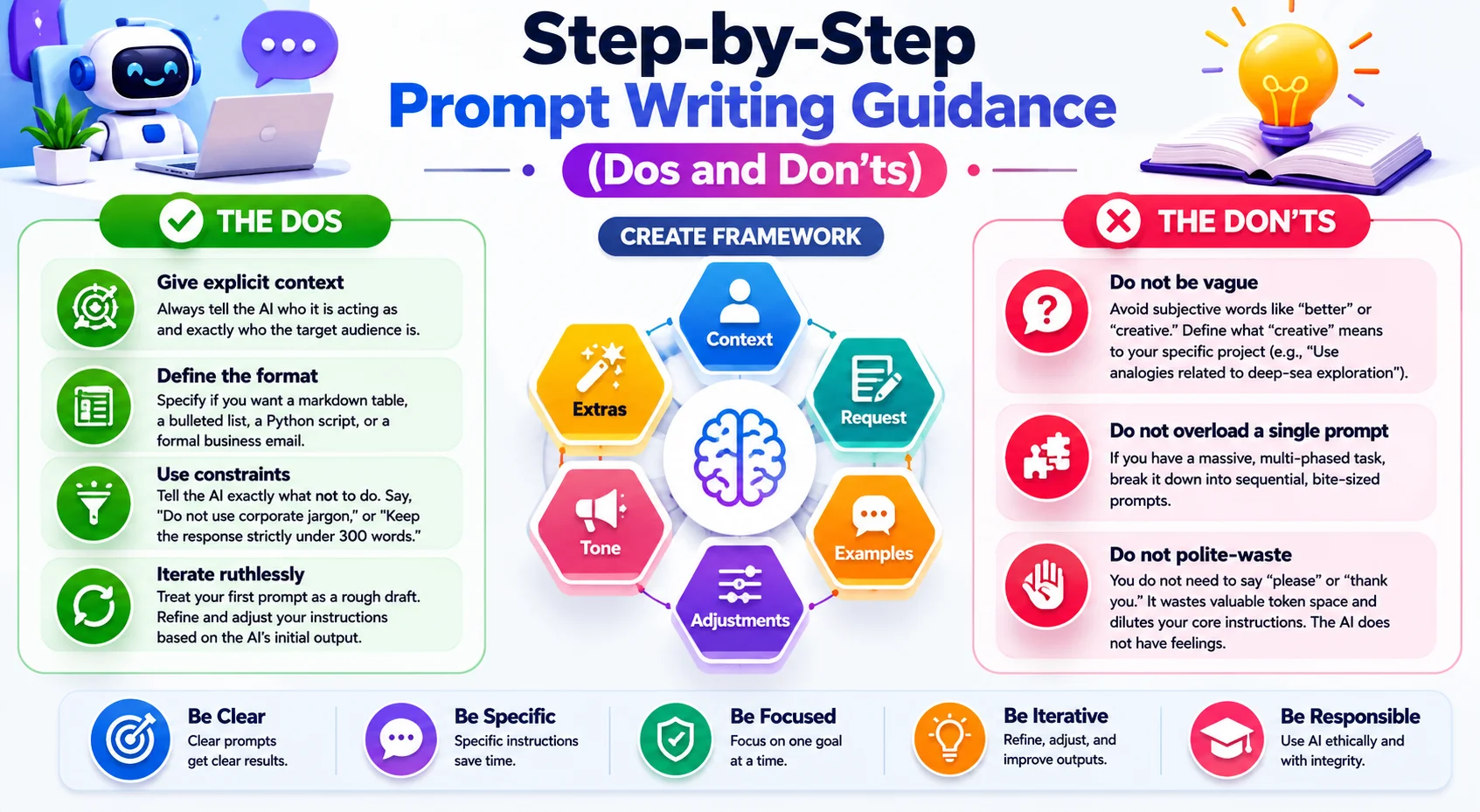
To extract maximum value out of ChatGPT, you need a reliable, repeatable framework. I recommend using the CREATE framework: Context, Request, Examples, Adjustments, Tone, and Extras.
The Dos
- Give explicit context: Always tell the AI who it is acting as and exactly who the target audience is.
- Define the format: Specify if you want a markdown table, a bulleted list, a Python script, or a formal business email.
- Use constraints: Tell the AI exactly what not to do. Say, “Do not use corporate jargon,” or “Keep the response strictly under 300 words.”
- Iterate ruthlessly: Treat your first prompt as a rough draft. Refine and adjust your instructions based on the AI’s initial output.
The Don’ts
- Do not be vague: Avoid subjective words like “better” or “creative.” Define what “creative” means to your specific project (e.g., “Use analogies related to deep-sea exploration”).
- Do not overload a single prompt: If you have a massive, multi-phased task, break it down into sequential, bite-sized prompts.
- Do not polite-waste: You do not need to say “please” or “thank you.” It wastes valuable token space and dilutes your core instructions. The AI does not have feelings.
Real-World Examples: Prompt Engineering in Action
Let us examine how professionals apply these prompt engineering techniques across different industries to achieve superior results.
Marketing and Content Creation
Average Prompt: “Write a blog post about SEO.” Expert Prompt: “Act as an expert SEO copywriter. Write a 600-word blog post about the importance of search intent. Target mid-level marketing managers. Structure the post with an H1, three H2s, and a concluding call-to-action urging readers to audit their content. Tone: Confident, actionable, and professional. Avoid overused words like ‘unlock’, ‘delve’, and ‘testament’.”
Coding and Software Development
Average Prompt: “Fix this Python code.” Expert Prompt: “You are a senior backend Python developer reviewing this script for memory optimization and security flaws. Identify any vulnerabilities, explain exactly why they occur, and rewrite the code to adhere strictly to PEP 8 standards. Include inline comments explaining your logic. Here is the code: [Insert Code]”
Business and Productivity
Average Prompt: “Summarize these meeting notes.” Expert Prompt: “Extract the key decisions, actionable items, and project deadlines from the following meeting transcript. Format the output strictly as a Markdown table with three columns: Assignee, Task, and Due Date. If a deadline is missing for a task, highlight the task in bold red text.”
Education
Average Prompt: “Explain quantum physics.” Expert Prompt: “Explain the concept of quantum entanglement to a high school senior who loves biology but struggles with advanced math. Use a detailed biological analogy—like the nervous system or genetics—to make the concept stick. Keep the explanation engaging and under two paragraphs.”
Personal Insights from the AI Trenches
Over the past few years, I have helped countless teams and individuals integrate artificial intelligence into their daily routines. The biggest hurdle I consistently observe is not technical capability; it is human imagination. People stubbornly default to using ChatGPT as a glorified, slightly smarter search engine.
When you finally learn to structure your thoughts and apply deliberate prompt engineering techniques, you experience a massive paradigm shift. You stop doing the heavy lifting of drafting and ideation, and you step up into the role of an editor and creative director. The AI does the typing; you do the thinking. I find that users who spend five extra minutes designing a robust, constraint-heavy prompt save themselves five hours of frustrating revision on the back end.
Sources and References
For further reading and data verification regarding AI adoption and prompt engineering, please consult these trusted industry sources:
- McKinsey & Company: State of AI Trust in 2026: Shifting to the Agentic Era
- Gartner: 2026 Hype Cycle for Agentic AI
- OpenAI Research: Techniques for Prompt Engineering and Model Grounding
- Anthropic: Claude’s Guide to Prompt Design and Interactive Workflows


