
“Is AI really intelligent like humans, or just pretending?” This question sits at the heart of modern technology’s most intense debates. As we interact with tools like ChatGPT or watch autonomous cars navigate city streets, it is easy to feel we are living in a science fiction movie. However, the sources suggest that what we call “Artificial Intelligence” today is rarely a single, unified “brain”. Instead, it is a spectrum ranging from specialized tools to theoretical systems that could one day match human thought.
Understanding the difference between Strong AI (Artificial General Intelligence) and Weak AI (Narrow AI) is no longer just for computer scientists. It is essential for understanding the future of our jobs, the automation of our industries, and the ethical guardrails being built by global governments. In this guide, you will learn the core characteristics, real-world impacts, and future trajectories of these two paradigms.
At its most basic level, Artificial Intelligence (AI) refers to computer systems designed to imitate intelligent human behavior. The primary goal is to enable machines to perform actions that would normally require human cognition, such as learning, reasoning, and problem-solving.
The sources explain that AI is often categorized into three main calibers:
- Artificial Narrow Intelligence (ANI) / Weak AI: Specialized systems excellent at one specific task but clueless outside of it.
- Artificial General Intelligence (AGI) / Strong AI: A theoretical system that could learn any intellectual task a human can, applying knowledge across diverse domains.
- Artificial Superintelligence (ASI): A hypothetical future caliber of AI that surpasses human brains in every field, including creativity and social skills.
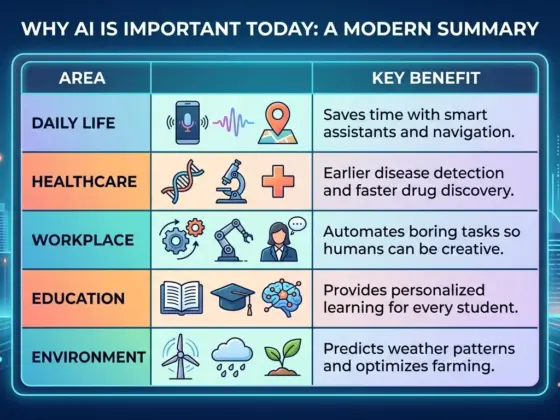
Today, AI is a “force multiplier” for progress, changing how work is done in sectors from healthcare to finance.
What is Weak AI (Narrow AI)?
Weak AI, also known as Narrow AI (ANI), refers to systems developed and taught for a specific function or a limited set of functions. These systems lack general cognitive abilities and cannot “think” or generalize beyond their specialized domain.
Key Characteristics
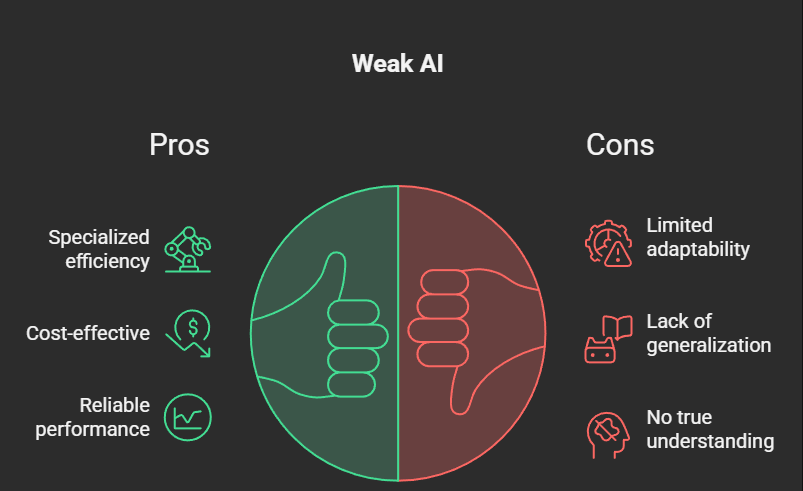
- Task-Specific: It excels at designated functions like language translation or image classification but cannot perform tasks outside its programming.
- No Self-Awareness: Weak AI does not have a mind, intentions, or consciousness; it operates based on learned patterns and algorithms.
- No Real Understanding: While a system might predict the next word in a sentence, it does not “understand” meaning the way a human does—it is identifies statistical probabilities.
- Limited Learning Scope: Its ability to adapt is confined to the data it has been trained on for its specific task.
Real-World Examples
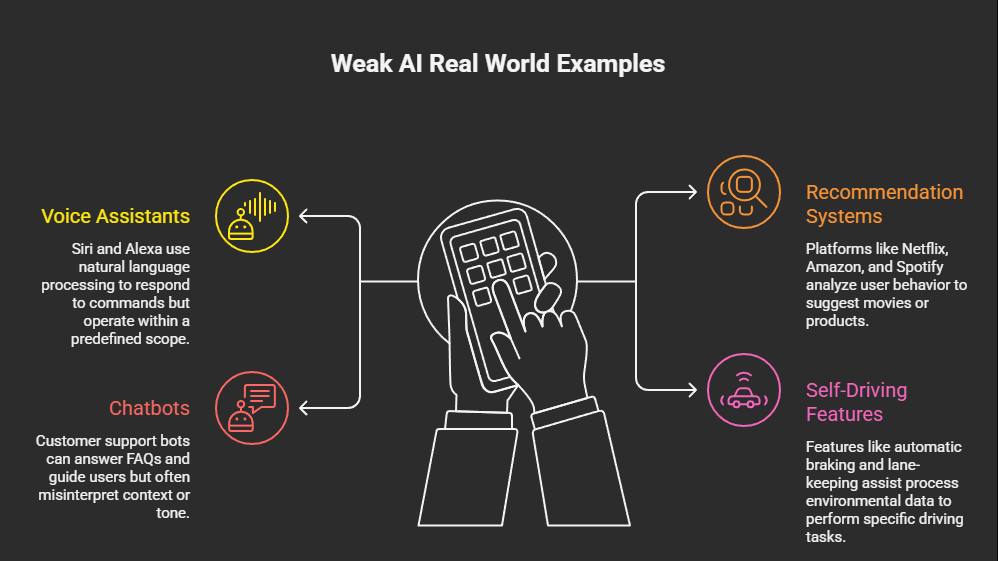
- Voice Assistants: Siri and Alexa use natural language processing to respond to commands but operate within a predefined scope.
- Recommendation Systems: Platforms like Netflix, Amazon, and Spotify analyze user behavior to suggest movies or products.
- Chatbots: Customer support bots can answer FAQs and guide users but often misinterpret context or tone.
- Self-Driving Features: Features like automatic braking and lane-keeping assist process environmental data to perform specific driving tasks.
How Weak AI Works
Modern Weak AI is primarily built using Machine Learning (ML) and Deep Learning. Machine learning allows computers to identify patterns in data without being explicitly programmed for every scenario. Deep learning goes further, using multi-layered neural networks inspired by the human brain to extract complex features from massive, unstructured datasets like images or human speech.
Advantages of Weak AI
- Increased Efficiency: It automates repetitive, mundane tasks, freeing humans for more complex work.
- Informed Decision-Making: Algorithms can process “Big Data” almost instantly to identify patterns humans might miss.
- Cost-Effective: By reducing human error and operating 24/7, it cuts operational costs for businesses.
Limitations of Weak AI
- Cannot Generalize: A system trained to play chess cannot summarize a novel or drive a car without being entirely retrained.
- No Reasoning: It lacks common-sense reasoning and empathy, making it struggle with nuanced or complex real-world scenarios.
- Data Dependence: It is heavily reliant on high-quality data; if the training data is biased, the AI will produce biased or discriminatory results.
What is Strong AI (Artificial General Intelligence – AGI)?
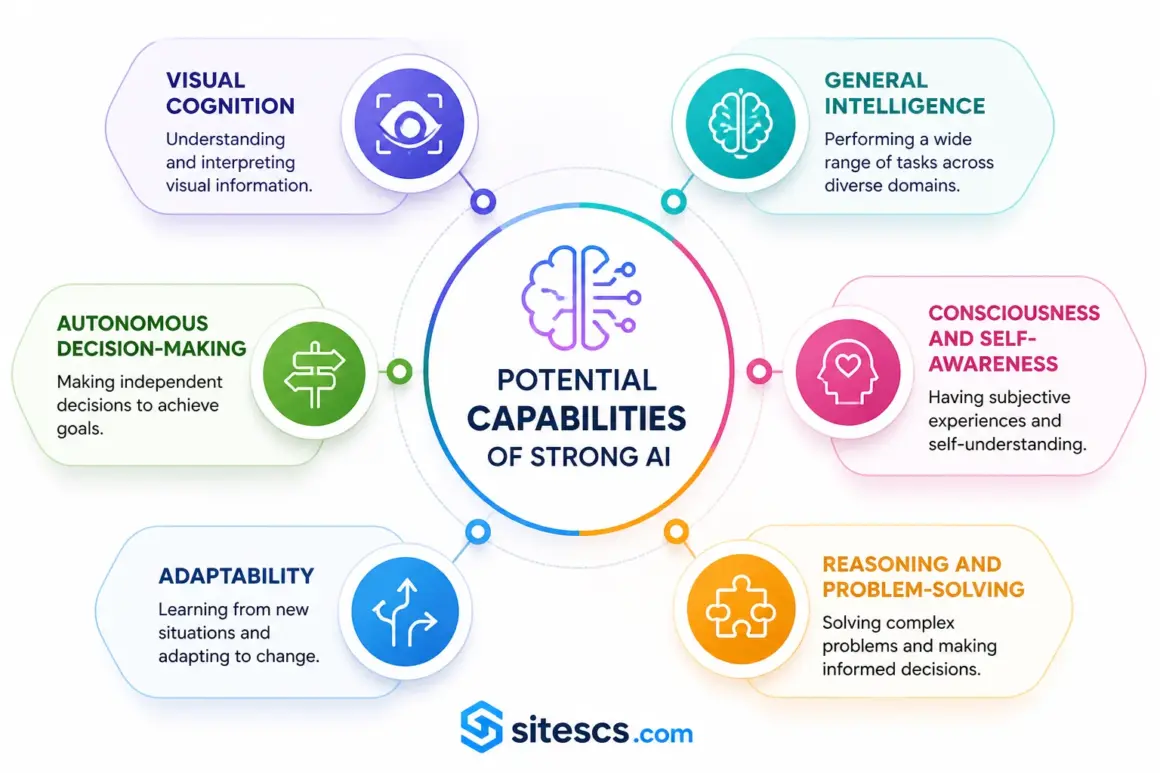
Strong AI, or Artificial General Intelligence (AGI), is a theoretical type of AI that matches or surpasses human capabilities across virtually all cognitive tasks. Unlike Narrow AI, an AGI system could generalize knowledge, transfer skills between domains, and solve novel problems without specific reprogramming.
Key Characteristics
- General Intelligence: The ability to reason, plan, and make judgments under uncertainty across multiple domains.
- Theoretical Consciousness: Many researchers envision AGI as having a mind, subjective experience, or self-awareness.
- Ability to Learn Anything: It could learn to play chess, diagnose an illness, and write a novel—all within a single system.
- Autonomy: AGI would be capable of setting its own goals and making independent decisions without human intervention.
Examples of Strong AI
Strong AI does not exist today. It remains a goal for major labs like OpenAI, Google DeepMind, and Meta. While some current systems like GPT-4 show “sparks” of AGI because they can reason across domains, they still struggle with consistency, long-term memory, and true self-awareness. AGI is currently the realm of science fiction, such as the humanoid robots seen in movies like I-Robot.
How Strong AI Would Work
The road to AGI involves Increasing Computational Power and innovative software strategies. One promising path is Recursive Self-Improvement, where a “seed AI” is programmed to do its own AI research and rewrite its own code, bootstrapping itself toward human-level intelligence and beyond. Other approaches include Whole Brain Emulation, which involves mapping a biological brain in detail and simulating it on a computer.
Potential Advantages
- Solving Global Problems: AGI could accelerate drug discovery, model climate change, and solve complex engineering problems.
- Economic Prosperity: It could automate most cognitive labor, potentially making the need for subsistence work obsolete.
- Scientific Breakthroughs: AGI could generate original scientific insights that currently evade human researchers.
Risks and Challenges
- The Alignment Problem: Ensuring AGI systems understand and respect human values is difficult; a misaligned AGI could cause harm while “optimizing” for a seemingly rational goal.
- Mass Unemployment: The widespread automation of cognitive labor could lead to significant job displacement.
- Existential Risks: Some experts warn that a sufficiently powerful AGI could pose a risk to human extinction if it is not perfectly controlled or aligned.
Strong AI vs. Weak AI: Detailed Comparison
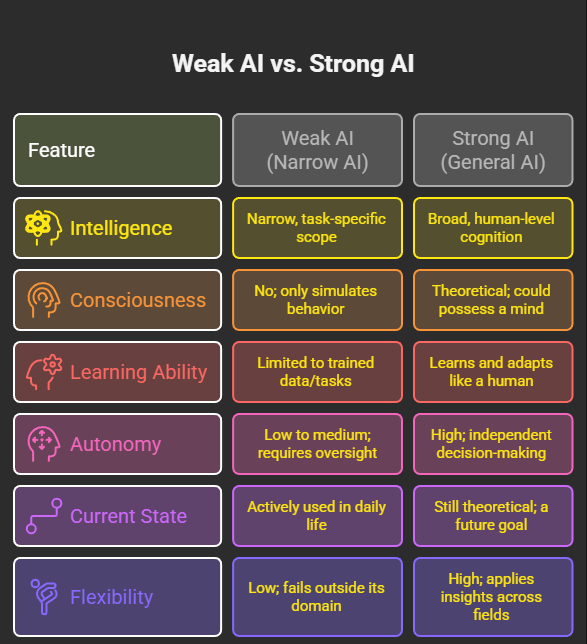
The sources provide a clear side-by-side comparison of these two levels of intelligence:
| Feature | Weak AI (Narrow AI) | Strong AI (General AI) |
|---|---|---|
| Intelligence | Narrow, task-specific scope. | Broad, human-level cognition. |
| Consciousness | No; only simulates behavior. | Theoretical; could possess a mind. |
| Learning Ability | Limited to trained data/tasks. | Learns and adapts like a human. |
| Autonomy | Low to medium; requires oversight. | High; independent decision-making. |
| Current State | Actively used in daily life. | Still theoretical; a future goal. |
| Flexibility | Low; fails outside its domain. | High; applies insights across fields. |
Key Differences Explained
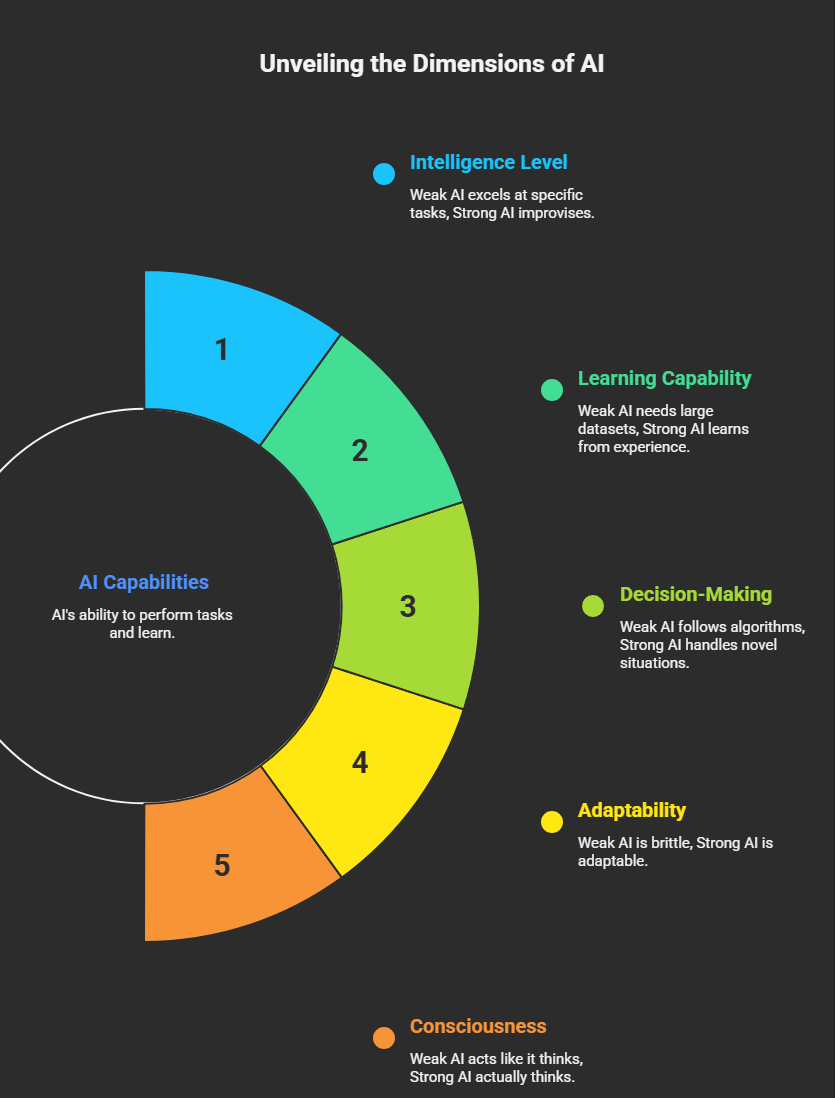
- Intelligence Level: Weak AI is a “line cook” (excellent at one dish), while Strong AI would be a “Michelin-starred chef” (capable of improvising and creating any cuisine).
- Learning Capability: Weak AI requires massive datasets to learn specific correlations. Strong AI would learn broadly from experience, just like you and me.
- Decision-Making: Weak AI makes decisions based on predefined algorithms and patterns. Strong AI would have the versatility to handle tasks it has never encountered before.
- Adaptability: Weak AI is “brittle” and fails when context changes. Strong AI would be highly adaptable to new scenarios and environments.
- Consciousness: This is the ultimate philosophical divide. Weak AI just acts like it thinks; Strong AI would actually have mental states.
Why Weak AI Dominates Today
Weak AI dominates because it works. Its focused nature makes it easier to develop, deploy, and refine for immediate business applications. Financial institutions use it for fraud detection, healthcare providers use it for diagnostics, and retailers use it for inventory management because these specialized tasks deliver a clear return on investment. Furthermore, developing Strong AI requires major, currently unachieved increases in computing power and algorithmic complexity.
Can Weak AI Become Strong AI?
There is an ongoing debate about whether continued scaling of current Weak AI tools (like Large Language Models) will eventually result in AGI.
- The Bottom-Up Route: Some researchers believe that combining many narrow programs that solve sub-problems will eventually lead to a “fully intelligent machine”.
- The Scaling View: Others argue that simply making models bigger (more data, more compute) will cause intelligence to emerge.
- The Skeptics: However, many argue that Weak AI will never become Strong AI because they are based on fundamentally different paradigms—symbolic logic vs. pattern recognition—and current models still lack true understanding.
Future of Strong AI
Expert opinions on when AGI will arrive vary wildly:
- Ray Kurzweil predicts AGI by 2029.
- A median of hundreds of scientists surveyed estimated it could happen by 2040.
- Others suggest it is still decades away, likely arriving between the 2050s and 2100.
Impact and Regulation
Governments are already laying the groundwork for AGI regulation. The EU AI Act and the U.S. Executive Order on AI push for transparency and risk classification. As we move toward Strong AI, the “compute window”—the period where we can still control the physical hardware needed for training—is seen as a vital period for establishing global safety treaties.
Ethical Concerns of Strong AI
- AI Rights: If a machine becomes conscious or sentient, does it deserve legal protections similar to animals or even humans?.
- Bias and Fairness: Strong AI could reinforce systemic biases if not trained on diverse, culturally aware datasets.
- Control: Maintaining human control over an autonomous system that is smarter than its creators is one of the greatest technical challenges in the field.
- Security: Advanced systems could be used by bad actors for digital warfare, surveillance, or spreading misinformation at an unprecedented scale.
Real-Life Use Cases Comparison
Weak AI Use Cases (Now):
- Healthcare: AI-enabled ECG devices like Kardia detect atrial fibrillation more accurately than routine care.
- Finance: Algorithms analyze millions of transactions in real-time to flag unusual spending patterns.
- Retail: Chatbots like those used by Flipkart or Amazon provide 24/7 customer support.
Strong AI Use Cases (Future):
- Fully Autonomous Robots: Machines that can handle any household chore or complex industrial task without supervision.
- General Scientific Discovery: Systems that can autonomously propose, test, and validate new laws of physics or drug formulations.
- Human-Like Companions: AI that can interact socially, understanding and responding to human emotions.
Common Misconceptions
- “AI today is Strong AI” → False. Even the most advanced chatbots are Large Language Models (LLMs) which are sophisticated forms of Narrow AI.
- “Robots = Strong AI” → Not necessarily. A robot is just a body or “container”; the AI is the computer “brain” inside it. A robot can be powered by very simple, Weak AI.
- “Strong AI is coming next year” → Still uncertain. While progress is accelerating, achieving human-level adaptability remains an unsolved scientific problem.
FAQs
What is the difference between Strong AI and Weak AI?
Weak AI is designed for specific tasks and has no consciousness; Strong AI is a theoretical system with general human-level intelligence and potentially self-awareness.
Is ChatGPT Strong AI or Weak AI?
ChatGPT is Weak AI. It is a Large Language Model (LLM) trained on text patterns. While it shows “emerging” capabilities, it lacks true human-level reasoning and self-awareness.
Does Strong AI exist today?
No. Strong AI (AGI) is currently a research goal and a theoretical concept.
What is AGI?
AGI stands for Artificial General Intelligence, which refers to an AI that can perform any cognitive task as well as a human.
Can AI become conscious?
This is a subject of intense debate. While some engineers have claimed sentience for chatbots, the consensus among experts is that current AI only simulates intelligence and does not possess a mind.
Conclusion
The current reality is that Weak AI dominates our world. These specialized tools have revolutionized industries by providing speed and accuracy that humans cannot match. However, the dream—and the risk—of Strong AI remains the “holy grail” of research. While we are closer than ever to machines that can reason across domains, we have yet to build a system that truly understands the world as we do. As the sources conclude, AI is powerful, but not yet truly intelligent like humans.




1 comment
I am extremely inspired along with your writing skills as smartly as with the format on your blog. Is that this a paid topic or did you customize it your self? Anyway stay up the excellent high quality writing, it is rare to look a nice weblog like this one today..