The Must-Know Topics Every LLM Engineer Should Master in 2026
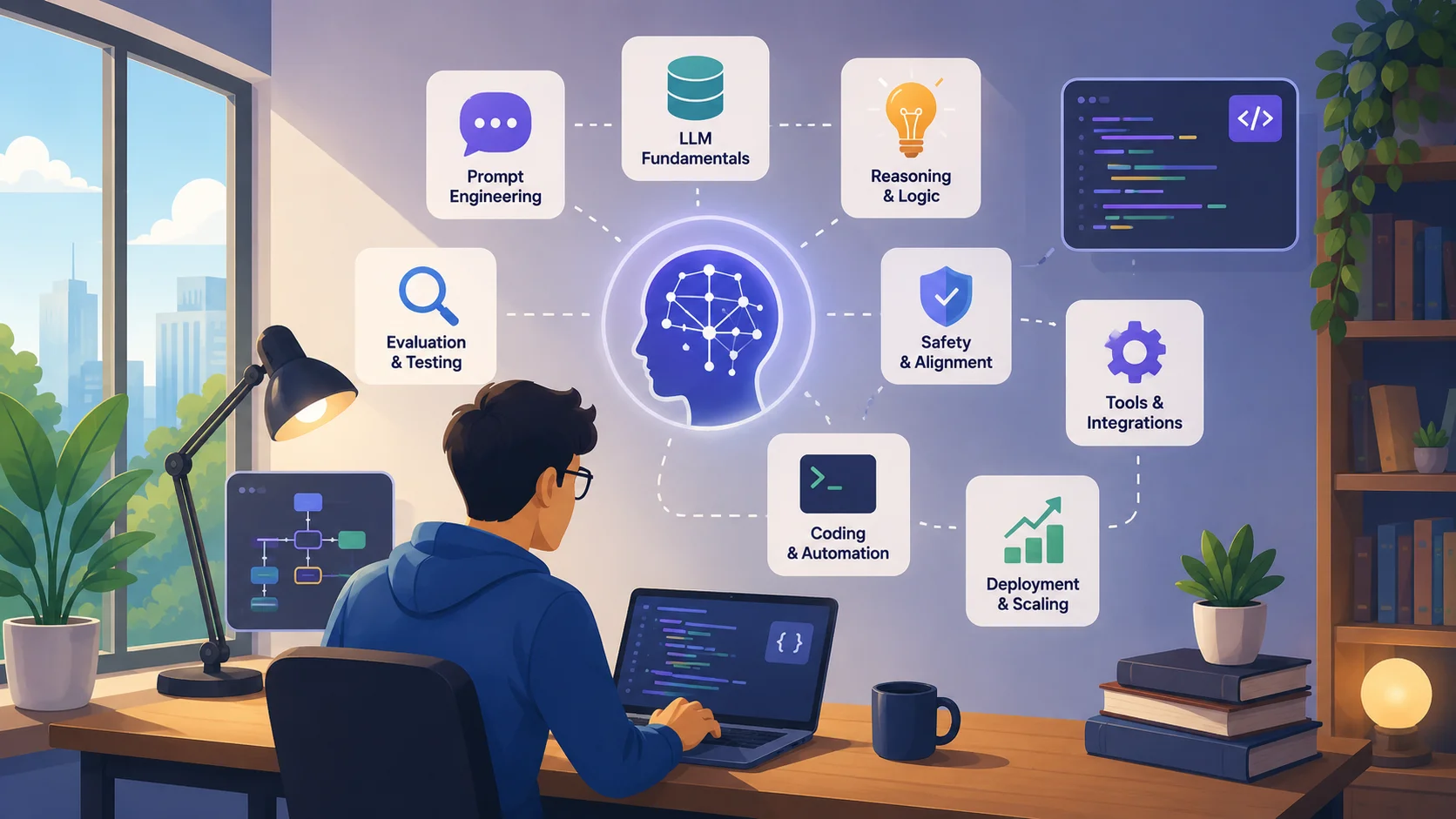
Large Language Models have moved far beyond experimental research projects. Today, they power AI copilots, enterprise search engines, autonomous agents, coding assistants, customer support systems, and even scientific research workflows. As organizations race to integrate generative AI into products and operations, the role of the LLM engineer has become one of the most valuable positions in modern technology.
But stepping into this field can feel overwhelming.
You hear terms like tokenization, attention mechanisms, LoRA fine-tuning, RAG pipelines, quantization, and RLHF thrown around constantly. Most resources explain these concepts individually, yet few connect them into a complete system-level understanding.
That’s the real challenge.
An effective LLM engineer doesn’t just know how transformers work theoretically. They understand how data flows through the entire stack — from raw text ingestion to inference optimization and production monitoring.
This guide walks through the most important concepts every LLM engineer should understand in 2026. Instead of focusing narrowly on one topic, we’ll build a practical mental model of how modern LLM systems are designed, trained, optimized, evaluated, and deployed in real-world environments.
Understanding How LLMs Represent Language
Before a model can generate intelligent responses, it first needs to convert language into mathematical representations.
Tokenization: Turning Text Into Machine-Friendly Units
LLMs cannot directly process words or sentences. Everything must eventually become numbers.
Rather than assigning a unique number to every possible word, modern models use tokenization, where text is broken into smaller subword units called tokens. Common words may exist as single tokens, while rare words are split into smaller components.
One of the most widely used techniques is Byte Pair Encoding (BPE), which gradually merges frequently occurring character combinations into reusable subword tokens.
This approach creates a balance between:
- Vocabulary efficiency
- Semantic understanding
- Computational performance
Without tokenization, training modern LLMs at scale would be nearly impossible.
Embeddings: Giving Tokens Meaning
Once tokens are created, the model transforms them into dense vector representations called embeddings.
Embeddings allow models to capture semantic relationships mathematically. Similar concepts cluster together inside high-dimensional vector space.
For example:
- “Doctor” and “physician” appear close together
- “Paris” and “France” share contextual relationships
- Even analogies emerge mathematically
This embedding layer becomes the foundation of semantic reasoning inside the model.
Positional Encoding: Understanding Sequence Order
Transformers process tokens in parallel, which means they naturally lack awareness of word order.
That’s where positional encoding comes in.
By injecting positional information into embeddings, models understand sequence relationships like:
- Grammar structure
- Sentence flow
- Long-range dependencies
Modern architectures increasingly rely on techniques like RoPE (Rotary Positional Embeddings) because they scale more effectively for long-context inference.
The Transformer Architecture: The Core of Modern LLMs
The transformer architecture fundamentally changed AI after the landmark paper Attention Is All You Need.
At the heart of transformers lies one key innovation:
Attention Mechanisms
Attention allows the model to dynamically decide which words matter most when processing language.
Each token generates three vectors:
- Query (what it searches for)
- Key (what information it offers)
- Value (the actual content)
The model compares queries against keys to determine relevance and aggregates useful values accordingly.
This creates contextual awareness that traditional neural networks struggled to achieve.
Multi-Head Attention
Instead of using one attention calculation, transformers run multiple attention heads simultaneously.
Different heads specialize in different patterns:
- Grammar relationships
- Context tracking
- Semantic meaning
- Entity references
- Long-range dependencies
This parallel attention mechanism is one reason modern LLMs feel remarkably coherent.
The Three Main Transformer Architectures
Not all transformers are built for the same purpose.
Encoder-Only Models
Models like BERT use bidirectional attention, meaning tokens can see both past and future context.
Best for:
- Classification
- Search relevance
- Semantic understanding
- Embeddings
Decoder-Only Models
Models like GPT use causal attention, where tokens only see previous tokens.
Best for:
- Text generation
- Chatbots
- Coding assistants
- AI agents
This architecture dominates modern generative AI systems.
Encoder–Decoder Models
Architectures like T5 and BART combine both approaches.
Best for:
- Translation
- Summarization
- Structured transformations
Training Stages Every LLM Engineer Should Understand
Training an LLM is not a single process. It happens in multiple stages.
Pre-Training
Pre-training teaches the model general language understanding by exposing it to enormous datasets.
These datasets often include:
- Web pages
- Books
- Research papers
- Code repositories
- Conversations
The model learns by predicting the next token repeatedly across billions or trillions of examples.
This stage develops the model’s capabilities.
Why Data Quality Matters
Raw internet data is messy.
Without aggressive filtering, models absorb:
- Spam
- Toxic content
- Duplicates
- Formatting noise
- Incorrect information
Data curation has become one of the biggest competitive advantages in AI development.
Fine-Tuning and Alignment
Pre-trained models are powerful but often poorly behaved.
Fine-tuning aligns them with useful tasks and human expectations.
LoRA and Parameter-Efficient Fine-Tuning
Training every parameter in a massive model is extremely expensive.
That’s why techniques like LoRA (Low-Rank Adaptation) became popular.
Instead of updating the entire model:
- Most weights remain frozen
- Small trainable matrices adapt behavior
- Memory and compute costs drop dramatically
This enables organizations to customize LLMs affordably.
Reinforcement Learning From Human Feedback (RLHF)
RLHF improves model behavior using human preference data.
The process usually includes:
- Humans rank model outputs
- A reward model learns preferences
- The LLM optimizes toward preferred behavior
This improves:
- Helpfulness
- Safety
- Instruction following
- Conversational quality
Modern alignment techniques now also include:
- DPO (Direct Preference Optimization)
- GRPO
- Reasoning-aware RL
Hallucinations and Why They Happen
One of the biggest misconceptions about LLMs is that they “know facts.”
They don’t.
LLMs are probabilistic next-token prediction systems. Even highly advanced models can generate convincing but false information.
These failures are called hallucinations.
How Engineers Reduce Hallucinations
Retrieval-Augmented Generation (RAG)
RAG connects LLMs to external knowledge sources during inference.
Instead of relying purely on internal memory, the model retrieves relevant documents first.
A typical RAG pipeline includes:
- Chunking
- Embedding generation
- Vector retrieval
- Reranking
- Context injection
This dramatically improves factual grounding.
Training Models to Say “I Don’t Know”
Another critical strategy involves explicitly rewarding uncertainty awareness.
Sometimes the best answer is refusing to fabricate information.
Inference Optimization: Making LLMs Fast and Scalable
Training models is expensive.
Serving them to millions of users is equally challenging.
Key Optimization Techniques
Quantization
Quantization reduces numerical precision from FP32 to formats like INT8 or FP16.
Benefits include:
- Lower memory usage
- Faster inference
- Reduced infrastructure costs
KV Caching
During autoregressive generation, recomputing previous attention states is wasteful.
KV caching stores earlier computations and reuses them efficiently.
This significantly accelerates long-form generation.
FlashAttention
FlashAttention optimizes memory movement during attention computation.
Result:
- Faster inference
- Longer context windows
- Lower GPU memory overhead
Mixture of Experts (MoE)
Instead of activating the entire model for every token, MoE activates only specialized expert subnetworks.
This enables massive parameter counts without proportional compute increases.
Models like Mixtral and Switch Transformer popularized this approach.
Prompt Engineering Is Still Critical
Even the most advanced LLM behaves differently depending on prompt design.
Prompt engineering is essentially behavioral programming through language.
What Makes a Strong Prompt?
Be Explicit
Weak prompt:
“Explain RAG.”
Strong prompt:
“Explain Retrieval-Augmented Generation for software engineers in under 300 words with one practical enterprise example.”
Specificity matters enormously.
Structure Outputs Clearly
Reliable systems often separate:
- Instructions
- Context
- Constraints
- Output formatting
This improves consistency dramatically.
Use Few-Shot Examples
Providing examples often produces better results than longer instructions alone.
Evaluation: Measuring Whether an LLM Actually Works
Evaluation is one of the hardest parts of LLM engineering.
Traditional metrics like:
- BLEU
- ROUGE
- Perplexity
still matter, but modern systems increasingly rely on LLM-as-a-judge evaluation approaches.
Why Human Evaluation Still Matters
Metrics cannot fully measure:
- Helpfulness
- Reasoning quality
- Clarity
- Safety
- Tone
That’s why production-grade systems combine:
- Offline benchmarks
- Human review
- Online A/B testing
- Real-world telemetry
Continuous evaluation is now essential because model behavior drifts over time as user patterns evolve.
The Bigger Picture: LLM Engineering Is Systems Engineering
The biggest realization for new engineers is this:
LLMs are not just models.
They are entire ecosystems.
Successful AI systems combine:
- Data pipelines
- Retrieval systems
- Prompt orchestration
- Inference infrastructure
- Evaluation frameworks
- Monitoring systems
- Feedback loops
- Safety layers
Understanding individual concepts matters.
Understanding how they connect matters even more.
Conclusion and Reference Links
The future of AI engineering belongs to people who understand the full LLM stack — not just isolated buzzwords.
Modern LLM engineering sits at the intersection of machine learning, distributed systems, human-computer interaction, optimization, and software architecture. Engineers who build strong mental models across these domains can design systems that are not only intelligent, but also scalable, reliable, efficient, and aligned with human goals.
The field is evolving rapidly. Context windows are expanding. Reasoning models are improving. AI agents are becoming more autonomous. Inference optimization continues advancing at breakneck speed.
But despite all the innovation, the foundational principles remain remarkably consistent:
- Represent language effectively
- Learn patterns efficiently
- Retrieve knowledge reliably
- Align outputs carefully
- Evaluate continuously
- Optimize relentlessly
Mastering these topics is what transforms someone from an AI user into a true LLM engineer.
Reference Links
NVIDIA LLM Inference Optimization Guide
Attention Is All You Need Paper


